
When a shopper lands on a product page, the decision to buy or leave happens in seconds, driven almost entirely by visuals. A strong image builds trust instantly, while a weak one sends potential customers elsewhere. Ecommerce product photography directly influences conversion rates, making it one of the highest-leverage investments an online seller can make.
Professional-quality product images no longer require expensive studio shoots or complex setups. Caspa's AI-powered tools enable online sellers to produce clean, polished visuals across flat lays, lifestyle scenes, and detail shots, all without the traditional overhead. Sellers ready to turn more browsers into buyers can get started with Caspa's product photography.
Table of Contents
- Why Ecommerce Product Photography Has Become More Challenging
- Why Many Brands Struggle to Produce Great Product Images
- What Is Ecommerce Product Photography?
- What Makes Ecommerce Product Photography More Effective?
- Speed and Creative Flexibility Have Become Competitive Advantages
- How Caspa Helps Ecommerce Brands Create Better Product Photography Faster
- Get Product Photos that Increase Your Sales Today
Summary
- Visual content drives purchasing decisions before a single word of product copy is read. Research shows that 75% of online shoppers rely on product photos when deciding on a purchase, which means every image across every channel serves as a direct conversion variable. Weak visuals not only fail to impress; they actively steer potential buyers toward competitors.
- Poor product photography creates problems beyond missed conversions. Approximately 22% of product returns occur because items look different in person than they did in photos, meaning inaccurate or low-quality imagery generates reverse logistics costs, erodes customer trust, and compresses margins in ways that rarely show up in a standard photography budget conversation.
- The volume of images a modern ecommerce brand needs has outpaced traditional production workflows. A single product now requires a white background image for marketplace listings, lifestyle scenes for social platforms, detail shots for product pages, and seasonal variations for campaigns. Across a catalog of 50 or more SKUs, that demand becomes structurally unmanageable through quarterly photoshoots alone.
- Supplier and generic images create a price-competition trap that brand investment cannot easily escape. When competing stores display identical product photos, the only remaining differentiator is price. Research indicates that 95.6% of brands have moved toward model photography precisely because contextual, human-centered visuals communicate perceived value in ways that flat catalog shots cannot.
- Creative testing is one of the most underfunded levers in ecommerce performance. Studies on real-world advertising datasets found that optimizing combinations of visual elements led to a 6.02% increase in click-through rates and a 10.37% lift in gross merchandise value. Those results come from running multiple image concepts simultaneously, which is impossible when each new asset requires a full production cycle.
- Speed has become a structural competitive advantage, not just a convenience. U.S. ecommerce sales grew 9.7% year over year in the first quarter of 2026, and that growth is compressing timelines across the entire selling process. Brands that can generate, test, and refresh visual content faster than competitors can schedule a photoshoot are capturing demand that slower operations consistently miss.
- Product photography tools like Caspa address this directly by enabling brands to generate on-demand lifestyle imagery, white-background shots, and A+ content without coordinating studios, models, or post-production timelines.
Why Ecommerce Product Photography Has Become More Challenging
Selling online is a visual game. What has changed is the volume, velocity, and variety of images needed to stay competitive across every place where buyers make decisions.
💡 Tip: One great hero shot no longer suffices. Modern ecommerce demands a full visual ecosystem across multiple channels, formats, and contexts.

"75% of online shoppers rely on product photos when deciding to buy something." — Star İstanbul's 2025 E-Commerce Photography Research
According to Star İstanbul's 2025 e-commerce photography research, 75% of online shoppers rely on product photos when deciding to buy something. Every poor image costs you real sales — making photography quality one of the highest-leverage investments in your entire ecommerce operation.
⚠️ Warning: A single low-quality product image doesn't just lose one sale — it erodes buyer trust across your entire catalog.
🔑 Takeaway: With 75% of purchase decisions tied directly to product photography, this is not a nice-to-have — it's a critical revenue driver that demands serious attention.
Why does one photoshoot no longer cover every channel?
A single product now requires a white background image for Amazon, a lifestyle scene for Instagram, a close-up detail for the product page, and seasonal variations for email campaigns. Multiply that across fifty SKUs, and the operation becomes difficult to manage through traditional photoshoot workflows.
With paid social, SMS, TikTok, and marketplace listings each demanding channel-specific creative, the gap between what a single photoshoot produces and what a modern content calendar requires has become impossible to bridge on a traditional budget. Teams increasingly turn to AI product photography platforms like Caspa, which replace studio shoots with on-demand generation of lifestyle imagery, white background photos, and A+ content at a fraction of the cost and time.
How much does traditional product photography actually cost?
Basic product photography costs $25–$75 per image, while lifestyle shots often cost $500 or more. Brands with large catalogs spend hundreds of thousands of dollars annually on photography before measuring conversion improvements. Most brands cannot afford to test enough visual variations to determine what converts.
What happens when product images don't match reality?
Star İstanbul reports that 22% of product returns happen because items look different in person than in photos. Inaccurate images increase shipping costs and reduce sales. The challenge is creating accurate, high-converting images consistently across every channel without enterprise-level budgets.
Related Reading
- Ai Tools for E-commerce
- Printify Alternatives
- Photoroom Pricing
- Ecommerce Product Photography Services
- E-commerce AI Tools
- Printful Alternatives
- Best Ai Tools for E-commerce
- How To Sell On Shopify
- Redbubble Alternatives
- Ecommerce Product Videos
- Automated Product Photography
- Ecommerce Product Imagery
- Visual Merchandising Ecommerce
- Photoroom Cost
Why Many Brands Struggle to Produce Great Product Images
Most ecommerce brands fail at product photography, not because they lack effort, but because their production system wasn't built for the pace of modern selling.
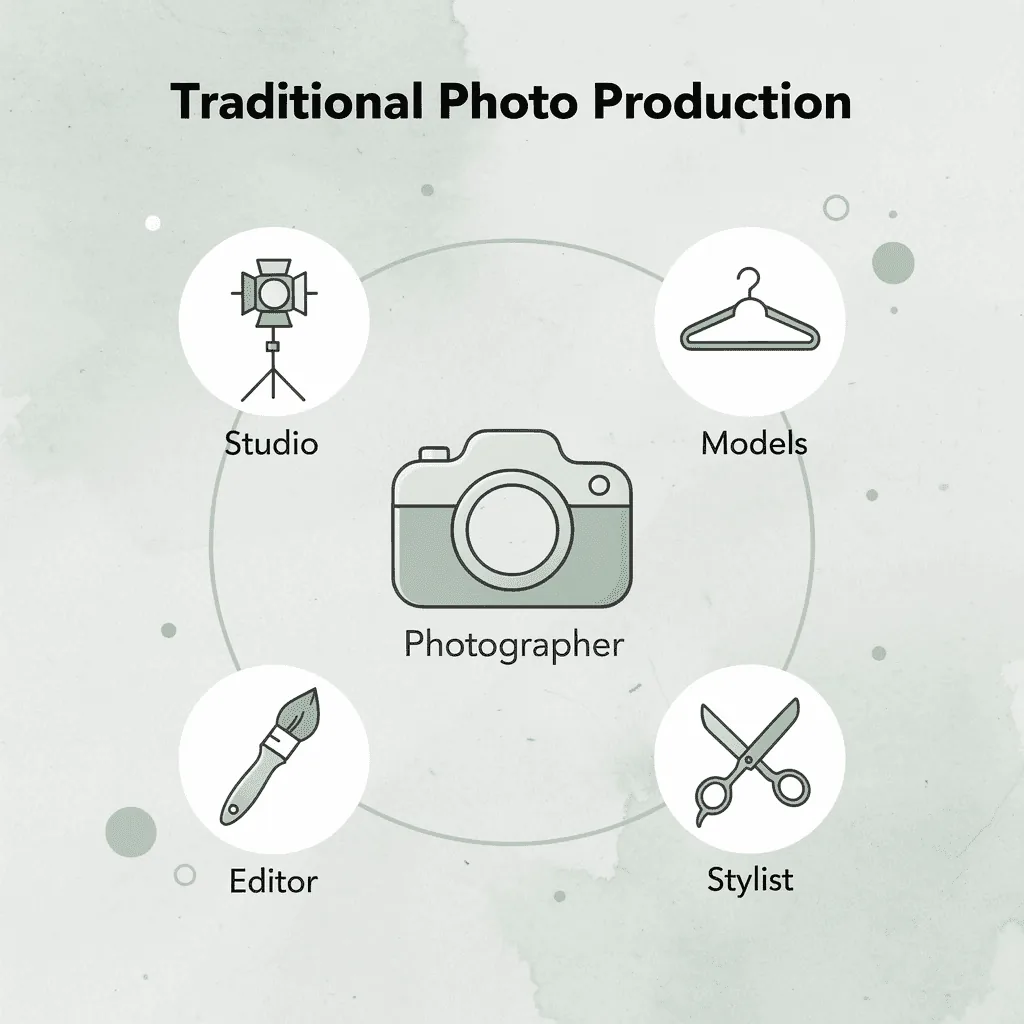
Cost is the surface problem. The real issue is how traditional workflows are structured: they require photographers, studios, models, stylists, editors, and shipping to coordinate. When one part changes, the entire schedule delays, hurting brands launching seasonal collections or capitalizing on trending moments.
When generic images become a race to the bottom
When three competing stores show the same product photo, price becomes the only differentiator. Brand identity collapses, and customer trust erodes. According to Electro IQ's Product Photography Statistics, 95.6% of brands use model photography for their product images. Brands relying on flat supplier shots operate with a structural disadvantage in perceived value.
Most teams stretch occasional photoshoots across every channel indefinitely, creating creative fatigue: ads underperform, pages feel stale, and brands appear static. Platforms like Caspa generate studio-quality lifestyle imagery and white-background shots on demand, cutting production timelines from weeks to hours without the overhead of physical shoots.
Why are volume requirements keeping growing
The content demand problem builds up quietly. Electro IQ's Product Photography Statistics report that 75% of online shoppers rely on product photos when deciding on a purchase. Amazon requires optimized image sets, Instagram rewards native lifestyle content, and paid social demands constant creative rotation to avoid audience fatigue. What once required ten polished images now requires fifty or more across formats that did not exist five years ago. The fastest-growing brands are not those with the biggest photography budgets: they're the ones that can generate, test, and refresh visuals faster than competitors can react.
Understanding the problem does not automatically solve it.
What Is Ecommerce Product Photography?
Product photography for ecommerce replaces the ability to touch, hold, and examine a product in person. Your images must do that job—they are not decoration, but the actual product as far as the customer is concerned.
💡 What It Is: Ecommerce product photography captures images that replace the in-store, hands-on experience for online shoppers, making visuals your single most important sales tool.
🎯 Key Point: If your product images fail to communicate quality, texture, and value, no amount of copywriting will save the sale.

"75% of online shoppers depend on product photos when they decide whether to buy something." — Star İstanbul, 2025 Ecommerce Photography Trends Report
According to Star İstanbul's 2025 ecommerce photography trends report, 75% of online shoppers depend on product photos when they decide whether to buy something. Online shopping requires a leap of faith that good visuals can make smaller. Every image either closes that gap—or makes it bigger.
⚠️ Warning: A single low-quality image can signal an untrustworthy brand, causing shoppers to abandon their cart before they ever reach checkout.
What are the core types of ecommerce product photography?
The core of any ecommerce catalog starts with white-background photography: clean, neutral, and distraction-free. Platforms like Amazon and Walmart require it because it maintains focus on the product and creates visual consistency across thousands of listings. But white background images answer only one question: "What does this look like?" They do not answer "How does this fit into my life?"
Lifestyle photography answers that second question. A candle on a plain white surface shows its shape and color. The same candle photographed on a marble countertop beside a Sunday morning coffee reveals something about the person who buys it. Lifestyle imagery creates emotional context, and emotional context drives purchasing decisions in ways product specs cannot. The same principle applies to human model photography for apparel and beauty brands, where shoppers need to see scale, fit, and proportion.
Why do detail shots and production flexibility matter for conversions?
Most brands use photoshoots every three months and hope the images last long enough. The hidden cost is inflexibility: markets shift, platforms change, and ads grow stale faster than production schedules allow. Platforms like Caspa solve this directly by letting brands create ultra-realistic lifestyle images, white-background shots, and A+ content on demand, without coordinating studios, models, or post-production timelines.
Detail shots matter more than most people plan for. Close-up images of texture, stitching, material grain, and product features reduce uncertainty—the primary barrier to purchase. Research from Star İstanbul shows that 22% of product returns happen because items look different in person than in photos. Poor imagery undermines conversion rates, increases returns, erodes margins, and damages customer trust.
Knowing what great product photography looks like and knowing how to make it consistently are two different things.
What Makes Ecommerce Product Photography More Effective?
Good product photography is not about spending more money. It is about removing doubt. Every image should answer the question a shopper is silently asking: "Will this work for me?"
"Every image should answer the question a shopper is silently asking: 'Will this work for me?'" — The core principle of effective ecommerce photography
💡 Tip: Before publishing any product image, ask yourself: Does this photo answer every question a hesitant shopper might have? If not, revise it.

Lighting, composition, and consistency form the technical foundation, but the real power comes from how well your images close the gap between a screen and a physical product. According to Star İstanbul, products with high-quality images see a 30% increase in conversion rates compared to those with low-quality visuals. This boost reflects confidence, not looks — shoppers who feel uncertain do not buy.
| Photography Factor | Impact on Shopper | Outcome |
|---|---|---|
| Lighting | Reveals true color and texture | Builds trust |
| Composition | Guides the eye to key details | Reduces confusion |
| Consistency | Creates a professional storefront feel | Increases confidence |
| High-quality visuals | Closes the gap between screen and product | +30% conversion rate |
🔑 Takeaway: That 30% conversion rate lift isn't driven by aesthetics alone — it's driven by certainty. When shoppers can clearly see what they're buying, doubt disappears, and purchases follow.
⚠️ Warning: Low-quality images don't just look unprofessional — they actively destroy conversions by signaling to shoppers that the product might not be worth their trust.
What actually moves buyers
Context does more persuasive work than most brands realize. A skincare serum photographed on a clean bathroom shelf with morning light tells a story about a routine. The same product on a white background tells the story of an SKU. Lifestyle imagery, close-up texture shots, and scale references (a hand holding the product, a ruler beside it, a model wearing it) each answer a specific customer question before it's asked. The brands that win on visual search and social commerce treat every angle as an answer, not decoration.
Why does a single photoshoot fail across every channel?
Most teams book a single photoshoot quarterly, then spread those assets across every channel for months. One batch of creative work cannot serve a homepage, a Meta ad, an Amazon listing, and an email campaign simultaneously without losing relevance. As platforms change and customer expectations shift, static image libraries slow performance. Platforms like Caspa address this by generating on-demand lifestyle imagery, white background shots, and A+ content without studio scheduling, cutting production costs by up to 10x while keeping creative output aligned with each channel's needs.
Mobile changes the rules
A picture that looks great on a computer can become blurry and hard to see on a phone screen. Since most people shop online using their phones, this blurriness can prevent purchases. Images need to be clear and simple enough to work at small sizes: fewer competing elements, stronger contrast between light and dark, and a product that's immediately recognizable without requiring the shopper to zoom in.
How do multiple angles reduce return rates?
Star İstanbul reports that 360-degree product views can reduce return rates by up to 40%. When shoppers can fully visualize a product before purchase, they're less likely to feel misled upon delivery. Multiple angles, detail shots, and in-use scenes reduce risk and protect both your profits and your brand.
Why does speed matter as much as quality?
The brands that are winning are not just making better images—they are making them faster.
Related Reading
- Shopify Vs Bigcommerce
- Ai For Ecommerce
- Shopify Vs Woocommerce
- How To Sell On Amazon
- Ai Generated Product Images
- Ai Product Photo Generator
- Amazon Vs Shopify
- Ai Product Video Generator
- Ai Clothing Model
- Printful Review
- Printful Vs Printify
- Shopify Vs Amazon
- Ai Model For Clothing
- Ai Product Video
- Ai Fashion Model
- Printful Pricing
- Best Amazon Seller Tools
Speed and Creative Flexibility Have Become Competitive Advantages
Speed in ecommerce is not about shipping alone. Brands that are winning make, test, and update visual content faster than competitors can plan a photoshoot. This content production speed has become a major competitive advantage.
"Brands that can make, test, and update visual content faster than competitors gain a decisive edge before the competition can even plan a photoshoot." — Key Industry Insight
🎯 Key Point: The speed of content production is no longer optional. It is a core competitive advantage separating winning brands from those falling behind.
💡 Tip: If your team relies on traditional photoshoots alone, you operate on a slower production cycle than brands using faster, more flexible creative workflows. That gap compounds over time.

Why does visual production speed matter more than ever?
Markets do not wait. Trends on TikTok have a shelf life measured in days, not months. A product landing in a viral moment needs supporting images immediately, not after a two-week studio booking window. According to the U.S. Census Bureau, U.S. ecommerce sales grew 9.7% year over year in the first quarter of 2026, compressing timelines across the selling process. Brands that respond to momentum in real time capture demand that slower competitors miss.
Testing speed is equally urgent. Research on real-world advertising datasets found that optimizing combinations of creative elements led to a 6.02% increase in click-through rates and a 10.37% lift in gross merchandise value. These gains come from running multiple visual concepts simultaneously and letting data decide. You cannot achieve this if every new image requires a photographer, a studio, and a three-day editing queue.
How does creative fatigue drain performance between photoshoots?
Most ecommerce brands photograph products in batches four times yearly, building an image library for use across Shopify listings, Amazon A+ content, Meta ads, and email sequences. This library depletes quickly as campaigns scale. Creative fatigue sets in within weeks, engagement drops, and ad costs rise while the next shoot remains six weeks away. Platforms like Caspa eliminate that bottleneck by generating ultra-realistic lifestyle imagery, white-background shots, and infographic-style content on demand, cutting production timelines from weeks to hours.
The same issue surfaces in channel expansion and seasonal pivots. A product launching into a new market needs localized lifestyle imagery; a summer collection needs context shots that feel warm and specific. Neither can wait for traditional production cycles. Brands treating visual content as continuous output rather than periodic events stay relevant across every channel and season without the cost spiral that once accompanied that volume.
Is faster iteration actually better for ecommerce product photography results?
Speed and quality are no longer at odds. The old tradeoff—fast or good—was a production constraint, not a creative truth. Faster iteration produces better results because it generates more data, learning, and opportunities to find the image that converts. Winning brands are not those with the biggest photography budgets, but those who discovered that the ability to adapt quickly is worth more than the perfect shot planned three months ago.
The question is not whether your visuals are good enough, but whether you can make them better and faster than the brand sitting one search result above you.
How Caspa Helps Ecommerce Brands Create Better Product Photography Faster
Many brands ask: "How do we create professional pictures without spending a lot of money on studios, photographers, and multiple tools?" This reflects a common pain point facing ecommerce brands today: the gap between high-quality visual content and the budget and time required to produce it.
💡 Tip: If your brand is asking this question, you're ahead of the curve — recognizing the problem is the first step toward finding a smarter, faster solution.
"The real cost of traditional product photography isn't just the shoot — it's the days of coordination, editing, and iteration that follow every single image." — Ecommerce Industry Insight
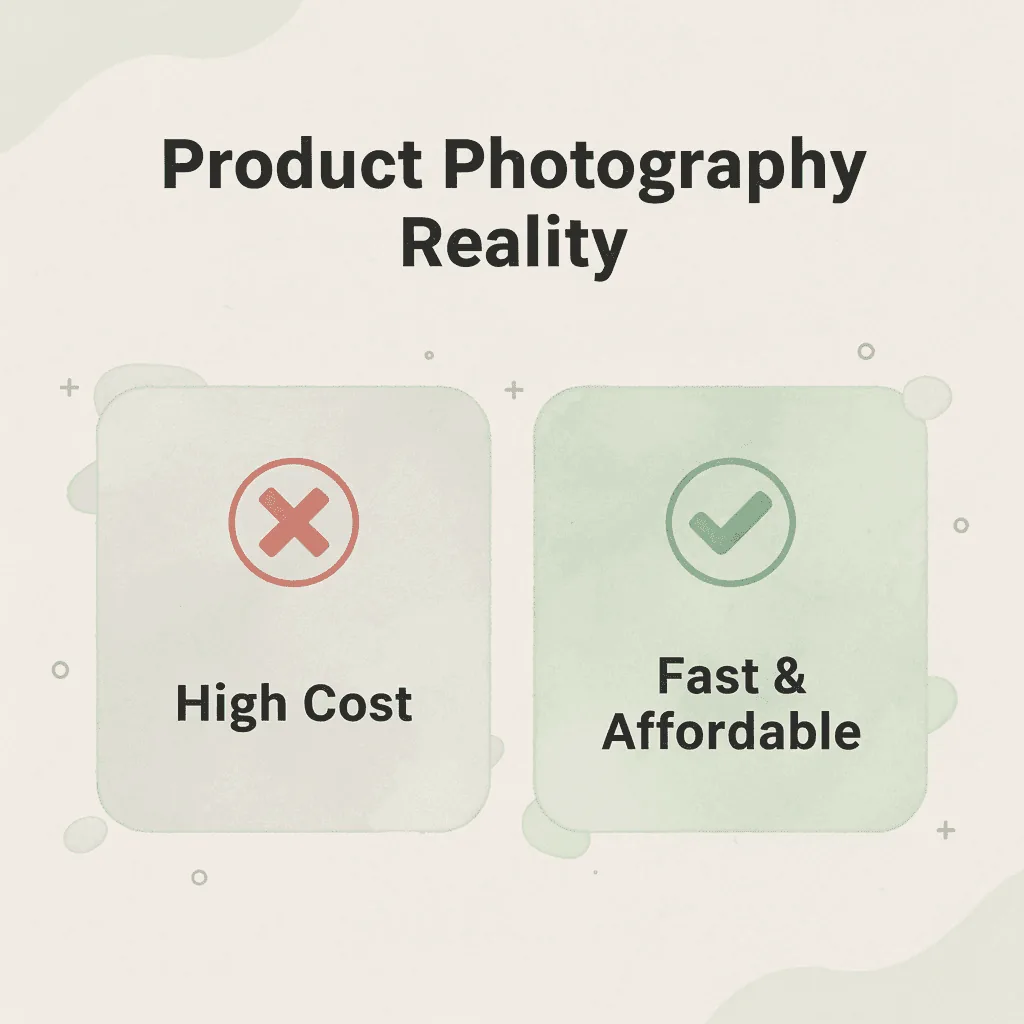
Traditional product photography requires coordinating multiple moving parts — photographers, models, studios, editing software, and stock image libraries — all working together before a single image is ready to publish. Even simple creative updates can take days or weeks, dramatically slowing down product launches and limiting how many ideas brands can realistically test.
⚠️ Warning: Every day spent waiting on a photography pipeline is a day your competitors can move faster, test more creatives, and capture more customers.
🎯 Key Point: The traditional model doesn't just cost money — it costs speed, agility, and creative freedom, three things ecommerce brands cannot afford to sacrifice in a competitive market.
| Traditional Photography | Modern AI-Powered Approach |
|---|---|
| Days or weeks per update | Minutes per update |
| Requires studio + photographer | Requires only your product image |
| High fixed costs per shoot | Scalable, low-cost production |
| Limited creative testing | Unlimited concept iteration |
| Slows product launches | Accelerates go-to-market speed |
What does Caspa's all-in-one platform actually do?
Caspa is an AI-powered all-in-one product photography platform built for ecommerce brands. Instead of starting from scratch, brands can generate ultrarealistic product shots featuring human models and realistic lifestyle scenes in seconds, delivering visuals that traditionally required expensive photoshoots without the associated costs and delays.
Caspa maximizes the value of existing images by editing and transforming photos without additional shoots: removing backgrounds, upscaling image quality, or creating new environments. Brands can quickly adapt assets for different campaigns and channels.
The platform provides custom stock photography and comprehensive studio editing capabilities, enabling teams to produce white-background catalog images, lifestyle scenes, and advertising creatives within a single workflow.
How does Caspa help brands produce more creative output without higher costs?
By bringing these capabilities together, Caspa eliminates the need to juggle multiple tools, coordinate photographers, or hire models. Brands spend less time managing production and more time testing creative ideas and optimizing campaigns.
Caspa helps businesses increase creative output without increasing costs. Faster production enables experimentation with backgrounds, models, settings, and messaging. Instead of relying on a handful of expensive images, our product lets brands continuously generate fresh visuals for product pages, paid ads, email campaigns, marketplaces, and social media.
In ecommerce, speed and creative flexibility matter as much as visual quality. Caspa delivers both.
Get Product Photos that Increase Your Sales Today
If you're still booking photographers and waiting weeks for edited files, that cycle is working against you. Product photography through Caspa lets you upload an existing product image and generate professional marketing assets with custom backgrounds, realistic lifestyle scenes, and enhanced image quality in a single session—no studio, model, or three-week wait required.
"No studio, no model, no three-week wait — professional marketing assets generated in a single session." — Caspa
💡 Tip: Upload your existing product image and generate multiple background variations in one session—what took weeks now takes minutes.

The fastest-growing brands aren't spending more money than competitors; they're producing more. They test more angles, update creative more often, and turn browsers into buyers because their visuals match the moment. Try Caspa today and see how faster visual production translates into real sales momentum.
| Traditional Photography | Caspa AI Photography |
|---|---|
| Weeks of turnaround time | Same-session delivery |
| Studio & model costs | No overhead required |
| Limited angles tested | Multiple variations generated |
| Slow creative updates | Rapid iteration on demand |
⚠️ Warning: Brands that delay updating their visuals risk losing buyers to competitors whose creative matches the moment — don't let an outdated production cycle cost you real sales.
🎯 Key Point: Faster visual production isn't just a convenience — it's a competitive advantage that directly drives sales momentum.
Related Reading
- Teespring Alternatives
- Ecommerce Product Video
- T-shirt Mockup Ai
- Amazon Ai Tools
- Placeit Alternative
- Advertising Product Photography
- Luxury Product Photography
- Best Background For Product Photography
- Ai Clothing Model Generator
- Printify Vs Gelato
- Merch On Demand
- Ai Product Video Maker
- Ai Product Photo Editor
- Amazon Merch On Demand
- Flat Lay Product Photography
- Ai Fashion Model Generator
- Redbubble Vs Printful
- Printful Vs Gelato
- Placeit Pricing
- Ai Clothing Mockup Generator