
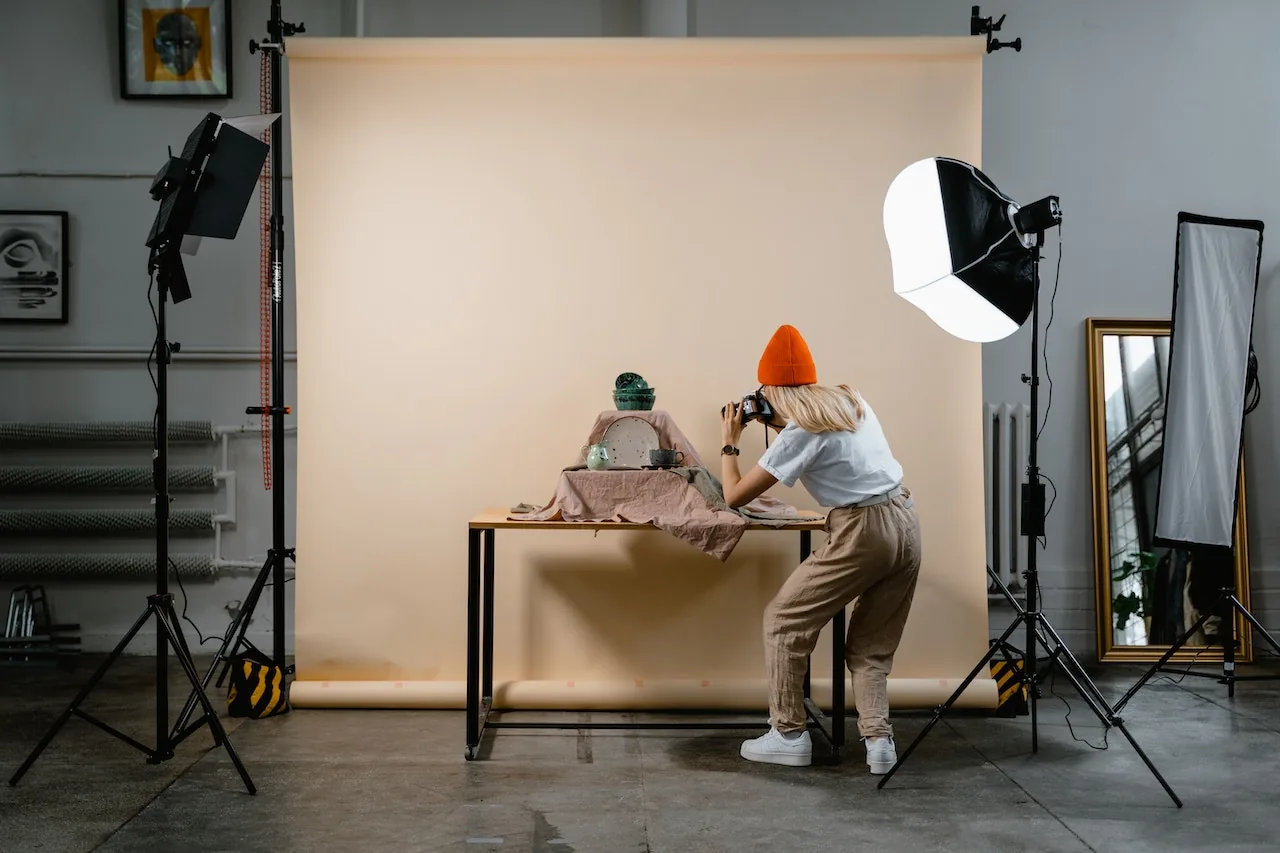
When shoppers cannot touch or try a product, images do all the selling. That gap between browsing and buying often comes down to visual quality, and weak photography is one of the most common reasons online stores underperform. Strong ecommerce product photography builds trust instantly and gives customers the confidence to complete a purchase.
Caspa is an AI-powered tool built specifically for ecommerce sellers who need professional results without the cost and delay of traditional studio shoots. It generates clean, polished images quickly, removing the usual barriers of sample shipping, studio booking, and lengthy editing turnarounds. For sellers ready to improve their visuals and drive more conversions, Caspa offers a practical starting point for better product photography.
Table of Contents
- Why Product Photography Has Become a Major Ecommerce Challenge
- What Types of Ecommerce Product Photography Services Are Available?
- 6 Best Ecommerce Product Photography Services for Different Needs
- Common Mistakes Brands Make With Product Photography
- How Modern Product Photography Helps Brands Scale Faster
- How Caspa Helps Ecommerce Brands Create Product Images Faster
- Get Product Photos that Increase Your Sales Today
Summary
- Visual appearance drives purchasing decisions more directly than most brands account for. Research cited in the article found that 93% of consumers consider visual appearance the key deciding factor in a purchase, meaning product imagery is not a supporting asset but the primary mechanism by which buying decisions are made online.
- Poor photography creates downstream costs that go beyond lost conversions. Studies cited in the article found that 22% of online product returns happen because items look different in photos than in real life. Returns eat margin, damage reviews, and reduce the likelihood that a customer returns, making image accuracy a cost-control issue as much as a creative one.
- Visual inconsistency across channels quietly suppresses performance even when individual images look polished. Brands using inconsistent product photography see up to 30% lower conversion rates, according to research cited in the article. Mismatched lighting, color grading, or styling between platforms erodes buyer confidence before a customer ever reaches checkout.
- The math on traditional photography workflows breaks down as catalog size grows. Brands managing hundreds of SKUs across multiple channels face scheduling delays, sample shipping, revision cycles, and format variations that can stretch a two-day job into a two-week wait. That lag has a measurable revenue cost, particularly for seasonal campaigns and trend-driven content windows.
- Content volume directly shapes channel performance at scale. Posts with images receive 650% higher engagement than text-only posts, and a modern ecommerce brand typically needs to maintain a presence across product pages, marketplace listings, paid social, email, and organic channels simultaneously. Brands producing 20 images per month cannot meaningfully compete with brands producing 200 images per month across all of them.
- Product photography addresses this volume and consistency challenge by serving as the connective tissue between brand standards and channel-specific execution, determining not just whether a product looks good in isolation but whether it looks credible and consistent everywhere a potential buyer encounters it.
Why Product Photography Has Become a Major Ecommerce Challenge
Product photography became critical for business the moment online shopping removed the ability to touch, hold, or inspect a product before buying. The image on screen fills that sensory gap—building trust, communicating quality, and pushing someone toward a purchase decision they cannot reverse without the friction of a return. This is the single most important conversion variable a brand controls at the moment of purchase.
💡 Tip: Think of every product image as a silent salesperson—it performs the job a store associate would do in person, without the ability to answer questions or offer reassurance.

According to Star İstanbul's 2025 ecommerce photography trends report, 93% of consumers consider visual appearance to be the key deciding factor in a purchasing decision. Yet many brands still treat product image production as a task to check off, not a revenue lever to optimize.
"93% of consumers consider visual appearance to be the key deciding factor in a purchasing decision." — Star İstanbul, 2025 Ecommerce Photography Trends Report
🔑 Takeaway: When 9 out of 10 buyers are making decisions based primarily on visuals, underinvesting in product photography isn't a minor oversight—it's a direct drag on revenue and conversion rates.
⚠️ Warning: Treating product photography as a one-time checkbox rather than an ongoing optimization strategy is one of the most common—and costly—mistakes ecommerce brands make.
| Approach to Product Photography | Business Impact |
|---|---|
| Treated as a task to check off | Missed conversions, higher return rates |
| Treated as a revenue lever | Higher trust, improved conversion, lower friction |
When content demand outpaces capacity
The failure point is usually scale. A brand with 20 SKUs can manage a quarterly photoshoot. A brand with 200 SKUs running seasonal campaigns across Amazon, Instagram, email, and paid social cannot. Each channel requires different image specs, aspect ratios, and creative contexts. A clean white-background shot for a product detail page rarely works as a lifestyle image for a Facebook ad. Traditional photography workflows were not designed to produce this volume efficiently.
How does AI-powered photography solve high-volume production bottlenecks?
AI-powered product photography platforms like Caspa solve this problem by creating studio-quality lifestyle photos, infographics, and multi-product visuals faster than traditional methods. Most brands reuse the same batch of images across channels until they look dated, but the core issue is time lost to scheduling delays, sample shipping, editing, and revision cycles that stretch a two-day job into two weeks. By then, the campaign window has closed. Caspa cuts production costs by up to 10x and saves teams more than 20 hours per week compared to traditional workflows.
The return problem nobody wants to talk about
Poor visual quality stops conversions and creates returns. The Star İstanbul 2025 report found that 22% of online product returns are due to items looking different from their photos. This photography problem costs brands twice: in return processing and lost customer trust. Winning brands produce accurate, high-quality images consistently and at speed across every surface where customers encounter their product. This consistency builds trust that converts browsers into buyers and prevents returns. But knowing visuals matter and knowing which photography approach fits your business are two different challenges.
Related Reading
- Ecommerce Product Photography
- Ai Tools for E-commerce
- Printify Alternatives
- Photoroom Pricing
- E-commerce AI Tools
- Printful Alternatives
- Best Ai Tools for E-commerce
- How To Sell On Shopify
- Redbubble Alternatives
- Ecommerce Product Videos
- Automated Product Photography
- Ecommerce Product Imagery
- Visual Merchandising Ecommerce
- Photoroom Cost
What Types of Ecommerce Product Photography Services Are Available?
There are six different service models for ecommerce product photography. Each one makes different trade-offs between cost, control, speed, and creative quality. Choosing the wrong model affects your margins, launch cycles, and channel consistency—factors that directly impact buyer confidence.
"Choosing the wrong photography service model affects your margins, launch cycles, and channel consistency—factors that directly impact buyer confidence and conversions." — Key Industry Insight
| Service Model | Best For | Trade-Off |
|---|---|---|
| In-House Studio | Full control & volume | High upfront cost |
| Freelance Photographer | Flexibility & budget | Inconsistent availability |
| Full-Service Agency | Premium creative quality | Slower turnaround |
| On-Demand Studio | Fast launches | Limited customization |
| AI-Generated Photography | Scale & speed | Emerging technology |
| Hybrid Model | Balanced cost & quality | Requires coordination |
💡 Tip: Match your service model to your launch cadence and channel requirements—not just your budget. The cheapest option often ends up costing more due to lost conversions and reshoots.
⚠️ Warning: Brands that choose a model based on cost alone frequently suffer from inconsistent visuals across channels, which directly undermines buyer confidence and damages long-term brand equity.
🎯 Key Point: Understanding all six service models before committing is essential—each one creates a different impact on your margins, creative output, and time-to-market.

What do traditional studios and freelancers actually offer?
Traditional photography studios offer complete service: photographers, lighting rigs, stylists, props, and post-production editing in one place. This full-service setup works for luxury campaigns or hero shots, but costs escalate when you need many photos. Shipping products, scheduling shoot days, waiting on revisions, and paying per image add up quickly—the economics break down once your catalog grows past a few dozen SKUs. According to Dash's complete guide to ecommerce product photography, 22% of returns happen because a product looks different in person than in photos, meaning expensive studio shoots still fail without precise brief execution.
Where do freelance photographers fall short in growing catalogs?
Freelance photographers offer flexibility and lower day rates but carry a risk of inconsistency. A freelancer who shoots beautifully for one campaign may deliver mismatched work for the next without clear brand guidelines. Freelancers suit brands that need occasional photos and small catalogs. For brands scaling toward hundreds of SKUs across multiple channels, managing coordination becomes a full-time job.
When does building an in-house creative team make sense?
Building an in-house creative team gives brands the most control over brand consistency and campaign responsiveness. However, salaries, equipment, studio rental, and editing software make this choice practical only for larger companies requiring constant, high-volume content. Most growing ecommerce brands face a dilemma: they need too much content for freelancers to handle, but not enough work to justify a full internal department.
How do CGI and AI platforms compare for product imagery?
CGI and product rendering work well for furniture, electronics, and products with many color or configuration choices. Generating a new angle or color option digitally costs much less than reshooting, though building high-quality CGI assets requires specialized technical expertise and a significant upfront investment in 3D modeling.
Many teams using product photography platforms powered by AI are finding a faster way: generating studio-quality lifestyle images, infographics, and multi-product scenes in seconds without shipping units or booking studios. Caspa, for example, reports a 10x reduction in production costs and more than 20 hours saved per week for teams that replace traditional workflows with AI-generated imagery.
Why Hybrid Workflows Are Winning
High-growth ecommerce brands use a hybrid model: professional studio shoots for hero images and AI-generated content for social media, advertising, and seasonal campaigns. This maintains quality where it matters most while increasing volume where speed and flexibility are priorities. Dash reports that 75% of online shoppers rely on product photos when deciding on a purchase, so every channel needs intentional visuals. A hybrid workflow achieves this without excessive studio costs for every promotional asset. The harder question is which specific providers actually deliver on their promises.
6 Best Ecommerce Product Photography Services for Different Needs
Six services cover most ecommerce needs. The right choice depends on what your catalog needs: speed, scale, visual realism, or cost per asset.
"The right product photography service isn't one-size-fits-all — it comes down to speed, scale, visual realism, and cost per asset." — Key Industry Insight
🎯 Key Point: Not every ecommerce brand needs the same solution — your catalog size, budget, and turnaround requirements should drive the decision.
💡 Tip: Before choosing a service, always audit your catalog first — identify whether you need high-volume speed, photorealistic 3D rendering, or low cost-per-asset output to find your best match.
| Priority | Best Fit |
|---|---|
| Speed | High-volume studios with fast turnaround |
| Scale | Automated or AI-powered photography services |
| Visual Realism | 3D product rendering specialists |
| Cost Per Asset | Budget-friendly or offshore photography services |

1. Caspa
Caspa creates realistic product images with human models, removes backgrounds, enlarges photos, and generates lifestyle scenes from a single product upload. According to Shopify, 22% of online product returns are due to items looking different in photos than in real life, making visual accuracy critical for sales. Our platform solves this by creating images designed to drive conversions. Caspa replaces traditional studio photography workflows with a single process, cutting production costs by up to 10x and saving more than 20 hours per week on scheduling and retouching.
2. Soona
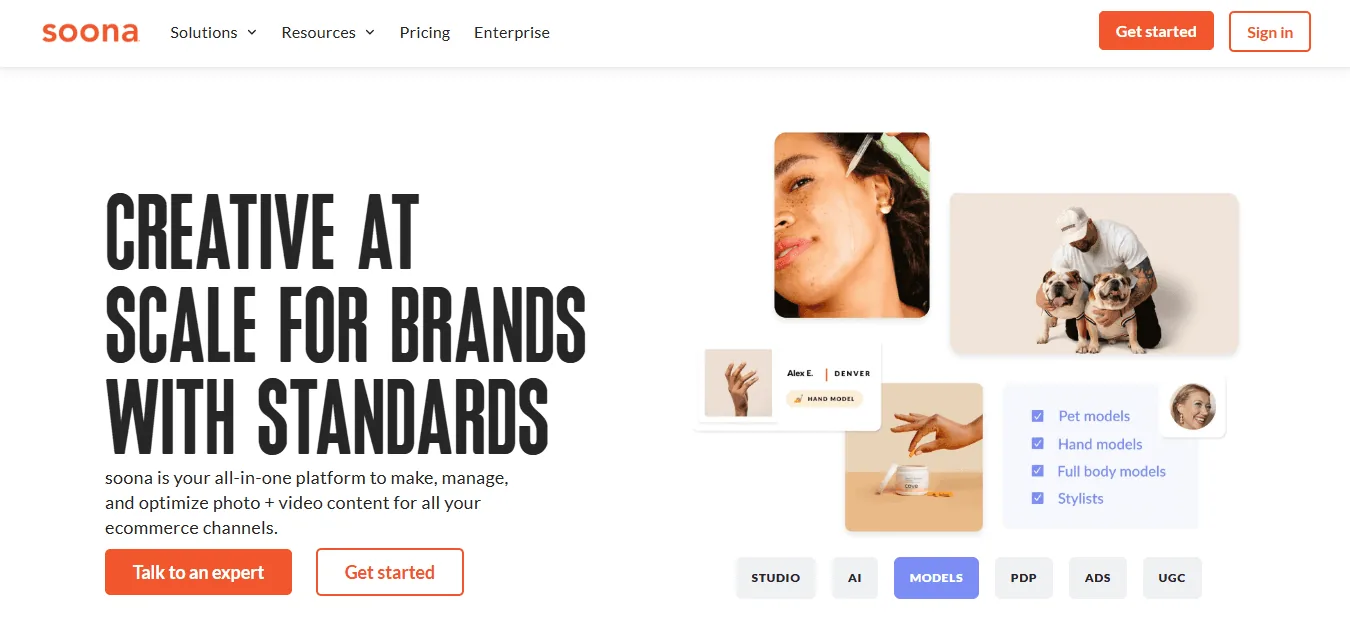
Soona runs a remote studio model in which products ship to their facility and you watch the shoot live online. This gives small and mid-sized brands access to professional photographers and lighting setups without paying for a full studio. Pricing is transparent and based on each image, making budgeting straightforward. For brands that need polished lifestyle content and a creative team, Soona delivers consistent quality at an accessible price point.
3. Squareshot
Freelance photography often struggles with inconsistency: lighting changes between shoots, editing styles shift, and maintaining a consistent visual identity becomes difficult. Squareshot solves this through a subscription model built for ecommerce, offering clean product images, styled scenes, and retouching as a repeatable service. It's ideal for growing brands needing steady output without rebuilding their creative pipeline every quarter.
4. Pixready

When a product comes in twelve color options and three sizes, traditional photography becomes uneconomical. Pixready creates photorealistic 3D renderings and CGI visuals, allowing every variation to be shown without the need for separate shoots. Jeff Bullas reports that product pages with high-quality images see up to 94% more views than those without. For catalog-heavy categories like furniture or home décor, CGI is often the only practical way to maintain visual quality across every SKU. Pixready suits mid-sized and larger brands for which high variation volume makes traditional photography prohibitively expensive.
5. Fotorise
Fotorise specializes in CGI imagery and custom visual scenes, enabling manufacturers and ecommerce brands to build entire campaign libraries from a single product model. This enables visual consistency across touchpoints: from white-background marketplace listings to styled editorial scenes, without re-shooting. Asset flexibility matters most when distribution spans multiple retail partners with different image requirements.
6. Flair AI

Flair AI generates product photos and marketing creatives using AI-generated scenes and templates, making it useful for startups and growing brands that need ads and social media content quickly. In performance marketing, where testing multiple creatives matters more than perfect editing, this approach eliminates the wait between conception and a finished asset. It won't replace a professional photo shoot, but it prioritizes speed over perfection when budget and time constraints demand rapid iteration.
How do you match the right service to your stage?
Traditional services like Soona and Squareshot prioritize human skill and professional quality over speed and scale. CGI platforms like Pixready and Fotorise require upfront modeling time but offer long-term flexibility for variation. AI platforms like Caspa and Flair AI prioritize speed and cost efficiency, with Caspa going further by integrating models, infographics, and A+ content into a single platform to drive conversion-focused output.
Does your brand size change which service makes sense?
A luxury brand launching a flagship collection may focus on the real-world feel of a traditional photo shoot. A brand managing 500 different products across three marketplaces needs a different approach, where cost per image and production speed outweigh individual image quality. Knowing which service fits your needs is only half the answer. The other half is understanding where brands go wrong when producing content at scale.
Related Reading
- How To Sell On Amazon
- Printful Vs Printify
- Shopify Vs Woocommerce
- Ai For Product Photos
- Ai Generated Product Images
- Ai Product Photo Generator
- Amazon Vs Shopify
- Ai Product Video Generator
- Ai For Ecommerce
- Ai Clothing Model
- Shopify Vs Bigcommerce
- Printful Review
- Shopify Vs Amazon
- Ai Model For Clothing
- Ai Product Video
- Ai Fashion Model
- Printful Pricing
- Best Amazon Seller Tools
Common Mistakes Brands Make With Product Photography
Brands that don't do well with product photography often treat it as a one-time project rather than an ongoing system. The photography gets done, images go live, and the project closes — but ecommerce demands change continuously.
"Treating product photography as a one-time task is one of the most costly mistakes an ecommerce brand can make — because the market never stops evolving." — Industry Best Practice
⚠️ Warning: If your image library isn't being updated regularly, you're actively falling behind competitors who treat photography as a living, breathing asset.
💡 Tip: Build a recurring photography schedule into your content calendar — not just a one-off shoot — to ensure your visuals stay fresh, consistent, and conversion-ready.
| One-Time Project Approach | Ongoing System Approach |
|---|---|
| Images go stale quickly | Continuously updated visuals |
| Inconsistent brand look | Cohesive, evolving aesthetic |
| Reactive to problems | Proactive content planning |
| Missed seasonal opportunities | Timely, relevant imagery |

When consistency breaks down across channels
Visual inconsistency erodes trust before a customer adds something to their cart. Different lighting treatments across a product line, mismatched color grading between a website and an Amazon listing, or lifestyle images that feel like they came from three different brands all signal the same problem. According to Zeelum, brands using inconsistent product photography see up to 30% lower conversion rates. This revenue problem compounds every time a new campaign goes live without a clear visual standard.
How do teams maintain visual standards at scale?
Most teams handle inconsistency through style guides and individual photographer briefings, which work at low volume. Managing hundreds of SKUs across multiple channels with weekly creative refreshes makes manual coordination a bottleneck. Platforms like Caspa generate studio-quality lifestyle photos, infographics, and model imagery from a single interface, maintaining visual identity across every asset without restarting production each time.
The return problem nobody wants to talk about
Product photography that misrepresents color, scale, or texture creates costly problems. Orbitvu's research on photography mistakes in e-commerce found that 22% of online product returns are due to items looking different in person than in photos. Returns reduce profit, damage reviews, and erode customer trust. Accurate product imagery controls costs.
Why do disconnected tools slow down ecommerce photography workflows?
The failure point is usually not the photography itself, but the workflow surrounding it. A brand might use one tool to remove backgrounds, another to resize for different platforms, a third to add text overlays, and a fourth to manage file delivery. Each handoff introduces lag and creates opportunities for errors in sizing, formatting, or brand consistency. Teams spend more time managing the process than improving output, and creative quality suffers because decision-makers focus on logistics rather than strategy.
How does treating photography as a one-time project hurt scaling?
Treating photography as a one-time project exacerbates this challenge. Seasonal campaigns, new product launches, and paid advertising all demand fresh visual assets quickly. Brands waiting two to three weeks for new photography cannot keep pace with modern ecommerce. Winning brands have built faster, more flexible systems for continuous content production without necessarily spending more. Once you understand how these mistakes connect, the question shifts from how to avoid them to how brands build the infrastructure to scale.
How Modern Product Photography Helps Brands Scale Faster
Making more creative content is a systems problem, not a photography problem. The fastest-growing brands don't rely on the most talented photographers—they've changed how visual content moves from concept to published asset, compressing weeks into hours.
"The brands winning at scale have systematized their creative output, turning visual production from a bottleneck into a competitive advantage."
🎯 Key Point: The gap between slow and fast-scaling brands isn't talent—it's systems. Brands that treat content production as a repeatable workflow consistently outpace those that don't.
💡 Tip: Audit your current content pipeline. If moving an asset from concept to published takes more than a few days, you have a process problem, not a creativity problem. Modern product photography workflows can solve this.
| Traditional Approach | Modern Scalable Approach |
|---|---|
| Weeks per shoot cycle | Hours from concept to asset |
| Reliant on top photographer availability | Systemized workflows anyone can execute |
| Content moves slowly through approvals | Compressed pipelines with faster publishing |
| High cost per creative asset | Lower cost at higher volume |
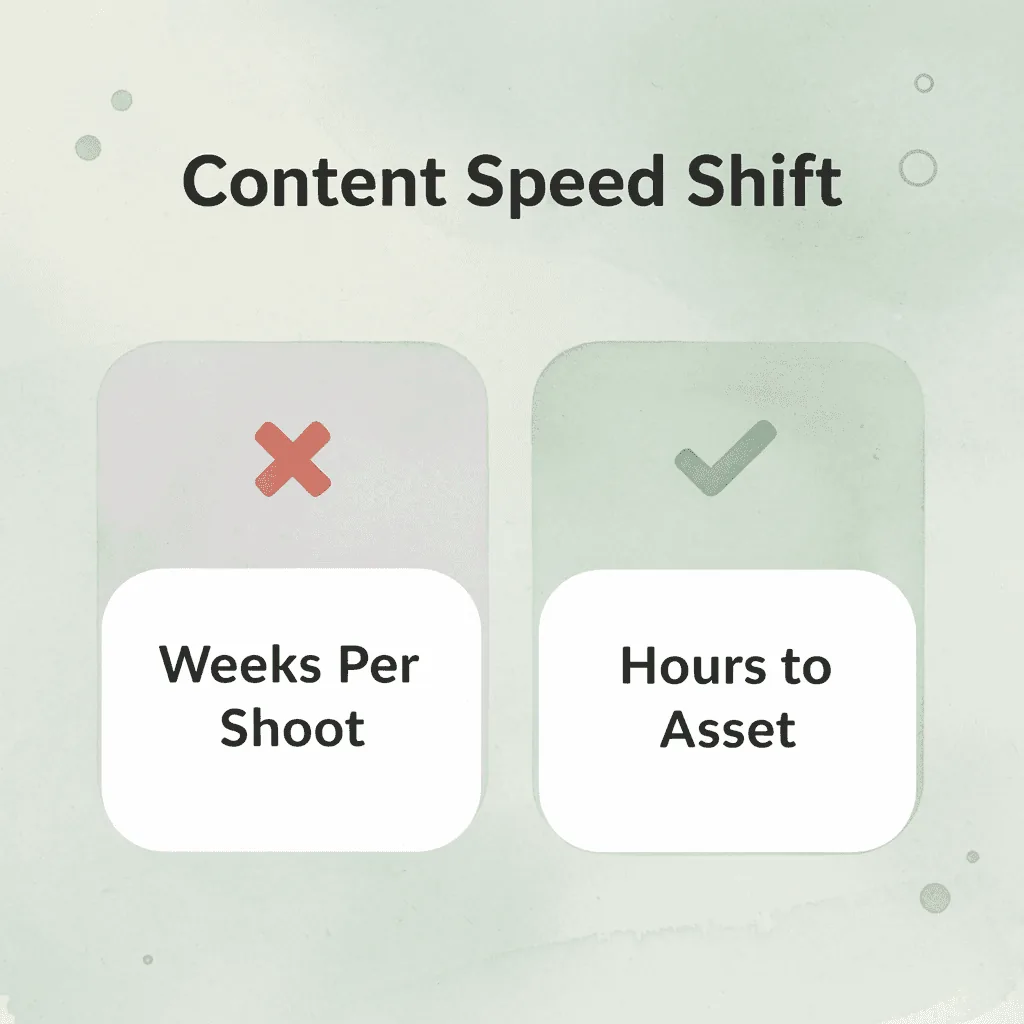
Why does slow production cost brands real revenue?
When a trend emerges on TikTok or a competitor releases a new product, brands must respond quickly. Traditional photography workflows—booking studios, shipping samples, waiting for edits—often cause campaigns to miss the window entirely. According to Rewarx Studio, high-quality product images increase conversion rates by up to 40%, meaning every week a campaign launches late represents lost revenue.
How do rigid pipelines fall behind seasonal and launch demands?
The same issue recurs during seasonal campaigns and new product launches: brands with rigid production pipelines cannot keep pace with the market. A summer promotion launching two weeks late captures only a fraction of its potential. A product launch without lifestyle imagery loses ground to competitors already publishing contextual, channel-ready visuals across Instagram, Pinterest, and paid ads simultaneously.
What scalable content production actually looks like
Most teams grow by hiring more people: photographers, editors, or studio partners. This works until product catalogs reach hundreds of items, at which point costs escalate disproportionately to content needs. Caspa's AI product photography platform creates professional-quality lifestyle photos with real people, custom backgrounds, and multiple products arranged together in seconds. The platform cuts production costs by 10x and saves over 20 hours per week, freeing creative teams to focus on strategy and channel optimization rather than logistics.
Content volume shapes channel performance
According to Kelly Heck Photography, posts with images get 650% more engagement than text-only posts. Modern online stores need images for product pages, marketplace listings, email campaigns, paid social media, organic Instagram, TikTok, and Pinterest, as well as retargeting ads, each of which requires different sizes and formats. A brand producing 20 images per month cannot compete across all these channels. A brand producing 200 cans.
Brands that create more content without spending more money separate content production from strategy. Production runs on systems, templates, and AI-assisted workflows, while strategy—deciding what to say, to whom, and when—remains human-driven. This separation transforms a photography budget into a growth tool rather than a fixed cost. The question is whether your current system can deliver images fast enough to make a difference.
How Caspa Helps Ecommerce Brands Create Product Images Faster
Finding the right ecommerce product photography service means eliminating expensive bottlenecks and creating content fast enough to support growth. As brands expand across websites, marketplaces, email campaigns, social media, and paid advertising, the ability to produce high-quality visuals quickly becomes a competitive advantage.
"As brands scale across multiple channels — from websites to paid advertising — the ability to produce high-quality visuals quickly is no longer a luxury. It's a competitive necessity."
💡 Tip: Brands that scale successfully eliminate visual production bottlenecks before they become a growth ceiling. The right product photography solution makes that possible.
🎯 Key Point: Speed and quality need not be a trade-off. Modern ecommerce product photography services like Caspa deliver both, helping brands stay ahead across every channel, every campaign, every launch.
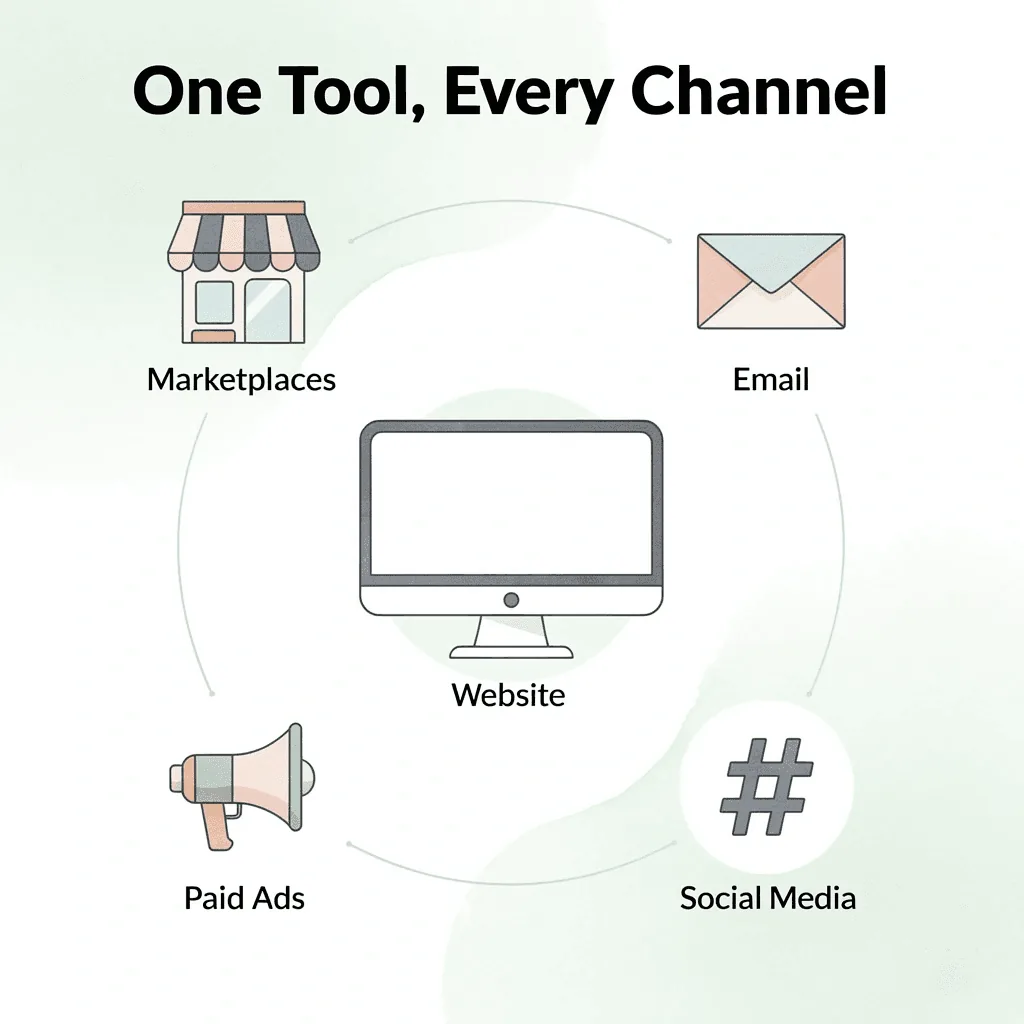
What does Caspa's all-in-one platform offer ecommerce brands?
Caspa helps online retail brands streamline product content creation with an all-in-one AI product photography platform. Instead of coordinating photographers, studios, models, and multiple editing tools, the platform lets brands create realistic product images with human models, edit existing photos, remove backgrounds, upscale images, and generate custom stock photography from a single interface.
Caspa removes the complexity of managing several separate tools. Rather than juggling different applications for background removal, retouching, upscaling, and image generation, our platform lets brands handle their entire product visualization workflow in one place. This reduces friction and lets teams focus on strategy instead of repetitive production tasks.
How does Caspa help teams produce marketing assets faster?
Speed is a major advantage. Traditional workflows require days or weeks to schedule shoots, edit images, and approve revisions. Caspa enables teams to create professional marketing assets in seconds, supporting product launches, advertising campaigns, and seasonal promotions without lengthy production cycles.
How does Caspa help brands scale content production efficiently?
The platform helps businesses efficiently scale content production. Whether launching a few products or managing thousands of SKUs, Caspa enables teams to create more assets without a proportional increase in cost. Consistent visuals across channels strengthen brand identity and customer experience. Caspa allows teams to move at the speed modern ecommerce demands. By removing delays and complexity associated with traditional photography, brands can create content fast enough to keep pace with growth, trends, and the constant need for fresh advertising creatives.
Get Product Photos that Increase Your Sales Today
If your team is organizing photoshoots, shipping samples, or waiting on edited assets before a campaign can launch, that delay carries a real cost. Speed is a revenue decision: every day spent waiting on visuals is a day your product isn't converting.
"Every delay in your content pipeline is a delay in your revenue pipeline — speed is not a luxury, it's a competitive advantage." — Marketing Operations Insight
💡 Tip: Audit your last campaign launch. If asset production was on the critical path, you have a fixable problem costing you money now.
⚠️ Warning: Teams relying on traditional photoshoot workflows (including sample shipping, studio booking, and post-production editing) are systematically slower to market than competitors using modern visual production tools.
Caspa lets you turn existing product photos into studio-quality visuals, test AI-generated scenes with human models, and produce a full content library without adding to your photography budget.
🎯 Key Point: Caspa eliminates the three biggest bottlenecks in visual content production — logistics, cost, and time — so your team can move from idea to live campaign faster than ever.
| Traditional Workflow | With Caspa |
|---|---|
| Ship physical samples to the studio | Use existing product photos instantly |
| Wait days for shoot scheduling | Generate studio-quality visuals on demand |
| Pay for the full photography budget | Produce content without added budget |
| Limited scene variations | Test AI-generated scenes with human models |
| Slow content library build-out | Deliver a full content library at speed |
✅ Best Practice: Use Caspa to run parallel creative tests across multiple scenes and models before committing to a single campaign direction — so every asset you launch is already optimized for conversion.
Related Reading
- Placeit Pricing
- Ai Clothing Model Generator
- Amazon Merch On Demand
- Flat Lay Product Photography
- Teespring Alternatives
- Ecommerce Product Video
- Ai Product Video Maker
- Teespring Vs Printful
- Amazon Ai Tools
- Redbubble Vs Printful
- Merch On Demand
- Luxury Product Photography
- Placeit Alternative
- Advertising Product Photography
- Printful Vs Gelato
- T-shirt Mockup Ai
- Printify Vs Gelato
- Ai Product Photo Editor
- Best Background For Product Photography
- Ai Clothing Mockup Generator
- Ai Fashion Model Generator