
Still images can build trust, but they rarely close the sale on their own. Shoppers want to see a product move, flex, pour, or fit before they commit, and that is exactly what video delivers. From quick demo clips to 360-degree views and lifestyle scenes, ecommerce product videos answer the unspoken questions that keep browsers from becoming buyers.
The strongest product pages pair compelling video with visuals that match in quality and style, giving shoppers a consistent, professional experience from first glance to checkout. Brands that get this right spend less time explaining and more time converting. Caspa makes it straightforward to build that foundation with AI-powered product photography that complements every video asset on the page.
Table of Contents
- Why Ecommerce Product Videos Matter More Than Ever
- Why Traditional Product Video Production Cannot Keep Up
- What Makes Great Ecommerce Product Videos
- The Biggest Benefits of Ecommerce Product Videos
- How Caspa Helps Ecommerce Brands Create Product Videos Faster
- Get Product Videos that Increase Your Sales Today
Summary
- Video dramatically outperforms text in information retention. Viewers retain 95% of a message watched in video format, compared to just 10% when reading the same content as text (Insivia). That gap has direct implications for ecommerce, where shoppers are making purchase decisions without any physical interaction with the product.
- Product videos reduce uncertainty before purchase, which reduces costly returns after the fact. Research from Kleep.ai found that return rates can be reduced by up to 25% when customers watch a product video before making a purchase. Fewer returns lower operational costs and improve customer satisfaction, since buyers already know what to expect when the package arrives.
- The case for video on product pages is nearly universal among consumers. According to api.video, 96% of consumers find videos helpful when making purchase decisions online, and Commerce-UI's analysis found that 73% of consumers are more likely to purchase after watching a video. Product pages with video also see up to 80% higher conversion rates than those without.
- Traditional production workflows were not built for the volume and speed that modern ecommerce requires. Marketers who use video grow revenue 49% faster than those who do not (Wistia), yet studio-based production timelines measured in weeks struggle to keep pace with weekly promotions, platform algorithm changes, and multi-channel launch requirements. The bottleneck is rarely the budget. It is speed and scalability.
- A single strong video is not a strategy on its own. The brands consistently outperforming competitors are publishing continuously, testing different hooks, and adapting creative for each platform where their customers spend time. The Desire Company's 2025 research found that 84% of people say they have been convinced to buy a product after watching a brand's video, meaning every gap in the content calendar is a missed conversion opportunity.
- Consistent visual branding across video and still imagery matters as much as volume. Customers who encounter the same colors, pacing, and tone across a Shopify listing, an Amazon page, and an Instagram Reel begin to associate that consistency with reliability, and that association transfers directly into purchase confidence.
- Product photography addresses this by giving brands a visual foundation that pairs with video content across every channel, keeping product pages cohesive and professional without requiring a separate studio shoot for each asset.
Why Ecommerce Product Videos Matter More Than Ever
Shoppers who cannot touch, hold, or test a product before buying make decisions based entirely on what you show them. When your visuals answer their questions before they think to ask, the purchase becomes easy. When they leave your page with doubts, they leave for good.
"When your visuals answer their questions before they think to ask, the purchase becomes easy. But when shoppers leave with doubts, they leave for good."
🎯 Key Point: Your product visuals function as a salesperson: they must answer every question a shopper has before doubt forms.
💡 Tip: Video content is the closest online equivalent to an in-store experience. Use it to show your product in motion, in context, and in detail that static images cannot match.

Why do shoppers retain more from video than from text?
The shift toward video reflects how people process information. According to Insivia, viewers remember 95% of a message when they watch it in a video, compared to 10% when reading the same information as text. That gap is the difference between a shopper who understands your product and one who is still guessing at checkout.
What can video show that static product images cannot?
Still, product images cannot show how a jacket moves, how a blender handles ice, or how furniture fits a real living room. Product demo videos, lifestyle footage, and 360-degree views fill those gaps. The problem with photos alone is not quality but the lack of motion, scale, and story.
Many brands treat product videos as creative assets for social media rather than as a primary tool for customer evaluation and decision-making. Most teams handle video production through traditional studio workflows, waiting weeks for edited content. Caspa's AI product photography platform addresses this friction, letting brands generate studio-quality lifestyle videos with models and realistic environments in seconds, cutting production timelines from weeks to minutes.
How does product video content reduce returns and improve margins?
Kleep.ai's research found that return rates can be reduced by up to 25% when customers watch a product video before making a purchase. Fewer returns lower operational costs, improve margins, and increase customer satisfaction by ensuring what arrives matches expectations.
The brands winning on product pages are creating the most relevant, specific, and honest visual content at the right pace. A solo ecommerce founder and an established brand managing hundreds of listings face the same core challenge: showing products in ways that make buying feel obvious. The playing field is defined by how quickly you can close the gap between what a shopper imagines and what your product actually delivers.
Related Reading
- Ecommerce Product Photography
- Ai Tools for E-commerce
- Printify Alternatives
- Photoroom Pricing
- Ecommerce Product Photography Services
- E-commerce AI Tools
- Printful Alternatives
- Best Ai Tools for E-commerce
- How To Sell On Shopify
- Redbubble Alternatives
- Automated Product Photography
- Ecommerce Product Video
- Ecommerce Product Imagery
- Visual Merchandising Ecommerce
- Photoroom Cost
Why Traditional Product Video Production Cannot Keep Up
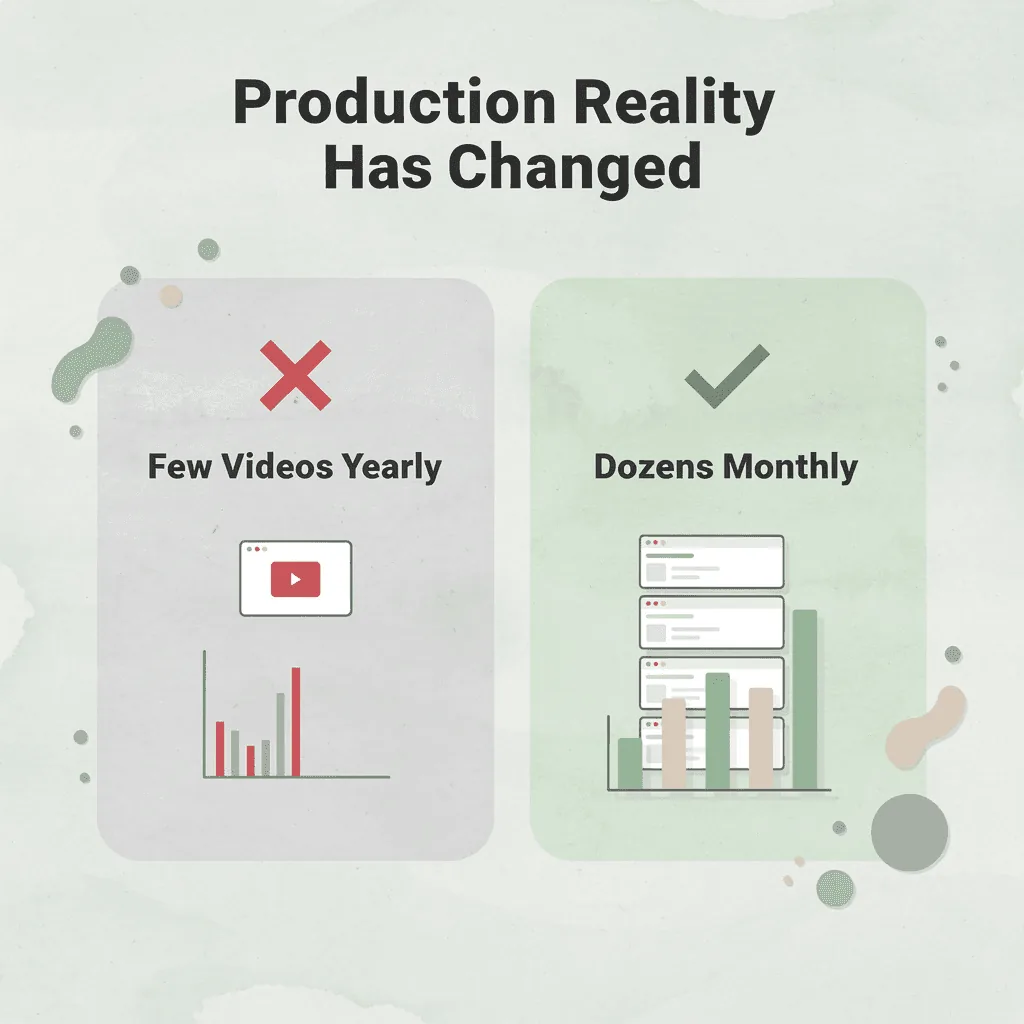
Traditional production workflows assume a brand needs just a few polished videos per year — not dozens per month across multiple platforms, product lines, and audience segments. That assumption is no longer true.
"Traditional production workflows were built for a world where a brand needed a handful of polished videos per year — not the dozens per month that modern multi-platform, multi-segment marketing now demands." — Industry Insight
⚠️ Warning: Brands still relying on traditional video production timelines risk falling critically behind competitors who are publishing at scale across every major platform.
🎯 Key Point: The core assumption of legacy production — few videos, high polish, long lead times — is fundamentally broken in today's multi-platform content environment.
| Traditional Production Model | Modern Content Demand |
|---|---|
| A few videos per year | Dozens of videos per month |
| Single platform focus | Multiple platforms simultaneously |
| One product line at a time | Multiple product lines in parallel |
| Broad audience targeting | Segmented audience customization |
Why does a single product launch expose the bottleneck so quickly?
The bottleneck appears immediately. A brand launches a new product and needs video assets for its Shopify page, Meta ads, Amazon listing, and TikTok simultaneously. Each platform has different format requirements and audience expectations. Booking a studio, coordinating a shoot, and waiting on post-production takes weeks. By then, the launch window has narrowed, competitors have moved, and early sales momentum has dissipated.
The Wistia State of Video Report shows marketers using video grow revenue 49% faster than those who don't, yet production demand outpaces traditional studio capacity. This is a systems problem, not a creative one. Most workflows treat every video as a custom project: beautiful for one campaign, broken for fifty product clips before Q4.
What happens to the products that never get a video?
Most teams focus on their best-selling products and leave the rest of the catalog without video. Shoppers landing on product pages with only still images must make decisions with incomplete information, and conversion rates reflect this. Platforms like Caspa create studio-quality product videos from existing images, enabling brands to cover their full catalog without scheduling shoots or compressing review cycles from weeks to hours.
Why does paid advertising demand more creative volume than studios can supply?
Paid advertising requires continuous creative testing: trying different hooks, angles, and formats to prevent audience fatigue. Rev's Video Marketing Statistics report that 91% of businesses now use video as a marketing tool. To stand out, you need volume and variety, not quality alone. Traditional production cannot make ten creative versions of the same product video in a single week.
Seasonal campaigns show this most clearly. Brands that win Black Friday are not those with the biggest budgets, but those whose creative assets were ready three weeks early. Speed and scalability have become structural advantages.
But knowing you need better video content is only half the equation. The other half is understanding what separates product videos that convert from ones that get scrolled past.
What Makes Great Ecommerce Product Videos
The best product videos close the gap between curiosity and confidence by giving shoppers enough visual evidence to decide.
"The best product videos don't just showcase a product — they eliminate doubt and replace hesitation with the conviction to buy." — Ecommerce Video Best Practices
🎯 Key Point: A great ecommerce product video isn't about looking polished — it's about delivering visual proof that moves shoppers from browsing to buying.
💡 Tip: Focus your video on closing the confidence gap — show your product in real use, from multiple angles, so shoppers have zero unanswered questions before they hit Add to Cart.
| What Weak Videos Do | What Great Videos Do |
|---|---|
| Show the product statically | Demonstrate real-world use |
| Leave shoppers with questions | Build immediate confidence |
| Focus on aesthetics only | Deliver visual evidence that converts |
| Create passive viewing | Drive active purchase decisions |

Show the product doing its job
Still pictures show what a product looks like; video shows what it does. A jacket photographed flat communicates color and shape. The same jacket shown on a person walking through wind and rain communicates waterproofing, fit in motion, and whether the hood stays up. According to The Desire Company's 2025 video marketing research, product pages with video achieve up to 80% higher conversion rates than those without video. A well-executed demonstration dissolves uncertainty in under thirty seconds.
Why does lifestyle video sell what specs cannot?
Lifestyle video works because it answers the question shoppers are asking: "Does this fit my life?" Furniture shown in a styled living room, skincare applied during a morning routine, a blender used in a real kitchen with real mess—these scenarios do what product specifications cannot. They make the purchase feel familiar before it happens. Human models sharpen this further by providing scale, proportion, and emotional relatability. The customer stops evaluating the product and starts imagining ownership.
How can brands produce lifestyle videos at scale?
Most brands produce lifestyle videos in studios, with models, and in shoots that take multiple weeks. This process limits content volume and slows response to trends. Platforms like Caspa generate studio-quality lifestyle videos with models and realistic environments directly from product images. Our solution compresses production into minutes, enabling brands of any size to create videos for their full catalog.
One video is not a strategy
Brands that consistently outperform competitors publish continuously, test different hooks, and adapt creative for each platform. A sixty-second product demonstration requires different edits for TikTok, paid Meta ads, and product pages. The Desire Company's 2025 research shows that 84% of people say they've been convinced to buy after watching a brand's video—every missed publishing opportunity is a lost conversion. Producing content at scale is no longer a luxury for large teams; it's the baseline requirement for staying visible.
Why does consistent branding across every video matter?
Consistent branding across every video matters as much as volume. Colors, typography, pacing, and tone should remain recognizable whether the video appears on a Shopify product page, Amazon listing, or Instagram Reel. Customers who repeatedly encounter the same visual identity associate it with reliability, which translates directly into purchase confidence.
Once you understand what separates converting videos from forgettable ones, the next critical question emerges.
Related Reading
- How To Sell On Amazon
- Printful Vs Printify
- Shopify Vs Woocommerce
- Ai For Product Photos
- Ai Generated Product Images
- Ai Product Photo Generator
- Amazon Vs Shopify
- Ai Product Video Generator
- Ai For Ecommerce
- Ai Clothing Model
- Shopify Vs Bigcommerce
- Printful Review
- Shopify Vs Amazon
- Ai Model For Clothing
- Ai Product Video
- Ai Fashion Model
- Printful Pricing
- Best Amazon Seller Tools
The Biggest Benefits of Ecommerce Product Videos
Product videos work like a real-time sales conversation, answering customer questions without needing a store associate or making customers wait.
"Product videos act as your always-on sales team — delivering answers, building confidence, and driving conversions without a single human interaction required."
🎯 Key Point: A well-crafted product video replaces the need for a live sales rep by proactively addressing customer hesitations and purchase objections in seconds.
💡 Tip: Think of every product video as a virtual store associate — one that works 24/7, never takes a break, and delivers a consistent sales message every single time.
| Traditional Sales Method | Product Video |
|---|---|
| Requires a store associate | Works autonomously, 24/7 |
| Customer must wait for answers | Delivers instant answers |
| Inconsistent messaging | Consistent every time |
| Limited to store hours | Available around the clock |

How video changes the purchase decision
A customer makes a purchase decision when they feel confident enough to commit. According to Commerce-UI's analysis of video in ecommerce, 73% of consumers are more likely to buy a product after watching a video. Static images show what a product looks like; video shows what it does, how it moves, and whether it fits into someone's real life.
Most brands treat video as a finishing touch added after the product page is built. Customers who cannot picture a product in use leave without buying, and no amount of writing can close that gap. Video placed early in the customer journey on the listing itself, rather than buried in a tab, shortens the distance between curiosity and confidence.
What does video do for advertising efficiency?
The same product video that lives on a Shopify listing can run as a TikTok ad, appear in an Amazon A+ content block, and anchor an email campaign without being recreated from scratch. Brands that build video into their workflow once get returns across every channel they touch, rather than paying separately for each platform's creative requirements.
Why do traditional production timelines struggle to keep pace?
Most teams make individual videos for each campaign, which becomes harder as product lists grow and ad cycles shorten. Production timelines designed for quarterly launches cannot keep pace with weekly promotions and algorithm changes. Caspa solves this by enabling brands to create studio-quality lifestyle product videos from existing images in seconds, reducing production cycles from weeks to an afternoon.
Where the real business case lands
According to api.video, 96% of consumers find videos helpful when making purchase decisions online. This near-universal adoption means customers expect video on product pages and will seek it elsewhere, likely on competitor listings, if absent. The business case for product video is to meet baseline expectations, not to chase trends.
Knowing that video converts, scales, and reduces creative costs is only part of the picture. The practical question that follows has a simpler answer than most expect.
How Caspa Helps Ecommerce Brands Create Product Videos Faster
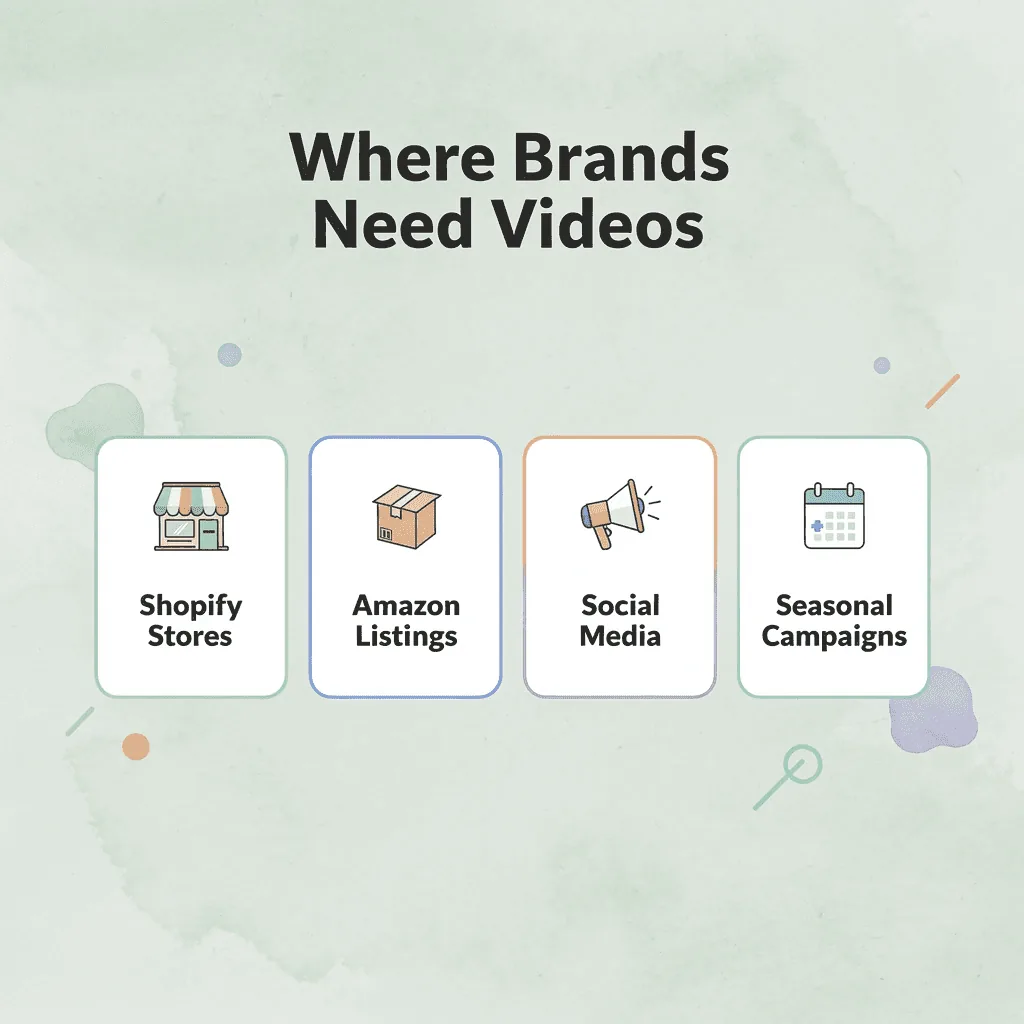
Making good ecommerce product videos is a tough job. Brands need lots of videos and pictures for product launches, Shopify stores, Amazon listings, social media, paid ads, and seasonal campaigns. The old way of making videos cannot keep up because every new piece of content requires more planning, more people, and more time.
"Every new piece of content needs more planning, more people, and more time: the traditional production model simply cannot scale with modern ecommerce demand."
💡 Tip: If your content production pipeline is slowing down your product launches, the bottleneck is the number of tools, teams, and handoffs involved, not your creative ideas.
⚠️ Warning: Relying on traditional video production for every channel—Shopify, Amazon, paid ads, and social media—means your team will fall behind on content, especially during high-volume seasonal campaigns.
Caspa changes that by helping ecommerce brands make both product videos and product photos through one AI-powered workflow. Instead of organizing photographers, videographers, studios, editors, and multiple creative tools, brands can make professional marketing assets much faster while keeping the same quality across every channel.
| Traditional Production | Caspa AI Workflow |
|---|---|
| Multiple photographers & videographers | One AI-powered platform |
| Separate studios & editors | Single streamlined workflow |
| Slow turnaround per asset | Faster delivery at scale |
| Inconsistent quality across channels | Consistent quality everywhere |
🎯 Key Point: Caspa replaces an entire roster of fragmented creative tools and teams with a single AI-powered workflow — giving ecommerce brands professional-grade assets for every channel, faster than ever before.
What core video and photography capabilities does Caspa offer?
One of Caspa's most powerful capabilities is AI product video generation. Brands can quickly create product videos that showcase features, demonstrate products in use, and support advertising campaigns without the delays of traditional video production.
Caspa combines AI product photography with video creation, allowing brands to build complete marketing campaigns from a single creative workflow. High-quality product images and videos establish a consistent visual identity across websites, marketplaces, email campaigns, and social platforms.
How does Caspa make product visuals more relatable and polished?
To make products more relatable, Caspa supports ultrarealistic human models and AI-generated lifestyle scenes. Rather than generic product shots, our product photography capabilities help you create visuals that place products in realistic environments where customers can imagine using them. These scenes add context, strengthen emotional appeal, and help products stand out in crowded ecommerce markets.
Businesses can improve existing assets by editing and enhancing product photos rather than replacing them entirely. Features such as background removal and image enhancement create cleaner, more professional visuals while reducing the need for repeated photoshoots.
For additional creative flexibility, Caspa can generate custom stock images that align with a brand's visual identity. Rather than relying on generic stock libraries, the platform helps you create original marketing visuals that reinforce consistent branding.
Why does an all-in-one workflow give ecommerce brands a competitive edge?
The biggest advantage is that Caspa brings all these capabilities together into one complete visual content workflow. Product videos, product photography, image editing, lifestyle scenes, background removal, image enhancement, and custom marketing assets are created within the same platform. This eliminates the need to manage multiple software tools, photographers, videographers, studios, and lengthy editing processes.
The result is a faster, more scalable approach to content creation that allows ecommerce brands to produce professional visuals whenever new products, campaigns, or opportunities arise. Winning brands are not those with the biggest production budgets but those that can consistently create compelling visual content at the speed the market demands.
Get Product Videos that Increase Your Sales Today
If you're ready to create ecommerce product videos without expensive production teams or weeks of editing, try Caspa. Our AI-powered product videos and professional product photography generate ready-to-use marketing assets for your store, social media, and advertising channels in your first session.
"You don't need expensive production teams or weeks of editing — AI-powered tools like Caspa deliver ready-to-use marketing assets in your first session." — Caspa
💡 Tip: Caspa's AI platform lets you launch professional product videos and photography from day one with zero production overhead, without waiting for the perfect budget or timeline.
🎯 Key Point: Ecommerce brands using AI-generated product videos skip the costly, time-consuming traditional production process and convert customers faster.

You don't need a bigger budget or a longer timeline. You need a tool that meets the moment — one that turns your product vision into polished, high-converting video assets fast.
✅ Best Practice: Choose an AI video platform that delivers professional-quality results immediately, so your marketing campaigns never have to wait on production schedules.
| Traditional Production | Caspa AI |
|---|---|
| Expensive production teams | No crew required |
| Weeks of editing time | Ready in your first session |
| High budget barrier | Accessible pricing |
| Delayed time-to-market | Instant marketing assets |
Related Reading
- Printify Vs Gelato
- Printful Vs Gelato
- Amazon Merch On Demand
- Flat Lay Product Photography
- Ai Clothing Mockup Generator
- Placeit Alternative
- Ai Product Photo Editor
- Teespring Vs Printful
- T-shirt Mockup Ai
- Amazon Ai Tools
- Merch On Demand
- Ai Fashion Model Generator
- Best Background For Product Photography
- Advertising Product Photography
- Ai Product Video Maker
- Ai Clothing Model Generator
- Ecommerce Product Video
- Teespring Alternatives
- Placeit Pricing
- Redbubble Vs Printful
- Luxury Product Photography