

Selling on Shopify is competitive, and most stores that struggle share a common weakness: weak visuals. Buyers cannot touch or try products before purchasing, so images carry the full weight of building trust and driving conversions. Strong ecommerce product photography, paired with a smart store setup and pricing strategy, is often the real difference between a store that sells and one that gets scrolled past.
Getting those visuals right does not have to mean expensive studio shoots or complicated production workflows. Sellers who invest in clean, professional imagery from the start consistently see stronger click-through rates and fewer abandoned carts. Caspa makes that process straightforward, and its AI-powered product photography tools are built specifically to help Shopify merchants compete without the overhead.
Table of Contents
- Why Selling on Shopify Is Harder Than It Looks
- Why Many Shopify Stores Struggle to Generate Sales
- How to Sell on Shopify
- What Makes Shopify Stores More Successful?
- Speed and Creative Iteration Have Become Competitive Advantages
- Get Product Photos that Increase Your Sales Today
- How Caspa Helps Shopify Stores Create Better Content Faster
Summary
- Only about 10% of Shopify stores are considered active and generating consistent revenue, according to Shopify's own data. The remaining 90% have products, pages, and prices but fail to earn the trust of first-time visitors. Shoppers make that credibility judgment in seconds, and once they leave, they rarely return.
- The failure point for most struggling stores is not traffic volume; it is what happens to that traffic after it arrives. Store owners often spend heavily on ads while the product page underneath quietly undermines conversions. Generic supplier images, inconsistent branding, and a lack of social proof create hesitation, and hesitation kills sales before a buyer ever reaches checkout.
- Stores with more than 100 product reviews convert at 3.5x the rate of those without, according to Yarnit's 2025 Shopify statistics report. Reviews and imagery function as a combined credibility system rather than independent features. Remove either one and the whole structure weakens.
- Mobile commerce accounts for approximately 69-70% of all Shopify store traffic, which means the product page most shoppers see is a compressed, thumb-scrolled version of the desktop design. Stores that treat mobile as the primary design surface, rather than an afterthought, consistently outperform those that optimize for desktop first.
- Speed of creative iteration has become a structural competitive advantage, particularly for smaller sellers. Research published on arXiv found that optimizing combinations of creative elements can increase click-through rates by over 6% and gross merchandise value by more than 10%. Stores that test four image concepts per month will find winning combinations faster than stores testing four per year, regardless of budget size.
- Small businesses can make decisions up to 5x faster than large enterprises, according to TriNet Insights, which means agility is a genuine advantage when applied deliberately. The bottleneck for most sellers is not strategy but production, because generating new creative assets through traditional shoots takes days or weeks, slowing the feedback loop that drives improvement.
- This is where product photography fits in, enabling sellers to generate studio-quality lifestyle images and listing-ready assets quickly enough to support continuous testing, rather than rationing creative decisions to one or two rounds per quarter.
Why Selling on Shopify Is Harder Than It Looks
Creating a store takes an afternoon. Building a store that sells is a different problem entirely: one that demands strategy, trust, and more than a polished homepage.
"The gap between launching a store and building one that sells is where most entrepreneurs get lost." — The Hard Truth of Ecommerce
🎯 Key Point: Launching is easy. The real challenge is converting strangers into buyers, and that requires work no platform can do for you.

According to the Shopify Blog's 2024 Sales Statistics, only about 10% of Shopify stores make consistent money. Ninety percent exist technically but do not produce. They lack the one thing no platform can provide: the trust of a stranger who has never heard of you.
| Store Category | Outcome |
|---|---|
| Top 10% | Make consistent money |
| Remaining 90% | Exist technically, produce nothing |
⚠️ Warning: Being live does not mean being profitable. 90% of stores fail to generate real revenue — not because of the platform, but because of a trust deficit with new visitors.
🔑 Takeaway: The #1 missing ingredient across failing Shopify stores isn't traffic or design — it's the earned trust of a stranger who has never encountered your brand before.
Why do most Shopify stores fail to convert visitors into buyers?
The failure point is usually not the product. Store owners watching 70-80% bounce rates are not selling bad products—they're selling to people who cannot yet believe the store is real. No models, no reviews, no visible story. Visitors judge credibility in seconds, and once they leave, they rarely return. The gap between traffic and sales is almost always a gap in perceived credibility, not product quality.
Most sellers handle product photography quickly and cheaply: flat lays on kitchen counters, supplier images, plain white backgrounds that show the product but communicate nothing about the brand. That approach fails when a customer compares your listing to a competitor whose visuals communicate quality before a word is read. Tools like Caspa let sellers generate studio-quality lifestyle photos with models and professional lighting at a fraction of traditional production costs, eliminating the visual credibility gap without a full creative team or photography budget.
How does visual trust separate the stores that sell from those that don't?
A $60 item photographed like a $10 item will sell like a $10 item. Shopify's platform gives every seller the same tools and resources. What separates the 10% that convert consistently is how much trust their store builds before a customer clicks "add to cart." That trust is built through visuals, immediately and without a second chance.
Modern Retail reports that Shopify's merchant count grew to over 2 million sellers worldwide by the end of 2025. With more sellers competing for buyer attention, success hinges on the visual layer. Sellers who underestimate the importance of product imagery compete at a disadvantage against brands that recognise it as the primary driver of conversion.
But knowing that visuals matter is only the beginning of the challenge.
Why Many Shopify Stores Struggle to Generate Sales
Starting a Shopify store is easy. Making consistent sales is harder, and most businesses get stuck in the gap between the two.
💡 Tip: Getting your store live is only the beginning. The real work starts when you try to turn visitors into buyers.
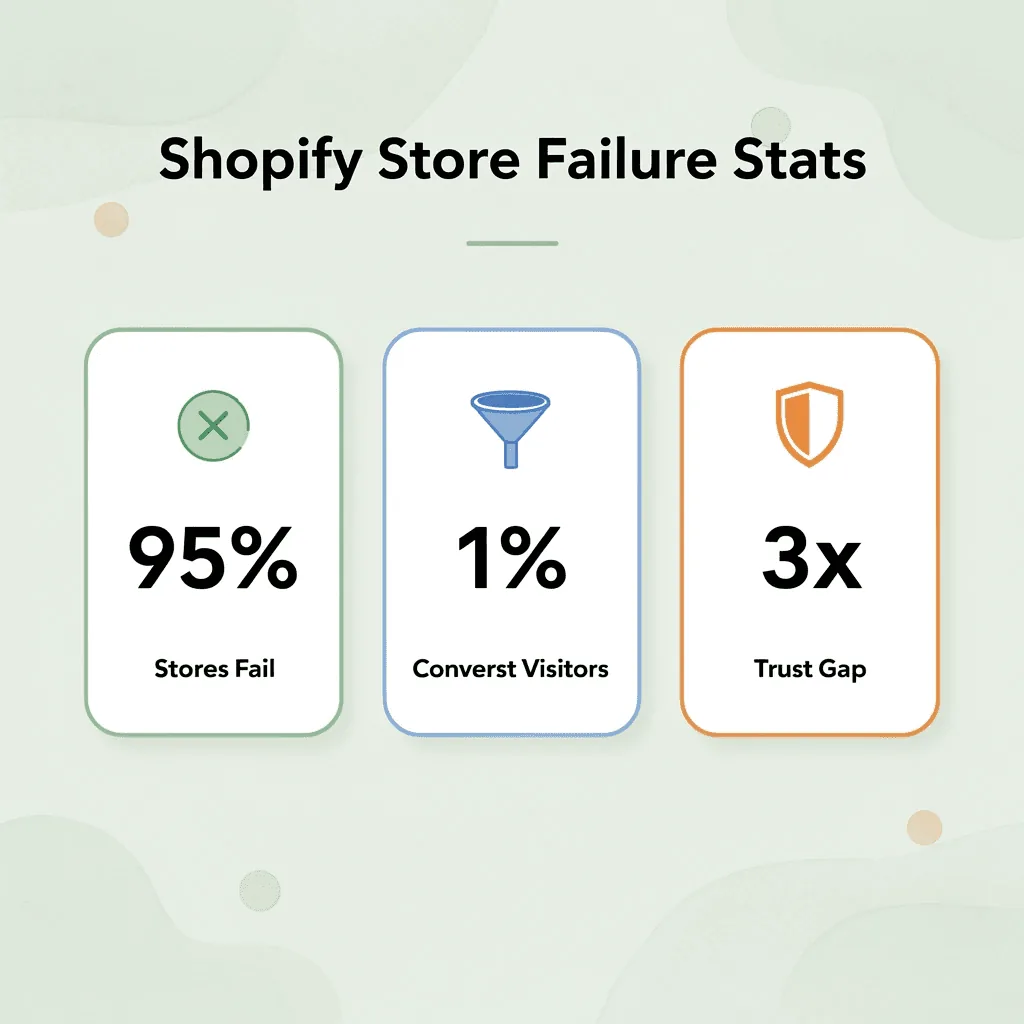
"95% of new Shopify stores fail — rarely because of the product itself, but because the store fails to earn trust." — Branvas
According to Branvas, 95% of new Shopify stores fail, and rarely because of the product itself. The pattern is a store that looks like it works but fails to earn trust. Shoppers land, look quickly, and leave without buying because nothing gives them a reason to stay. Traffic without sales is just an expensive way to measure disappointment.
🔑 Takeaway: A store that looks functional but fails to build trust will bleed traffic and revenue — fixing the trust gap is the single most important lever for turning visitors into customers.
⚠️ Warning: Don't mistake high traffic for store health — if visitors are leaving without buying, you don't have a traffic problem; you have a conversion problem.
Where does the real problem hide?
The failure point is usually not traffic volume, but what happens once it arrives. Store owners pour budget into ads while product pages underneath do quiet, invisible damage. Generic supplier images, inconsistent branding, and weak copy create a credibility gap that paid traffic cannot close. Shoppers don't consciously think "this image is low quality"—they simply feel uncertain, and uncertain shoppers don't buy.
Why do supplier images stop working as competition grows?
Most store owners take product photos quickly and cheaply, often using supplier images. This works until a competitor presents the same product in a way that resonates emotionally with buyers. Platforms like Caspa solve this by creating professional lifestyle images, infographics, and A+ content without a photographer or large budget, cutting traditional content costs by up to 10x while maintaining competitive visual standards.
The compounding cost of weak creative
A practitioner on a LinkedIn post about Shopify stores struggling noted that building real relationships with customers doubled conversion rates compared to standard conversion tools. Conversion is not a technical fix; it's a trust problem. Trust is built or broken in the first few seconds a shopper spends on your product page.
What do stores that actually convert do differently?
Stores that break through share one trait: they treat every product image as a sales argument, not a placeholder. They test new creative regularly, match visuals to their buyer's emotional context, and iterate without waiting for perfect conditions. Speed of learning beats budget size.
What is the question that actually changes your results?
Once you understand what separates converting stores from traffic collectors, the next question becomes the one that changes your results.
Related Reading
- Ecommerce Product Photography
- Ai Tools for E-commerce
- Printify Alternatives
- Photoroom Pricing
- Ecommerce Product Photography Services
- E-commerce AI Tools
- Printful Alternatives
- Best Ai Tools for E-commerce
- Redbubble Alternatives
- Ecommerce Product Videos
- Automated Product Photography
- Ecommerce Product Imagery
- Visual Merchandising Ecommerce
- Photoroom Cost
How to Sell on Shopify
To sell successfully on Shopify, you need to treat every part of your store as a deliberate choice that helps turn visitors into buyers. Your product page is like a sales pitch that works without a salesperson having to build rapport with customers.
"Your product page is your highest-leverage sales asset — it must persuade, reassure, and convert without a human ever entering the conversation." — Shopify Commerce Insights
💡 Tip: Treat your product page as a silent salesperson — every image, headline, and description must do the heavy lifting that a live rep would normally handle.
⚠️ Warning: Ignoring the conversion potential of your product pages is one of the most common and costly mistakes new Shopify sellers make. A poorly optimized page means lost sales before a customer ever reaches checkout.
| Store Element | It's a Sales Role | Impact on Conversion |
|---|---|---|
| Product Page | Silent sales pitch | High |
| Product Images | Visual trust builder | High |
| Product Description | Objection handler | Medium–High |
| Pricing & CTA | Decision trigger | Critical |
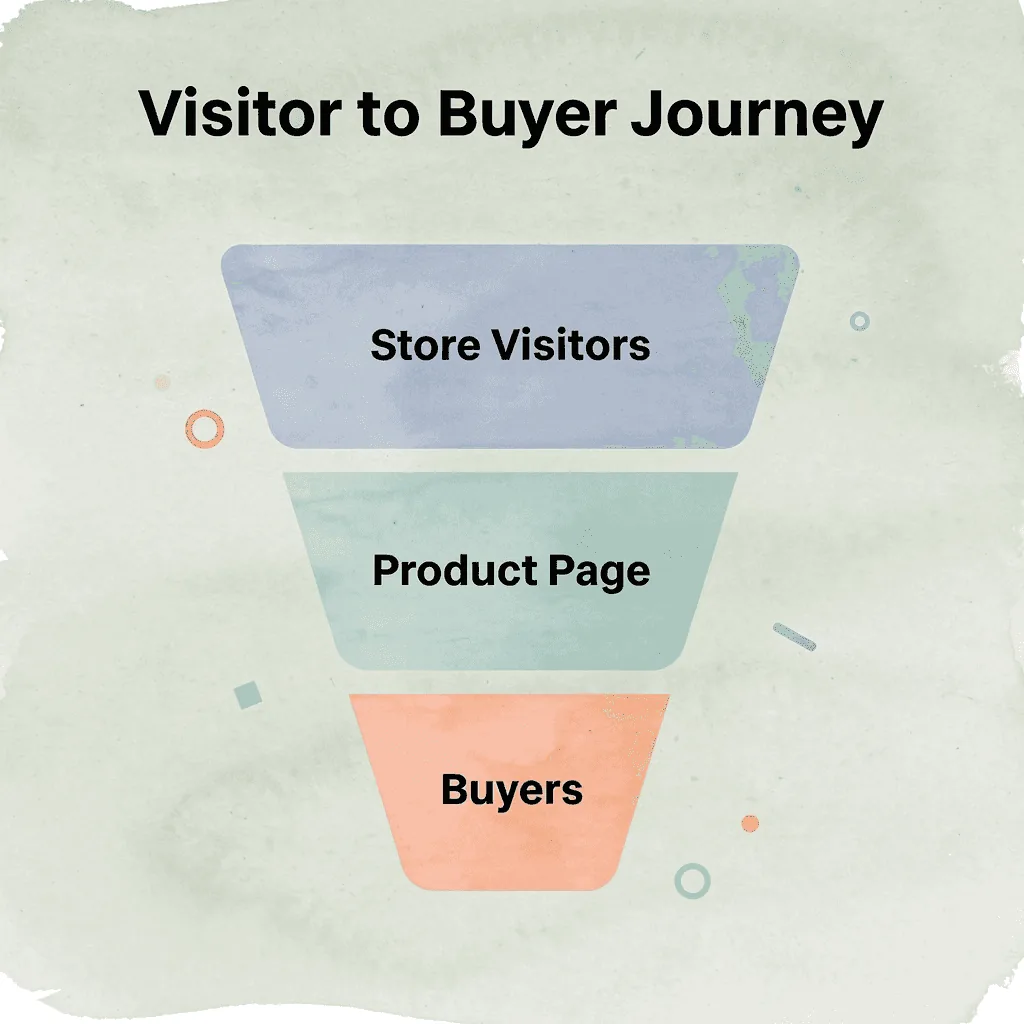
Build Your Store Around the Buyer's Journey
Top-performing stores map every page, image, and line of copy to a specific moment in the buyer's journey. A new visitor needs to feel safe. A returning visitor needs a reason to act. A hesitant buyer needs proof. When you design with those states in mind, your store becomes a guided experience rather than a grid of products. According to the Yarnit Blog's Shopify Statistics 2025, mobile commerce accounts for approximately 69% of all Shopify store traffic, meaning the experience must work on a 4-inch screen with one thumb in under 3 seconds.
What Traffic Channels Actually Do
Traffic is not the goal; qualified attention is. SEO builds compounding visibility over time, pulling in buyers with intent. Paid advertising accelerates testing but punishes stores with low conversion rates. Email marketing remains the highest-return channel for retention because it reaches people who already said yes once. The fastest-growing sellers know their cost per acquisition, average order value, and repeat purchase rate well enough to make every channel decision with math, not instinct.
The Visual Gap Most Sellers Ignore
Most early-stage Shopify sellers use white-background product photos or supplier images. The problem emerges when shoppers compare your product to competitors whose images show items in real-life use, creating doubt that prevents purchase. Platforms like Caspa generate studio-quality lifestyle photos, infographics, and A+ content without the cost or scheduling constraints of traditional photo shoots, reducing production costs by up to 10x and giving smaller sellers access to the visual quality established brands use to justify higher prices.
Trust Is Built Before the Cart
Reviews, social proof, and clear policies are essential. A buyer who cannot find a return policy, see real customer photos, or verify that purchases are safe will leave before checkout. Stores that display trust signals prominently, not hidden at the bottom, see fewer abandoned carts. Short, specific reviews outperform long, generic ones. A photo from a real customer carries more weight than a polished brand image because it answers the question every buyer asks: does this actually work for someone like me?
Retention Is the Lever Nobody Starts With
Most Shopify growth strategies focus on acquiring new customers while neglecting retention, an expensive mistake. Yarnit Blog's Shopify Statistics 2025 report states that Shopify merchants processed over $235 billion in gross merchandise volume in 2023. Post-purchase emails, loyalty rewards, and upsell sequences aren't fancy tactics: they're what separates growing stores from stagnant ones that spend more each month to maintain the same revenue. What separates stores that keep winning from those that stop growing?
What Makes Shopify Stores More Successful?
How well you carry out your plan separates stores that grow from ones that stay stuck. Choosing the right products creates the chance to make sales, but how you show your products, where you place them, and trust-building are what actually close the deal.
"Execution is the difference between a store with potential and a store with real revenue — product selection opens the door, but presentation and trust walk customers through it."
🎯 Key Point: Product selection is only the starting point — your store presentation, product placement, and trust signals are the real drivers of conversions.
💡 Tip: Audit your store's product pages, layout, and social proof regularly. Even small improvements to trust-building elements like reviews, badges, and clear CTAs can have an outsized impact on your conversion rate.
| Success Factor | What It Does |
|---|---|
| Product Selection | Creates the opportunity to sell |
| Product Presentation | Captures attention and communicates value |
| Strategic Placement | Guides shoppers toward purchase decisions |
| Trust-Building | Closes the deal and reduces buyer hesitation |
Where trust gets built or lost
The failure point is usually visual. When a shopper lands on a product page, they make a trust decision in seconds based on what they see. According to Yarnit's 2025 Shopify statistics report, stores with more than 100 product reviews convert at 3.5 times the rate of those without reviews. Shoppers evaluate not just the product but whether others trusted you enough to buy. Reviews and imagery form a credibility system: remove either one, and the structure weakens.
Why do most store owners lose the visual advantage at launch?
Most store owners handle product photography quickly and cheaply at launch: supplier images, plain white backgrounds, no lifestyle context. Every competitor selling the same product does the same, making price the only differentiator. Platforms like Caspa offer a different path, generating studio-quality lifestyle photos, infographics, and A+ content without the cost or scheduling burden of traditional shoots. This lets solo sellers present products with the visual authority of brands spending ten times more on creative production.
What does positioning actually do for your Shopify store?
Most successful Shopify stores sell something familiar to a specific person with a specific story. Positioning answers three questions: who you're for, what problem you solve, and why buying from you differs from competitors. Stores that answer these questions clearly in copy, images, and product page structure convert at higher rates because shoppers feel understood rather than targeted.
Why does mobile design affect whether positioning converts?
Yarnit reports that mobile commerce makes up over 70% of Shopify store traffic. Most shoppers see a thumb-scrolled mobile version of your desktop design. Great photography and positioning can fail if the mobile layout hides the add-to-cart button or if the page loads slowly on 4G. Top-performing stores treat mobile as the primary design surface, not an afterthought.
The stores that keep winning treat improvement as a system
Stores that stop growing treat optimization as a one-time project: launch, adjust briefly, then shift focus to traffic. Winning stores run continuous experiments instead, testing product images, adjusting headlines, refining upsell sequences, and comparing checkout flows. Each test is small; the cumulative effect is not. Treating your store as a living system rather than a finished product closes the gap between your current conversion rate and its potential. Stores that figure this out earliest gain an advantage that becomes harder to close over time.
Related Reading
- How To Sell On Amazon
- Printful Vs Printify
- Shopify Vs Woocommerce
- Shopify Vs Bigcommerce
- Ai For Ecommerce
- Ai For Product Photos
- Ai Generated Product Images
- Ai Product Photo Generator
- Amazon Vs Shopify
- Ai Product Video Generator
- Ai Clothing Model
- Printful Review
- Shopify Vs Amazon
- Ai Model For Clothing
- Ai Product Video
- Ai Fashion Model
- Printful Pricing
- Best Amazon Seller Tools
Speed and Creative Iteration Have Become Competitive Advantages
Faster learning adds up over time. Stores that started using continuous testing early are pulling ahead, while those treating product pages as finished work are falling further behind. The gap between iterative teams and static teams widens with every cycle, making speed of learning one of the most compounding competitive advantages available.
🎯 Key Point: Continuous testing is a structural advantage that compounds over time. Every iteration puts you further ahead of competitors who treat their pages as done.
"Stores that started using continuous testing early are pulling ahead, while those treating product pages as finished work are falling further behind."

Speed means making the distance shorter between an idea and real feedback from the market. When you can test a new product image today and see conversion data tomorrow, you're making decisions based on facts rather than gut feeling. According to TriNet Insights, small businesses can make decisions up to 5 times faster than large companies — being quick and flexible is a real structural advantage that grows stronger when used on purpose.
💡 Tip: The moment you shorten the loop between idea → test → data, you stop guessing and start compounding real market knowledge with every decision.
| Approach | Decision Speed | Outcome |
|---|---|---|
| Gut feeling only | Slow, uncertain | High risk, low confidence |
| Occasional testing | Moderate | Inconsistent gains |
| Continuous iteration | Up to 5x faster | Compounding advantage |
Why does production cost stop most sellers from testing creative?
The failure point is usually production, not strategy. Most Shopify sellers understand they should test creative, but production costs keep them from doing so. A traditional photoshoot takes days to schedule, hours to execute, and more hours to edit. By the time new images go live, the market signal has shifted. Teams test less, iterate more slowly, and watch conversion rates plateau, while competitors who solved production keep improving.
Most brands limit creative testing to one or two variations per quarter due to production costs. The hidden cost is the compounding loss of revenue from untested images that could have converted better. Our Caspa platform removes this bottleneck by generating studio-quality lifestyle photos, infographics, and listing-ready assets in minutes rather than days, enabling the iteration that most stores cannot afford.
How does faster creative iteration translate into measurable revenue gains?
The same issue shows up across product launches and ad campaigns: brands with fast creative pipelines run more experiments, find winning combinations sooner, and pull ahead of slower competitors before they finish their first round. Research published on arXiv found that optimizing combinations of creative elements increases click-through rates by over 6% and gross merchandise value by more than 10%—a meaningful revenue gap between stores that test and those that don't.
The critical difference between stores that scale and stores that stall is not initial creative quality, but how often they make creative decisions. A store testing four image concepts per month discovers what works faster than one testing four per year, regardless of budget. Speed and iteration are habits any seller can build by removing the production friction that makes testing feel expensive. Stores that solve that friction problem earliest build a library of proven creative assets that continue performing long after the initial test ends.
Get Product Photos that Increase Your Sales Today
Stores that are pulling ahead are not waiting on photoshoots or design budgets to test new product angles or seasonal campaigns. They generate studio-quality lifestyle images, infographics, and listing-ready photos in minutes, then use them right away.
"Sellers using better imagery report up to 40% more conversions, with production costs dropping as much as 10x compared to traditional shoots."
🎯 Key Point: Speed-to-market is now a competitive advantage — brands that can generate and deploy visuals instantly are capturing sales that slower competitors are losing.
| Traditional Photoshoot | AI-Generated Imagery |
|---|---|
| Days or weeks of lead time | Ready in minutes |
| High production costs | Up to 10x cheaper |
| Limited angles & scenes | Multiple assets per session |
| Slow seasonal campaign testing | Instant campaign iteration |

If you rely on supplier images or space out launches because photography is slow, try Caspa. Our product transforms an existing product image into multiple professional marketing assets with custom backgrounds, realistic lifestyle scenes, and enhanced quality in one session. Sellers using better imagery report up to 40% more conversions, with production costs dropping as much as 10x compared to traditional shoots.
💡 Tip: Don't let a slow photography pipeline bottleneck your product launches. A single existing image generates a full suite of listing-ready assets.
🔑 Takeaway: A 40% conversion lift combined with a 10x cost reduction makes better imagery one of the highest-ROI investments an e-commerce seller can make.
How Caspa Helps Shopify Stores Create Better Content Faster
After learning how to sell on Shopify, many store owners face the same challenge: "How do we create professional product visuals without expensive photoshoots and multiple editing tools?"
With customer acquisition costs up roughly 222% over the past decade and top-performing stores converting far better than average ones, presentation matters more than ever. Yet producing high-quality creative has traditionally been expensive and time-consuming.
"Customer acquisition costs have risen roughly 222% over the past decade, making every conversion — and every visual impression — more valuable than ever."
🔑 Takeaway: When it costs significantly more to acquire each customer, your product visuals aren't just aesthetic: they're a direct driver of ROI.
Caspa solves this with an AI-powered, all-in-one product photography platform. Instead of coordinating photographers, studios, models, and editing software, store owners can create ultrarealistic product images with human models and lifestyle scenes in seconds, making it easier to showcase products in ways that build trust and help customers visualize ownership.
💡 Tip: The ability to generate lifestyle scenes in seconds means you can test multiple visual concepts in the time it took to book a single photoshoot.
Caspa also maximizes existing assets. Product photos can be edited and transformed without starting from scratch. Background removal creates clean catalog images, while image upscaling enhances quality for Shopify product pages, social media, and advertising campaigns.
| Feature | What It Does | Where It Helps |
|---|---|---|
| Background Removal | Creates clean, isolated product shots | Catalog pages, marketplaces |
| Image Upscaling | Enhances resolution and quality | Shopify pages, paid ads |
| AI Lifestyle Scenes | Adds human models and environments | Social media, landing pages |
| Custom Stock Photography | Brand-specific visuals on demand | Campaigns, email marketing |
| Studio Editing | White-background and promotional graphics | Product listings, ads |
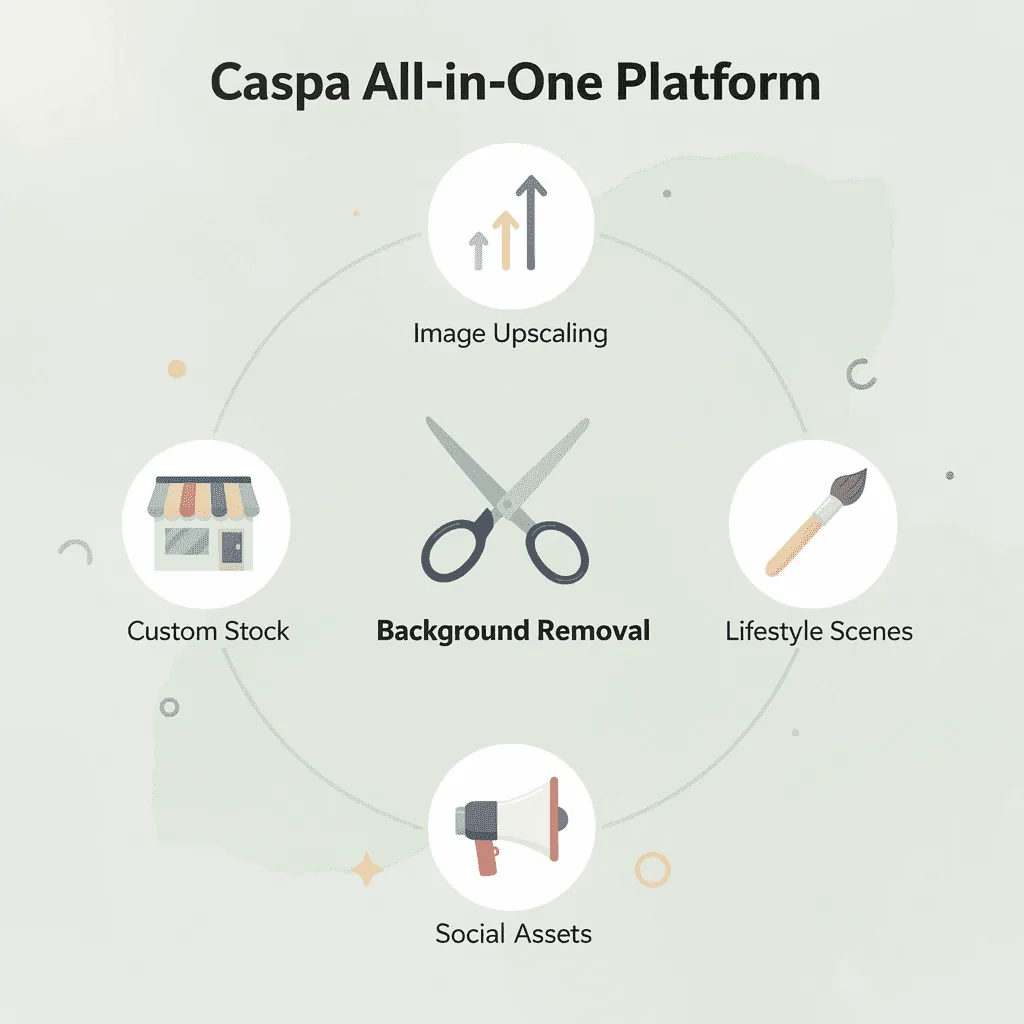
Beyond basic editing, Caspa offers custom stock photography and complete studio editing capabilities. White-background product images, lifestyle scenes, promotional graphics, and social media assets can all be created from a single platform rather than through multiple disconnected tools.
⚠️ Warning: Relying on multiple disconnected tools for creative production slows you down, compounds errors, increases costs, and creates inconsistent brand visuals across channels.
This streamlined workflow eliminates bottlenecks that slow growth. Instead of waiting days for photoshoots or revisions, teams produce professional visuals almost instantly, enabling faster testing of creative concepts, product page refreshes, and campaign adaptations.
🎯 Key Point: Speed isn't a convenience—it's a competitive advantage. Brands that refresh visuals rapidly can respond to trends, seasons, and performance data faster than competitors.
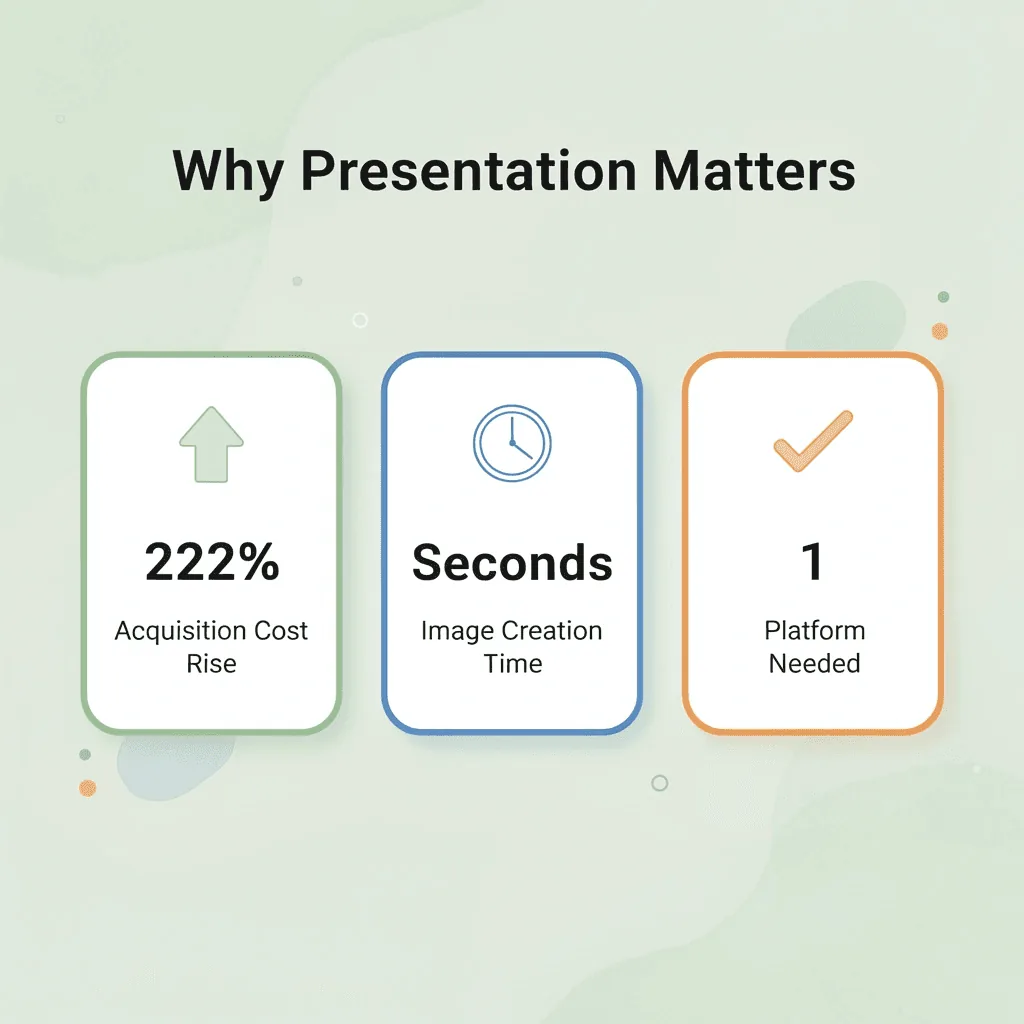
Stores that learn faster outperform those with larger budgets. Caspa increases creative output while lowering production costs, allowing brands to experiment continuously with different backgrounds, models, angles, and visual styles without limits imposed by time, budget, or capacity.
✅ Best Practice: Use Caspa's all-in-one platform to run ongoing creative experiments testing different models, backgrounds, and scenes, so your best-performing visuals are driven by data, not guesswork.
Related Reading
- Flat Lay Product Photography
- Redbubble Vs Printful
- Printful Vs Gelato
- Best Background For Product Photography
- Printify Vs Gelato
- Ai Clothing Mockup Generator
- Ai Product Video Maker
- Luxury Product Photography
- Merch On Demand
- Placeit Alternative
- Teespring Alternatives
- Advertising Product Photography
- Ecommerce Product Video
- Placeit Pricing
- T-shirt Mockup Ai
- Ai Clothing Model Generator
- Teespring Vs Printful
- Ai Fashion Model Generator
- Amazon Merch On Demand
- Amazon Ai Tools
- Ai Product Photo Editor