

Great product images drive sales, but shooting, editing, and managing hundreds of them is slow, expensive, and inconsistent. Automated ecommerce product photography is changing that, giving online sellers a faster way to produce professional visuals without the overhead of a traditional studio setup.
Caspa makes this possible through an AI-powered tool that generates clean, high-quality product images at scale, no photographer or editing queue required. More products get listed faster, and store owners spend less time on production and more time on growth, starting with smarter product photography.
Table of Contents
- Why Traditional Product Photography Slows Ecommerce Growth
- Why Manual Product Photography Is No Longer Enough
- What Automated Product Photography Can Actually Do
- The Biggest Benefits of Automated Product Photography
- Strong Ecommerce Brands Build Better Systems for Visual Content
- How Caspa Automates Product Photography Without Sacrificing Quality
- Get Product Photos that Increase Your Sales Today
Summary
- Traditional product photography timelines create measurable drag on ecommerce growth. According to Star İstanbul's Future of E-Commerce Product Photography report, a single product batch can take 2 to 3 weeks to move through a traditional shoot workflow. For brands managing dozens of SKUs across multiple marketplaces simultaneously, that delay means products sit unpublished while revenue potential goes unrealized.
- The volume of visual content required to stay competitive has grown significantly. Brands now need three times as much visual content as they did five years ago, according to LinkedIn Pulse, yet studio capacity has not kept pace with that demand. The result is a structural mismatch between what ecommerce growth requires and what traditional production pipelines can realistically deliver.
- Cost compounds the volume problem for smaller and mid-sized sellers. A single studio shoot can run between $500 and $1,500 per day, and that figure does not include reshoots, variation sessions, or the editing backlog that can stretch timelines by another week. Every product update or campaign variation adds another line item to an already strained budget.
- Visual inconsistency across a catalog quietly erodes customer trust over time. When images are produced across different studios, photographers, and editing setups, the brand's visual language fragments. This has direct commercial consequences: 22% of online product returns are attributed to items looking different in photos than in real life, according to Color Experts International.
- Purchase decisions depend heavily on image quality and volume. Research from Squareshot and Clipping Path Lab consistently shows that 75% of online shoppers rely on product photos when making a purchase decision, and products with six or more images see up to 27% higher conversion rates than those with fewer visuals. That data reframes photography as a sales infrastructure rather than a creative expense.
- Brands that systematize visual production gain a compounding competitive advantage. According to BrandQuad, brands with consistent visual content across digital shelves achieve up to 33% more repeat purchases, and better product visuals are associated with up to a 40% reduction in ecommerce returns. The operational discipline of maintaining that consistency at scale is where the real business case sits.
- Product photography addresses this by enabling the generation of channel-ready images at the volume and consistency required by modern ecommerce, without rebuilding the creative process for every campaign.
Why Traditional Product Photography Slows Ecommerce Growth
Traditional product photography was built for a slower world—quarterly campaigns, annual catalogs, weeks to prepare a shoot. Modern ecommerce doesn't work that way, and the gap between what traditional photography can deliver and what growth demands has become an operational liability.
"Traditional photography pipelines were designed for quarterly cycles — but modern ecommerce moves at the speed of daily demand, making slow content production a direct drag on revenue." — Ecommerce Operations Insight
🚨 Warning: If your product photography pipeline still takes weeks to execute, you're already falling behind competitors who can launch new visuals in a fraction of the time.
💡 Tip: Audit your current photography turnaround time — if it exceeds 5–7 days per product, your content production is actively throttling your ecommerce growth potential.
| Traditional Photography | Modern Ecommerce Demand |
|---|---|
| Quarterly campaign cycles | Daily content updates |
| Weeks of shoot preparation | Same-day asset delivery |
| High fixed costs per shoot | Scalable, low-cost production |
| Limited creative iterations | Unlimited visual variations |

How does the production timeline slow time-to-market?
The production timeline creates serious problems. According to Star İstanbul's Future of E-Commerce Product Photography report, traditional product photography takes 2 to 3 weeks per product batch, which slows time-to-market when speed is critical. For brands managing dozens of SKUs across Amazon, Shopify, and social channels, the delay compounds quickly. A product waiting for its photo shoot isn't generating revenue.
Why does the cost structure make scaling harder?
The cost structure makes scaling harder. Studio rentals, professional photographers, lighting equipment, models, and post-production editing multiply with every new product or variation. Small and mid-sized sellers face a choice: photography or payroll. This structural disadvantage is inherent to the traditional model.
Most teams batch shoots to reduce per-unit costs, then manage the resulting backlog. Product launches get delayed, seasonal campaigns miss their windows, and marketing teams spend energy on logistics rather than strategy. Platforms like Caspa replace the studio workflow with AI-generated product imagery, producing studio-quality visuals with human models and custom backgrounds in a fraction of the time, cutting production costs by up to 10x while maintaining brand consistency.
How does inconsistency across shoots damage catalog quality?
Consistency is its own problem. When shoots span different studios, photographers, and editing teams over months, product pages become a patchwork: lighting varies, backgrounds shift, and visual language drifts. According to Color Experts International, 22% of online product returns stem from items looking different in photos than in real life, reflecting inconsistent visual standards across catalogs.
Traditional photography fails not because photographers are careless, but because it was never designed for the volume, speed, and consistency that ecommerce at scale requires. Every delayed launch signals the model has hit its ceiling.
Related Reading
- Ecommerce Product Photography
- Ai Tools for E-commerce
- Printify Alternatives
- Photoroom Pricing
- Ecommerce Product Photography Services
- E-commerce AI Tools
- Printful Alternatives
- Best Ai Tools for E-commerce
- How To Sell On Shopify
- Redbubble Alternatives
- Ecommerce Product Videos
- Ecommerce Product Video
- Ecommerce Product Imagery
- Visual Merchandising Ecommerce
- Photoroom Cost
Why Manual Product Photography Is No Longer Enough
Manual product photography was built for a fundamentally different era of business. It assumes you have time, controlled variables, and a catalog that changes slowly enough to wait. None of those assumptions holds today.
💡 Tip: If your product catalog updates faster than your photography workflow can keep up, you're already falling behind competitors who've automated the process.
"Manual photography workflows were designed for a world where slow and steady won the race — but in modern ecommerce, speed-to-market is the competitive edge that separates thriving brands from stagnant ones."
⚠️ Warning: Relying on manual product photography in today's fast-moving market means risking outdated visuals, missed launch windows, and a catalog that never quite catches up to your actual inventory.
| Manual Photography | Modern Business Reality |
|---|---|
| Requires significant time per shot | Catalogs update constantly |
| Depends on controlled studio variables | Conditions and needs change rapidly |
| Built for slow catalog cycles | Brands need on-demand, scalable visuals |
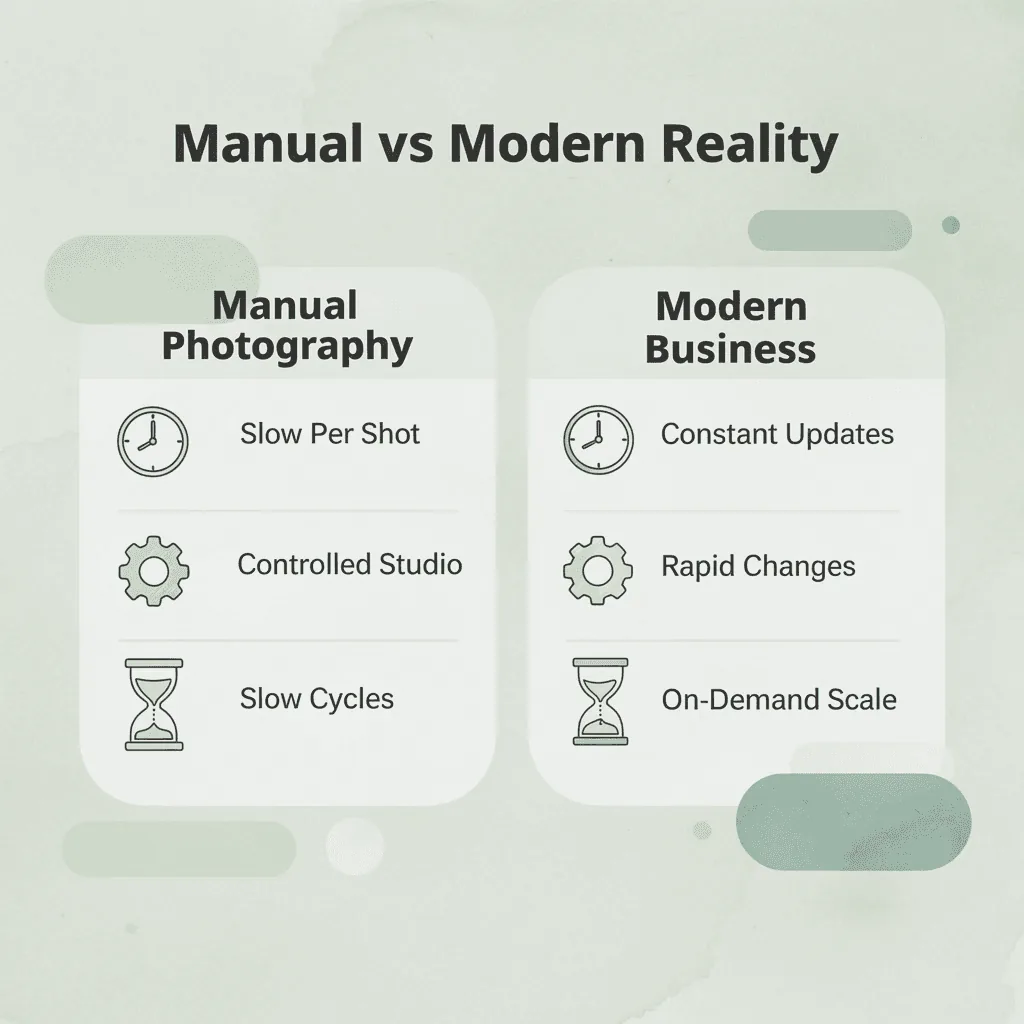
🎯 Key Point: Manual product photography is no longer a sustainable default — it's a bottleneck that modern businesses simply cannot afford to maintain.
Why can't studios keep up with the volume of modern content?
The volume problem is where strain first appears. According to LinkedIn Pulse, brands need three times as much visual content as they did five years ago to stay competitive across digital channels. A studio booked twice a year cannot serve a brand needing fresh images for paid ads, organic social, seasonal promotions, and marketplace listings simultaneously.
The cost structure exacerbates the problem. A single studio shoot costs between $500 and $1,500 per day, excluding reshoots for product changes, additional sessions for new backgrounds, or editing work that can delay delivery by another week. Every change costs money; every delay costs opportunity.
Most teams schedule shoots close together to reduce the cost per image, but this means catalogs show what was ready six weeks ago, not what customers need today. Platforms like Caspa solve this problem by creating studio-quality images with real models, custom backgrounds, and consistent branding in seconds instead of weeks, cutting production costs by up to 10x while maintaining product detail, logos, and text clarity.
How does visual inconsistency quietly erode brand equity?
The consistency issue quietly damages brand equity over time. When images come from different shoots, studios, and lighting setups, the visual language fractures. A customer seeing the same product on a product page, in an email, and in a social media ad might encounter three versions that feel like they belong to different brands.
What competitive advantage comes from faster, consistent imagery?
Speed and consistency create a compounding advantage. Brands that generate accurate, on-brand imagery quickly can test more ad creatives, respond to trends before they peak, and launch products without waiting for production windows. According to Clipping Path Lab, 75% of online shoppers rely on product photos when making purchase decisions, so every delayed or inconsistent image directly impacts revenue.
What most brands haven't reckoned with yet is what becomes possible when the production bottleneck disappears entirely.
What Automated Product Photography Can Actually Do
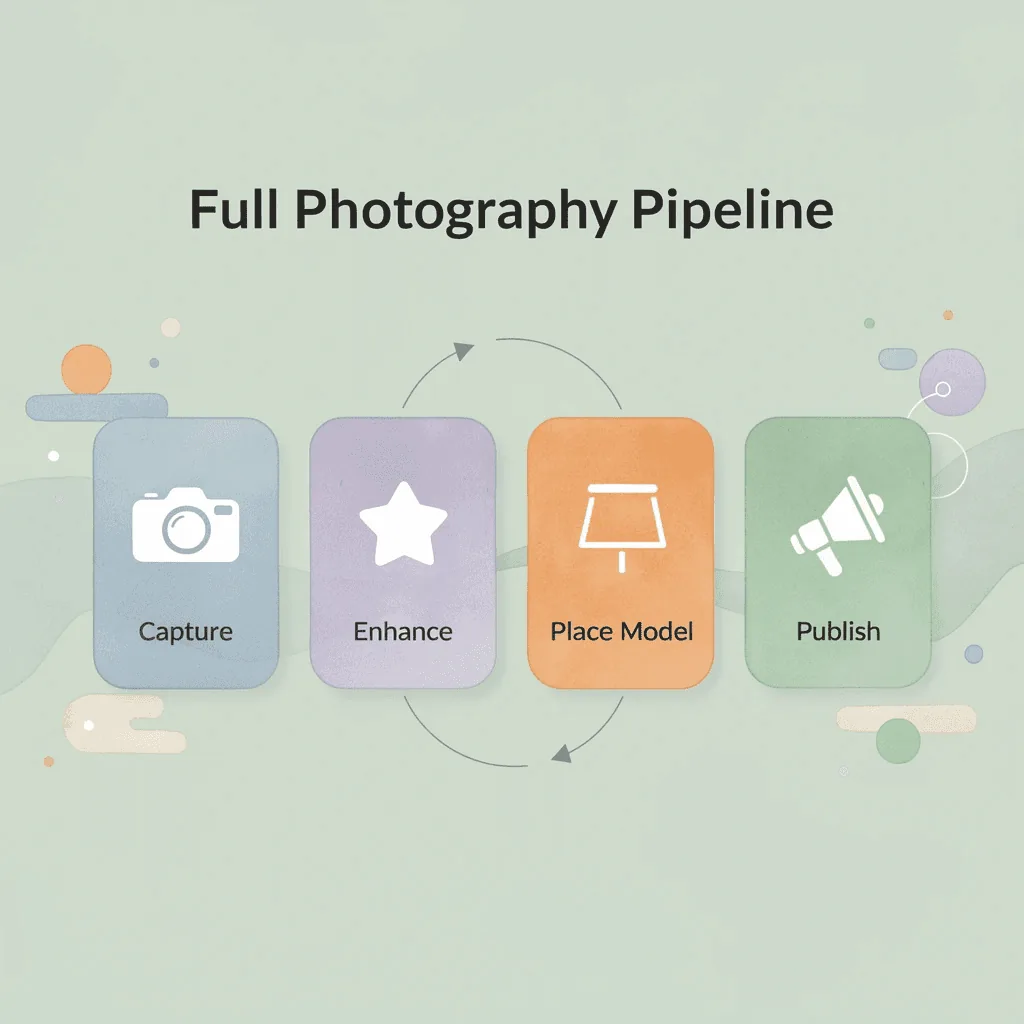
Automated product photography handles the full process of making pictures: creating studio-quality images from the beginning, putting products on human models, changing backgrounds, improving older pictures, and getting content ready for every channel at the same time. The production bottleneck disappears because the entire workflow compresses.
"The entire production workflow — from studio-quality creation to multi-channel delivery — compresses into a single automated process, eliminating the bottleneck entirely." — Key Industry Insight
| Capability | What It Replaces |
|---|---|
| Studio-quality image creation | Traditional photo shoots |
| Human model placement | Expensive model casting & sessions |
| Background swapping | Manual post-production editing |
| Legacy image enhancement | Costly reshoots of old product photos |
| Multi-channel content output | Separate formatting for each platform |
🎯 Key Point: Automated product photography doesn't just speed up one step — it compresses the entire production workflow from shoot to publish into a single streamlined process.
💡 Tip: If your team is still managing backgrounds, model shoots, and channel formatting as separate tasks, automation can collapse all of these into one unified pipeline — saving significant time and budget.
How does automation handle multiple image variations from a single shoot?
The same issue arises in fashion, home goods, and consumer electronics: brands need dozens of image variations per SKU, and traditional workflows treat each variation as a separate project, while automated systems treat them as a single task. One product image becomes a clean white-background shot for Amazon, a lifestyle scene for Instagram, and a high-resolution asset for a paid ad, all without scheduling a second shoot. PhotoRobot's research on robotic process automation found up to an 80% reduction in time spent on product photography workflows, freeing teams to redirect effort toward campaign strategy and creative development.
How does AI-generated lifestyle imagery replace full production crews?
AI-generated lifestyle imagery places products on human models in realistic settings with accurate lighting and proportions: work that once required a full production crew. Automation handles this composition in minutes, consistently across ethnicities, body types, and environments. For apparel and accessories, that consistency directly shapes whether customers can picture themselves using the product, where purchase decisions are made.
How can older product images be recovered without a full reshoot?
Most teams save older product images and plan for reshoot budgets that they often can't afford. Automated upscaling and enhancement tools recover those images, sharpening resolution and correcting lighting without starting over. Platforms like Caspa create entirely new, ultra-realistic images with precise logo and text consistency, letting brands move fast without sacrificing brand integrity.
What does automation mean for creative teams?
Automation doesn't reduce creative work—it redirects it. When production tasks run automatically, designers and marketers shift from image processors to storytellers. According to the Orbitvu Blog, e-commerce returns drop by up to 40% with improved product visuals. Better imagery isn't a branding expense; it's a returns management strategy with measurable payoff.
Why can't stock photography solve the differentiation problem?
Custom image generation solves a problem stock photography cannot: generic stock images are used by thousands of brands simultaneously, making it nearly impossible to stand out. Automated product photography creates visuals built around a specific product, audience, and brand identity—content that feels owned by the brand rather than borrowed from a shared library. This difference compounds as customers develop stronger visual connections with the brand.
The advantage lies not in what automation produces, but in what it unlocks in the decisions that follow.
The Biggest Benefits of Automated Product Photography
Automated product photography only delivers real value if the underlying images perform at the business level — not just the production level.
"The true measure of automated product photography isn't how fast images are produced — it's whether those images drive conversions, reduce returns, and scale revenue." — Industry Insight
🎯 Key Point: The biggest benefit of automation isn't just speed — it's the ability to produce consistently high-performing images that work harder for your business across every channel, every SKU, and every market.
💡 Tip: When evaluating automated photography solutions, always measure success by business outcomes — think conversion rate lift, return rate reduction, and time-to-market improvement — not simply how many images are produced per hour.
| Benefit | Business Impact |
|---|---|
| Consistent image quality | Builds trust and reduces buyer hesitation |
| Faster time-to-market | Gets products live sooner, capturing revenue earlier |
| Scalable production | Handles high SKU volumes without proportional cost increases |
| Reduced production costs | Frees budget for higher-value marketing activities |
| Cross-channel readiness | Images optimized for every platform from a single workflow |
What changes when speed meets quality
According to Squareshot, 75% of online shoppers rely on product photos when deciding on a purchase. This means photography is a sales tool, not a creative cost, and automation changes how much it costs to produce.
How does launch velocity shift when assets are generated in hours?
The most immediate benefit is speed to launch. When visual assets are created in hours rather than weeks, products reach customers while demand is still high. Seasonal windows, trending search terms, and competitor gaps close quickly. Brands that produce marketplace images, lifestyle scenes, and ad creatives simultaneously capture these opportunities; those waiting on studio availability miss them.
How does automated product photography handle catalog expansion at scale?
Product photography platforms like Caspa solve the problem of expanding your catalog by creating studio-quality images with different human models, accurate logos and text, and custom backgrounds in seconds. Our platform cuts production costs by up to 10 times while preserving the detailed product information that traditional photo shoots often lose.
Why does testing capacity matter more than most brands realize?
The second major benefit, rarely discussed honestly, is the ability to test at scale. Squareshot reports that products with high-quality images get up to 94% more views than those without. Brands capturing the most value run five variations to learn which hero shot, background, and lifestyle context converts best for their audience. Automation makes that testing volume financially and operationally realistic for the first time.
How does visual consistency compound into brand trust over time?
There is also a consistency benefit that builds over time. When visual assets come from different photographers, studios, and editing workflows, small inconsistencies accumulate. Customers often cannot articulate why a brand feels less trustworthy, but visual inconsistency across product pages, emails, and paid ads is frequently the culprit. Automated workflows standardize lighting, composition, and post-processing across all assets, so the brand looks consistent everywhere it appears.
Better systems produce better decisions, not just better images, and that realization points somewhere worth following.
Related Reading
- How To Sell On Amazon
- Printful Vs Printify
- Shopify Vs Woocommerce
- Ai For Product Photos
- Ai Generated Product Images
- Ai Product Photo Generator
- Amazon Vs Shopify
- Ai Product Video Generator
- Ai For Ecommerce
- Ai Clothing Model
- Shopify Vs Bigcommerce
- Printful Review
- Shopify Vs Amazon
- Ai Model For Clothing
- Ai Product Video
- Ai Fashion Model
- Printful Pricing
- Best Amazon Seller Tools
Strong Ecommerce Brands Build Better Systems for Visual Content
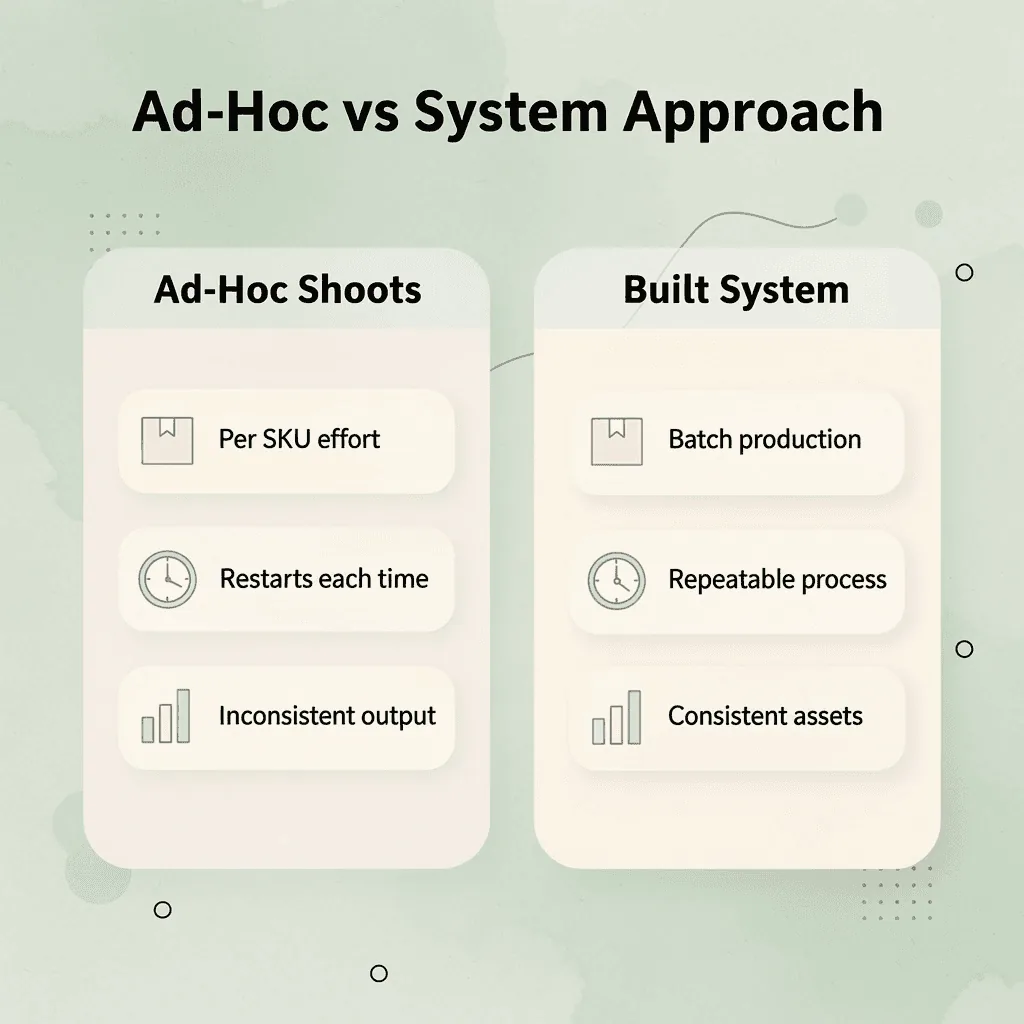
Strong ecommerce brands treat visual content as infrastructure, not output. The difference is whether the brand has built a repeatable system that produces consistent, high-quality assets across every channel and season without starting from scratch each time.
🎯 Key Point: Brands that treat visual content as infrastructure, not an afterthought, scale without breaking.
Volume breaks improvised processes. A brand managing 20 SKUs can survive on ad-hoc shoots. A brand managing 200 cannot. According to BrandQuad, brands with consistent visual content across digital shelves achieve up to 33% more repeat purchases — meaning operational discipline is a revenue decision, not an aesthetic one.
"Brands with consistent visual content across digital shelves achieve up to 33% more repeat purchases." — BrandQuad
🔑 Takeaway: That 33% lift in repeat purchases isn't a marketing win — it's a systems win. The brands capturing it have built scalable content operations, not just beautiful imagery.
| Approach | SKU Capacity | Consistency | Revenue Impact |
|---|---|---|---|
| Ad-hoc shoots | ~20 SKUs | Inconsistent | Limited |
| Repeatable system | 200+ SKUs | High | Up to 33% more repeat purchases |
⚠️ Warning: If your visual content process restarts from scratch every season, you're not running a brand — you're running a bottleneck.
What breaks when visual content production doesn't scale with the catalog?
Most teams batch shoots and distribute assets manually across channels, which breaks down as channel count grows, formats multiply, and seasonal deadlines overlap. Platforms like Caspa generate ultra-realistic product images with human models, custom backgrounds, and precise logo and text consistency, enabling brands to produce channel-ready assets without having to rebuild the creative process for each campaign.
Scaling brands separates creative direction from production execution. Strategy, brand identity, and campaign vision remain human-driven. Rendering, resizing, background replacement, and format adaptation become systematized. This separation enables speed without sacrificing quality and frees creative teams to think rather than repeat.
Why do visual depth and production speed compound competitive advantage?
BrandQuad also reports that products with six or more images see up to 27% higher conversion rates than those with fewer visuals. Success requires a complete visual story across multiple angles, contexts, and use cases, not a single main image. Brands that create this depth efficiently and maintain it across growing catalogs gain a structural advantage over competitors.
The critical difference between brands that stop growing and those that keep growing is whether the system behind assets can keep pace with ambition. When visual production is slow, every other marketing operation stalls. When it runs on a reliable, repeatable workflow, the whole business accelerates.
How Caspa Automates Product Photography Without Sacrificing Quality
Automated product photography creates professional-looking images at the speed that modern marketing needs. Caspa is an all-in-one AI product photography platform that helps ecommerce brands create, edit, and enhance product visuals without needing multiple tools, photographers, studios, or long production cycles.
"The future of ecommerce visuals is automation — brands that eliminate slow production cycles and high studio costs move faster, scale smarter, and convert better." — Industry Insight
💡 Tip: If your brand is still relying on traditional photography workflows, you're spending more time and money than necessary — Caspa consolidates the entire process into a single AI-powered platform.
🎯 Key Point: Caspa replaces the need for separate tools, photographers, and studios by delivering a complete, end-to-end solution for ecommerce product imagery — all in one place.
| Traditional Photography | Caspa AI Platform |
|---|---|
| Multiple tools required | All-in-one solution |
| Requires professional photographers | AI-powered generation |
| Long production cycles | Fast, automated output |
| High studio costs | No studio needed |
| Difficult to scale | Built for ecommerce scale |
How does Caspa generate studio-quality product images with AI?
At the center of Caspa is AI product photography. Our platform helps brands generate ultrarealistic product images that look professionally shot, making it easier to launch new products, refresh existing listings, and build consistent marketing campaigns without organizing traditional photo shoots.
For businesses that want to showcase products in real-world settings, Caspa supports ultrarealistic human models. Rather than relying solely on isolated product shots, our platform helps brands create lifestyle images that let customers visualize products being worn or used in everyday situations. These visuals add context, strengthen emotional appeal, and elevate the product's perceived value.
How does Caspa help brands get more from existing content?
Caspa helps businesses extract more value from existing content. Our AI-powered background removal creates clean, professional images suitable for ecommerce marketplaces, branded websites, and advertising campaigns, while image upscaling enhances resolution, keeping visuals sharp across every channel. Brands can generate custom stock images that align with their branding, producing original marketing assets that reinforce a consistent visual identity rather than relying on generic stock libraries that competitors may also use.
How does an all-in-one workflow reduce production costs and complexity?
By bringing all capabilities into one complete workflow, Caspa eliminates the need to switch between separate photography software, editing applications, stock image services, freelancers, and design tools. This reduces production costs, eliminates unnecessary complexity, and allows marketing teams to produce high-quality visuals more efficiently. As product catalogs grow and marketing demands increase, brands can create professional product images quickly without sacrificing consistency or quality.
Get Product Photos that Increase Your Sales Today
Try Caspa and see what your first session produces. In one sitting, you can transform existing product images into professional-quality marketing materials, create lifestyle photos with AI-placed human models across different backgrounds, and build a repeatable workflow that cuts production costs by up to 10x. Brands using Caspa have seen conversion lifts of up to 40% — not because the photos look polished, but because more of the right visuals reach the right buyers faster.
"Brands using Caspa have seen conversion lifts of up to 40% — not because the photos look polished, but because more of the right visuals reach the right buyers faster."
🔑 Takeaway: A single Caspa session can replace an entire traditional photo shoot — delivering AI-generated lifestyle imagery, human model placement, and a 10x reduction in production costs, all without a studio, crew, or camera.
💡 Tip: Don't wait for a full product catalog overhaul. Start with one hero product image in your first Caspa session — a 40% conversion lift begins with a single optimized visual.
| Traditional Product Photography | Caspa AI Workflow |
|---|---|
| High studio & crew costs | Up to 10x lower production costs |
| Days or weeks of turnaround | Single session turnaround |
| Limited background options | Multiple AI backgrounds available |
| Manual model booking required | AI-placed human models included |
| Inconsistent output at scale | Repeatable, scalable workflow |

Related Reading
- Teespring Alternatives
- Ai Product Photo Editor
- Flat Lay Product Photography
- Best Background For Product Photography
- Ai Clothing Model Generator
- T-shirt Mockup Ai
- Redbubble Vs Printful
- Teespring Vs Printful
- Luxury Product Photography
- Placeit Pricing
- Printify Vs Gelato
- Ai Clothing Mockup Generator
- Ai Product Video Maker
- Amazon Ai Tools
- Advertising Product Photography
- Amazon Merch On Demand
- Printful Vs Gelato
- Ecommerce Product Video
- Placeit Alternative
- Merch On Demand
- Ai Fashion Model Generator