
How To Sell on Amazon: A Guide for New and Growing Sellers

Selling on Amazon is more competitive than it looks. Thousands of sellers are chasing the same customers, and standing out requires more than a live listing. Pricing strategy, Amazon FBA logistics, inventory management, and optimized product detail pages all demand attention from day one. Knowing where to focus first makes the difference between gaining traction and getting lost in search results.
Among all the factors that drive clicks and conversions, visuals consistently separate high-performing listings from overlooked ones. Shoppers make fast decisions, and strong imagery builds the trust that turns browsers into buyers. For sellers serious about ecommerce product photography and selling on Amazon effectively, the quality of every image directly affects whether a customer chooses their product or a competitor's. Caspa helps sellers get that edge with standout product photography.
Table of Contents
Why Many New Amazon Sellers Struggle to Make Sales
Why Product Listings Often Determine Whether You Get Sales
How To Sell on Amazon: Step-by-Step Process
9 Proven Ways to Increase Amazon Sales
Common Mistakes That Prevent Amazon Sellers From Growing
How Caspa Helps Amazon Sellers Create High-Converting Product Images at Scale
Get Product Photos that Increase Your Sales Today
Summary
Listings with high-quality images convert at three times the rate of those with low-quality images, according to Analyzer Tools. That gap is not a marginal advantage. It reflects how quickly shoppers make trust decisions, often before reading a single word of the listing copy. Sellers who treat photography as a secondary concern are effectively handing conversions to competitors who invested in it first.
About 20% of new Amazon sellers fail within their first 90 days, and the pattern behind those failures is usually structural rather than accidental. Sellers choose products based on instinct rather than validated demand, then list them with weak images and generic copy. Amazon's A9 algorithm rewards listings that earn clicks and convert shoppers, so a poorly built listing loses visibility before it ever gets a fair chance.
Amazon can take up to 45% of a seller's revenue in combined fees, according to Seller Assistant Blog, which means conversion rate is not a vanity metric. It is the primary lever controlling whether any margin survives. A listing that attracts clicks but fails to convert wastes ad spend and erodes the already thin profit.
Products with optimized titles and bullet points see up to 30% higher conversion rates, according to Analyzer Tools. The distinction that drives this is whether copy describes features or explains outcomes. A bullet point that tells a shopper what a product is made of is not the same as one that tells them what problem it solves and why that matters to their specific situation.
Sellers who plateau on Amazon often share a common habit: focusing on traffic while ignoring conversion rate. A listing that pulls strong impressions but converts at 8% while the category average is 15% is losing roughly half its potential revenue every day. The fix is rarely more ad spend. It is almost always found inside the listing itself, in the images, copy, and pricing signals that either build or break shopper confidence.
U.S. sellers averaged more than $375,000 in annual sales in 2025, according to Amazon's Small Business Empowerment Report, and the sellers reaching those figures consistently treat their listings as living documents rather than finished products. Amazon's A/B testing tool lets brand-registered sellers test main images, titles, and A+ content against real traffic, and even a 5% conversion improvement compounded across a full catalog and a full year separates businesses that grow from those that plateau.
Product photography addresses this directly by giving sellers a way to close the visual gap between their listings and category leaders without the cost or timeline of traditional studio shoots.
Why Many New Amazon Sellers Struggle to Make Sales
Selling on Amazon is not hard to start; it is hard to succeed at. The marketplace rewards sellers who understand that a product listing is not a requirement but a sales argument. Most new sellers do not realize how many ways that argument can fail before a customer reads a word.
"The marketplace rewards sellers who understand that a product listing is not just a requirement — it is a sales argument that must be won before a customer ever clicks 'Add to Cart'."
⚠️ Warning: Most new sellers treat their listing as a formality, a box to check before going live. In reality, a weak listing is the #1 reason new sellers fail to generate consistent sales.
🎯 Key Point: Success on Amazon isn't about getting listed; it's about winning the argument your listing makes to every potential buyer who lands on your page.

How crowded is the Amazon marketplace for new sellers?
Competition is the first wall most sellers hit. With over 9.7 million registered sellers worldwide and more than 60% of Amazon units sold by third-party sellers, the platform is crowded. Your product sits next to dozens of near-identical options, and shoppers have no patience for confusion. According to Analyzer Tools, about 20% of new Amazon sellers fail within their first 90 days, a sign that early mistakes are significant problems.
The failure pattern is consistent: a seller picks a product on gut instinct, lists it with manufacturer photos and a generic title, then waits for sales that never materialize. Product selection without demand validation is one problem. The listing itself is another. Amazon's A9 algorithm rewards listings that earn clicks and convert shoppers. Weak keyword optimization, thin product descriptions, and low-quality images signal that the listing isn't worth promoting. Visibility collapses before the product gets a fair chance.
What is the real cost of a listing that does not convert?
The most underestimated cost on Amazon is not the referral fee or FBA fulfillment charge, but the invisible cost of a listing that does not convert. Seller Assistant Blog reports that Amazon can take up to 45% of a seller's revenue in combined fees, leaving minimal margins for error on conversion. A listing that attracts clicks but fails to convert wastes advertising spend and erodes already-tight profit margins.
New sellers often treat product photography as a late-stage task, but the hidden cost is real: listings without strong visuals lose clicks to competitors, which diminishes ranking signals and visibility over time. Platforms like Caspa let sellers generate ultra-realistic product photos and A+ content without a studio or photographer, cutting production costs by up to 10x. For solo sellers with tight margins, investing in professional visuals on day one transforms a launch's trajectory.
Why do reviews make it even harder to gain early traction?
Reviews add another layer of difficulty. Shoppers use ratings to decide whether to trust a seller, and new listings with zero reviews struggle to compete with established products that have months or years of customer feedback. Even well-organized listings with strong images can fail to convert without reviews. This is why sellers who understand the full picture invest early in every element of the listing: each piece either builds trust or breaks it. The listing itself is not merely a container for your product information.
Why Product Listings Often Determine Whether You Get Sales
Your listing is the decision environment where shoppers commit or walk away in seconds.
"Your product listing isn't just a page — it's your single most powerful sales tool, working around the clock to convert browsers into buyers."
🎯 Key Point: A weak listing doesn't underperform; it drives potential customers to your competitors.
💡 Tip: Treat every element of your listing — images, titles, descriptions, and pricing — as a critical lever that directly impacts your conversion rate.

Why do images decide the sale before shoppers read a word?
A shopper lands on your listing after viewing competing products. They decide in seconds: does this look trustworthy? Images answer that question before any text is read. According to Analyzer Tools, listings with high-quality images convert at three times the rate of those with low-quality images. That gap is the difference between a listing that earns its traffic and one that wastes it.
Many sellers spend weeks on keywords and pricing, then upload four flat photos shot on a kitchen counter. The listing ranks. Shoppers arrive. Nothing happens. Professional imagery communicates care, quality, and legitimacy in ways bullet points cannot match at first glance.
Most sellers improvise with a smartphone, a white sheet, and window light. But shoppers comparing your listing to a competitor's clear, contextual images will choose the one that feels more credible. Caspa addresses this directly, using AI to generate studio-quality product photos, infographics, and A+ content without a photographer or studio, reducing visual content costs by up to 10x compared to traditional photography.
How does written content convert shoppers once images earn the click?
Once images earn the click, written content carries its own weight. According to Analyzer Tools, products with optimized titles and bullet points see up to 30% higher conversion rates. A bullet point explaining why a feature matters to someone with a specific problem outperforms one that merely lists the feature.
Why does a poorly converting listing become a ranking liability?
A listing that ranks on page one but converts poorly is a liability. Amazon's algorithm reads conversion performance as a signal of listing quality, so weak listings gradually lose their rankings. Every element either builds momentum or erodes it. The real question is not whether your listing is good enough, but whether it outperforms the listing directly next to yours.
Related Reading
How To Sell on Amazon: Step-by-Step Process
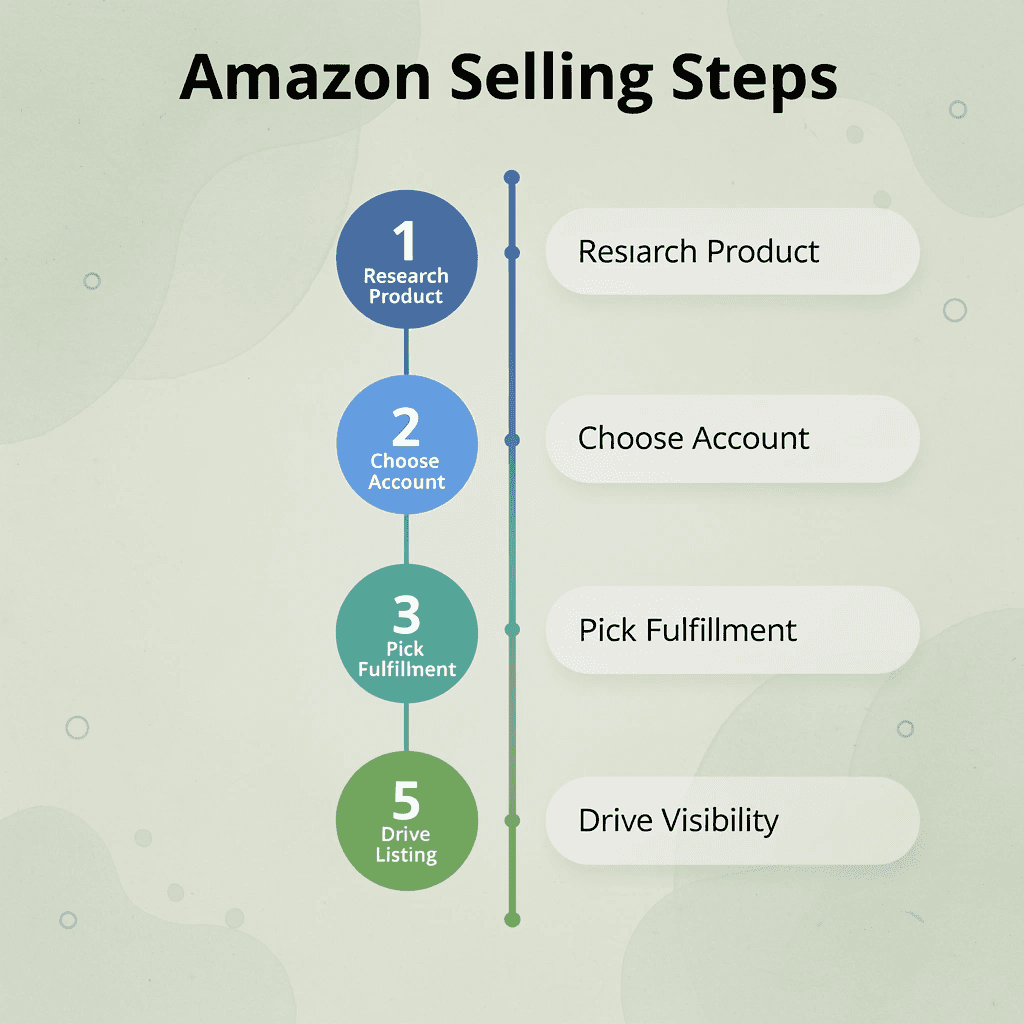
Selling on Amazon requires following a structured sequence to succeed: research a product that people really want to buy, set up the right account type, choose a fulfillment model that works with your profits, build a listing that converts customers, and invest in visibility.
"Sellers who follow a structured, step-by-step process are significantly more likely to build a profitable, sustainable Amazon business than those who skip critical setup stages." — Amazon Seller Best Practices
Step | Action | Why It Matters |
|---|---|---|
1. Product Research | Find high-demand, profitable products | Validates your entire business model |
2. Account Setup | Choose the right seller account type | Determines your fee structure and access |
3. Fulfillment Model | Select FBA, FBM, or SFP | Directly impacts your profit margins |
4. Listing Creation | Build a high-converting product page | Drives clicks and sales |
5. Visibility Investment | Run ads and optimize SEO | Puts your product in front of buyers |
💡 Tip: Never skip the product research phase — it is the single most critical step that determines whether your Amazon business succeeds or fails before you spend a dollar.
⚠️ Warning: Choosing the wrong fulfillment model early on is one of the most common and costly mistakes new sellers make — always calculate your profit margins before committing to a model.
Why do sellers choose products the market doesn't want?
Product research determines everything that follows. The critical failure: sellers choose products they personally like rather than products the market actively buys. Before spending money, evaluate search volume trends, competitor review counts, pricing benchmarks, and realistic profits after Amazon fees, shipping, and advertising. A product with strong demand but thin profits is a trap.
Which Amazon selling plan actually supports growth?
Once you have a working product, choose your Amazon plan: Individual for sellers with low sales, or Professional, which includes a monthly fee but provides access to advertising tools, detailed reports, and bulk listing. Most growing sellers choose Professional early to gain access to advertising. According to Amazon Seller Central, more than 60% of sales in Amazon's store come from independent sellers, meaning the platform rewards execution over brand size or budget.
Fulfillment, listings, and the visual gap
Fulfillment by Amazon (FBA) connects your products to Prime customers seeking fast delivery, while Fulfillment by Merchant (FBM) gives you control and works better for oversized or slow-moving products where FBA storage fees would erode your profits. The choice comes down to your margins.
What makes a listing convert instead of collapse?
Your listing determines success or failure. Titles need keywords your buyers actually search for. Bullet points should answer: "What does this do for me?" Backend search terms help more people find your product without cluttering what customers read. Sellers who neglect listing copy end up spending money on ads and wondering why conversions lag.
Most sellers use a single manufacturer's image for product photography. Today's shoppers decide in less than three seconds, and flat, boring images signal low quality before anyone reads a word. Platforms like Caspa let sellers create studio-quality product photos, lifestyle images, and infographics without a photographer or studio, cutting production costs by up to 10x while matching the visuals that top sellers in the category offer.
How does the launch window determine early momentum?
PPC advertising helps your listing gain visibility during the initial weeks before reviews accumulate. Promotions and coupons drive purchases and accelerate sales velocity, signaling relevance to Amazon's algorithm. Reviews take time to build, and the launch window is critical—even one negative review can derail momentum before it builds. Top-performing sellers launch with polished listings that compel early customers to buy.
9 Proven Ways to Increase Amazon Sales
Selling more on Amazon comes from nine improvements that build on each other. Each one makes a different part of the customer journey better until the whole system works for you.
"Success on Amazon is never the result of a single fix — it's the compounding effect of nine strategic improvements, each one strengthening the next."
🎯 Key Point: These nine strategies don't work in isolation — they form a connected system where every improvement amplifies the others, turning individual wins into sustained sales growth.
💡 Tip: Start by identifying your weakest link in the customer journey — that's where your biggest opportunity for immediate gains lives.
Improvement Area | Part of Journey It Optimizes |
|---|---|
Listing Optimization | Discovery & First Impression |
Keyword Strategy | Search Visibility |
Pricing Tactics | Purchase Decision |
Review Generation | Trust & Social Proof |
Image Quality | Engagement & Conversion |
A+ Content | Brand Storytelling |
Advertising (PPC) | Paid Traffic & Reach |
Inventory Management | Fulfillment & Availability |
Customer Experience | Retention & Loyalty |

1. Optimize Product Titles for Search
Your product title serves two purposes: it signals to Amazon's algorithm what your listing contains, and it persuades customers to click. Most sellers fail by prioritizing one goal over the other—either stuffing keywords until the title appears broken, or crafting something appealing that search filters never surface to customers. Balance specificity with readability. Start with your primary keyword, then add the most important detail that helps someone decide to buy (size, material, compatibility, or use case), and stop before the title sounds unnatural.
2. Use Better Product Images
Before a shopper reads a single word of your listing, they've made a preliminary judgment based on your main image. That first visual impression determines whether they click or scroll past.
Why does image quality affect conversion numbers?
The standard that most sellers accept—a product on a white background, one angle, and good lighting—follows the rules but doesn't boost sales. Strong images show the product from multiple angles, clearly display texture and size, and communicate quality through visual detail alone. According to OLBUZ, most sellers see improvements within 30 to 60 days after optimizing listings and running PPC campaigns, with image quality consistently ranking among the first factors to improve conversion rates.
3. Add Lifestyle Photography
Regular product photos build trust. Lifestyle photos drive purchase intent. Listings using only one photo type miss sales opportunities.
What does lifestyle photography actually do for a listing?
A lifestyle image answers an unspoken question: "Where does this fit in my life?" A yoga mat in a sunlit studio, a ceramic mug held on a winter morning, a cable organizer on an actual desk. These images show the outcome of owning the product: the emotional bridge that converts browsing into buying.
How can sellers add lifestyle images without breaking the budget?
Most sellers skip lifestyle photography because booking a studio and hiring a photographer cost hundreds of dollars per SKU. Platforms like Caspa generate ultra-realistic lifestyle images using AI, reducing production costs by roughly 10x compared to traditional shoots. For sellers who manage multiple listings or frequently launch products, this cost structure makes lifestyle photography feasible.
4. Write Customer-Focused Bullet Points
Bullet points usually fail because they list features from the manufacturer's perspective rather than what buyers care about. "Stainless steel construction." "12-inch diameter." "BPA-free." These facts describe the product without explaining why they matter to you. Reframe every bullet point around a result. "Stainless steel construction" becomes "holds temperature for 8 hours, so your coffee is still hot when you get to drink it." The feature stays the same, but now the benefit is clear: the shift that moves a hesitant browser toward a confident purchase decision.
5. Build Social Proof Through Reviews
Reviews spread trust. When shoppers don't know your brand, they gain confidence from others' experiences. A product with 200 reviews at 4.6 stars appears proven, while one with 4 reviews at 4.8 stars seems uncertain, despite the higher rating. Building a collection of reviews requires consistent product quality and customer engagement from day one. Amazon's Request a Review tool is the easiest approved way to ask for feedback after purchase confirmation.
6. Price Strategically
Competing on price alone destroys margins and invites a race to the bottom. The durable strategy is pricing to reflect perceived value, not competitive position. Perceived value is shaped by everything the shopper sees before reading the price: image quality, review count, listing completeness, and brand presentation. A product that looks premium, is described clearly, and has strong social proof can command a higher price than an identical product with a weak listing. Price is the last thing a shopper evaluates, after visual quality and trust have already established their effect.
7. Use Amazon PPC Advertising
Building organic ranking takes time. PPC advertising buys visibility while that process unfolds. Sponsored Products campaigns place your listing directly in front of shoppers already searching for what you sell. Most new sellers view PPC as a cost rather than an investment with measurable returns. A well-structured campaign with focused keyword targeting and regular bid adjustments creates sales velocity that supports organic ranking growth. Advertising performance influences organic positioning, thereby reducing long-term cost per sale.
8. Monitor Inventory Carefully
When you run out of stock, sales stop, and your Amazon ranking suffers. The algorithm interprets stockouts as a sign of unreliability. Recovering your previous position in competitive categories takes longer than the stockout itself. Top sellers treat inventory forecasting as a core business function. They track weekly sell-through rates, account for supplier lead times, and build buffer stock before peak periods. Consistent execution of this discipline separates sellers who scale from those who stall.
9. Continuously Test and Improve Listings
The Amazon 2025 Small Business Empowerment Report found that U.S. sellers averaged more than $375,000 in annual sales. Top performers treat their listings as living documents, not finished products.
How does A/B testing turn small gains into compounding growth?
Amazon's A/B testing tool (Manage Your Experiments) lets brand-registered sellers test main images, titles, and A+ content against one another using real traffic data. A 5% improvement in conversion rate on a listing generating 1,000 visits per month compounds across a full catalog and year, making the difference between growth and stagnation.
Which variables should you test first for the clearest results?
The most important elements to test are the main image, lifestyle images, title structure, bullet points, and competitive pricing. Testing one element at a time yields clear data; testing everything simultaneously creates confusion. The fastest-growing sellers know which levers to pull and which mistakes quietly work against them.
Common Mistakes That Prevent Amazon Sellers From Growing
Sellers who stop making progress on Amazon usually share one thing in common: they stopped examining the mistakes they couldn't see.
"The most damaging errors aren't the obvious ones: they're the ones that look like normal operating procedure." — Hunter H., LinkedIn
🎯 Key Point: The invisible mistakes compound quietly. By the time you notice them, the damage is already done.

The most damaging errors aren't the obvious ones. Mispriced inventory or a missing keyword is fixable in an afternoon. The harder problems are the ones that look like normal operating procedure. According to Hunter H. on LinkedIn, there are 12 common Amazon selling mistakes that consistently cost sellers sales. Sellers often don't recognize the problem until data has been quietly declining for weeks — by which time a competitor has already captured the ranking.
Mistake Type | Visibility | Time to Detect |
|---|---|---|
Mispriced inventory | ✅ Obvious | Hours |
Missing keyword | ✅ Obvious | Afternoon |
Structural/process errors | ⚠️ Hidden | Weeks or longer |
⚠️ Warning: If your sales data is quietly declining, don't assume it's a market shift — 12 common, fixable mistakes may already be handing your ranking to a competitor.
🔑 Takeaway: The 12 mistakes Hunter H. identifies aren't edge cases — they're routine blind spots that sellers at every level overlook until the ranking loss is already done.
Where differentiation breaks down
The failure point is usually at the product level, not the listing level. Sellers enter categories with nearly identical products, then attempt to out-optimize their way to growth through bidding and keyword targeting. This works until someone with a better product or stronger visual identity enters the space. Differentiation doesn't require a completely new invention: better packaging, a cleaner brand story, or images that show the product doing something competitors' images don't all work. The listing becomes the argument for why your product deserves the sale, and a weak argument loses even when the product is solid.
How does closing the visual gap affect conversions?
Most sellers use whatever photos are available: supplier images, phone pictures, or generic white-background shots. Every competing listing looks identical. Platforms like Caspa create ultra-realistic product photos, lifestyle images, and infographics without a studio or large budget. The product reduces production costs by up to 10x compared to traditional photo shoots. When your listing matches the category leader's, customers are more likely to buy from you.
The conversion trap nobody talks about
Focusing only on traffic is one of the most expensive habits in ecommerce. A listing that pulls strong impressions but converts at 8% while the category average is 15% loses roughly half its potential revenue daily. The fix isn't more ad spend—it's usually the listing itself: images that don't communicate value, bullet points that describe features rather than outcomes, or a price that signals the wrong tier. Responding to customer complaints within 24 hours protects reviews, which directly influence conversion rates in ways no amount of traffic can compensate for.
Why do consistent sellers treat every listing element as a variable?
Sellers who grow consistently treat every element of their listing as a conversion variable and test it with discipline. Performance data reveals what's broken. Keyword rankings show where you're invisible. Return rates indicate whether your product matches the expectations your images created. Ignoring these metrics creates blind spots that compound over time. The gap between a listing that converts and one that doesn't often comes down to something visual.
Related Reading
Ai For Product Photos
Ai Generated Product Images
Ai Product Photo Generator
Amazon Vs Shopify
Ai Product Video Generator
Ai Clothing Model
Printful Review
Shopify Vs Amazon
Ai Model For Clothing
Ai Product Video
Ai Fashion Model
Printful Pricing
Best Amazon Seller Tools
How Caspa Helps Amazon Sellers Create High-Converting Product Images at Scale
Product images play a significant role in Amazon's success. Shoppers make buying decisions in seconds, and poor images reduce clicks, weaken trust, and hurt conversions.
"Shoppers make buying decisions in just a few seconds — making every pixel of your product imagery a critical factor in whether a listing wins or loses." — Amazon Seller Insights
💡 Tip: Even marginal improvements in image quality can boost your click-through rate and conversion performance.
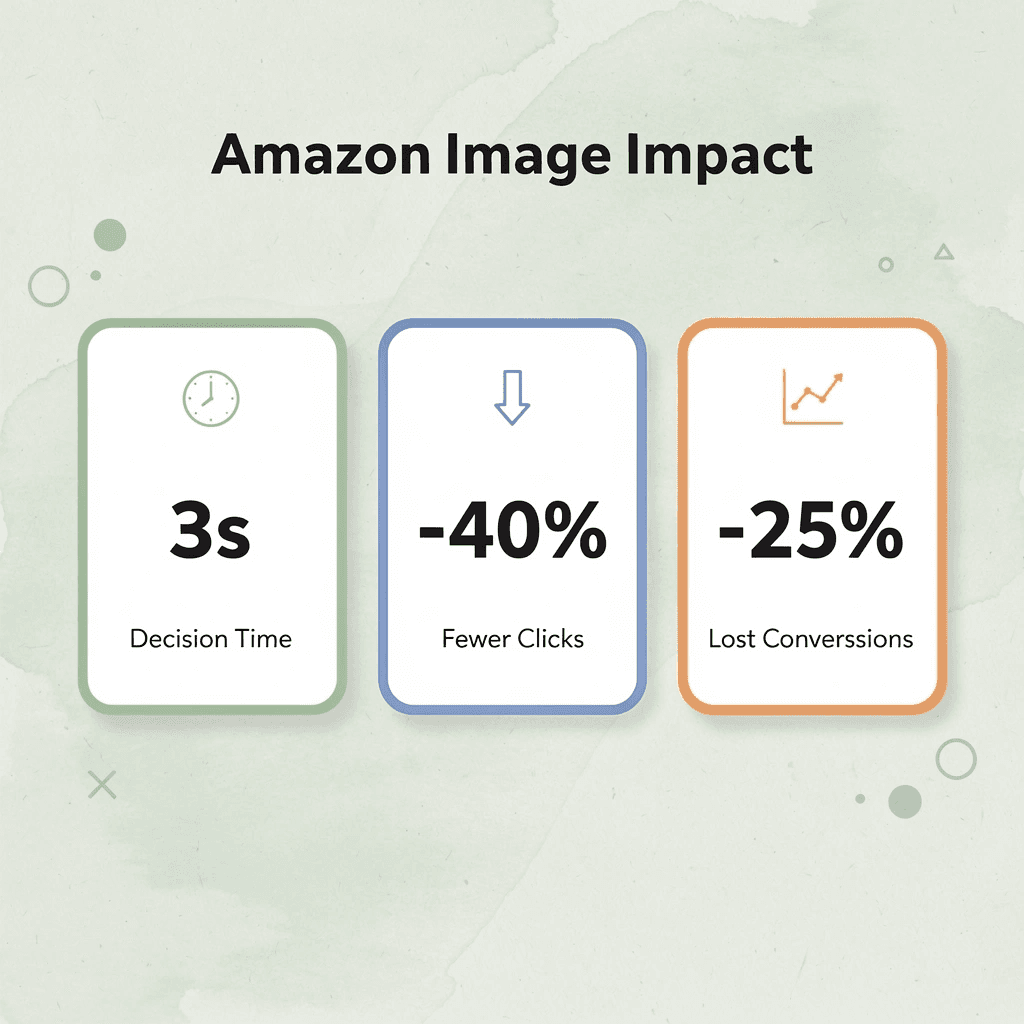
Professional product photography is expensive, takes a lot of time, and is hard to grow — especially when you need multiple versions, lifestyle images, advertising creatives, and listing updates. As catalogs get bigger, creating enough high-quality visuals for every listing becomes increasingly challenging.
Challenge | Impact on Sellers |
|---|---|
High photography costs | Limits visuals to top SKUs only |
Long production timelines | Delays new listing launches |
Scaling across catalogs | Creates inconsistent image quality |
Multiple creative formats needed | Strains time and budget resources |
⚠️ Warning: Relying solely on traditional photoshoots means your image production will never keep pace with a growing catalog — leaving listings under-optimized and revenue on the table.
Caspa is an AI-powered product photography platform that helps Amazon sellers create professional, Amazon-ready imagery faster and more efficiently. Rather than relying solely on traditional photoshoots, sellers can generate a wide range of visuals designed to improve listing performance and support marketing efforts.
🎯 Key Point: Caspa removes the bottleneck in Amazon selling — visual content production — so sellers can scale their imagery output without scaling costs.
✅ Best Practice: Use AI-generated imagery alongside your core product shots to rapidly produce lifestyle visuals, A/B test creatives, and keep every listing in your catalog fully optimized.

What types of product visuals can Caspa generate for Amazon listings?
Caspa's AI-powered photography transforms existing product photos into polished, professional images suitable for Amazon listings, eliminating the time and cost of traditional photography. Lifestyle image generation lets sellers place products in realistic environments and real-world situations, helping shoppers visualize products in actual settings and creating more engaging listings. Human model image creation produces visuals with realistic models using products. These images communicate scale, demonstrate product use, and showcase benefits without expensive model shoots.
Background replacement lets sellers quickly change images for different campaigns, branding needs, or marketplace guidelines. You can create new versions in minutes rather than taking new photos. Image enhancement and upscaling improve existing photos by sharpening details, enhancing lighting, increasing resolution, and refining the overall appearance. This maximizes value from current photos while maintaining a professional look.
How does Caspa help sellers test, scale, and reduce photography costs?
Caspa helps create custom visuals for listings and advertisements, including branded images, promotional creatives, and feature callouts that make products stand out from competitors. Successful Amazon sellers continuously improve their listings, and Caspa allows quick testing of multiple image variations. Rather than waiting for new photo shoots, sellers can try different visual approaches and see what customers prefer.
This flexibility reduces the need for expensive traditional photo shoots, eliminating the need to coordinate photographers, studios, locations, props, and models for every update or launch. As catalogs grow, Caspa's ability to scale becomes critical, enabling sellers to produce consistent, high-quality images across hundreds or thousands of products while maintaining a professional brand presence.
Get Product Photos that Increase Your Sales Today
The gap between a listing that gets scrolled past and one that converts is rarely about price—it's about what the buyer sees first. If your visuals aren't doing that work, no amount of keyword tuning will close the distance.
"The difference between a listing that converts and one that doesn't is rarely price — it's the first visual impression that stops the scroll." — E-Commerce Best Practices
💡 Tip: Before adjusting your ad spend or SEO strategy, audit your product images first. They're the most influential factor in a buyer's split-second decision.

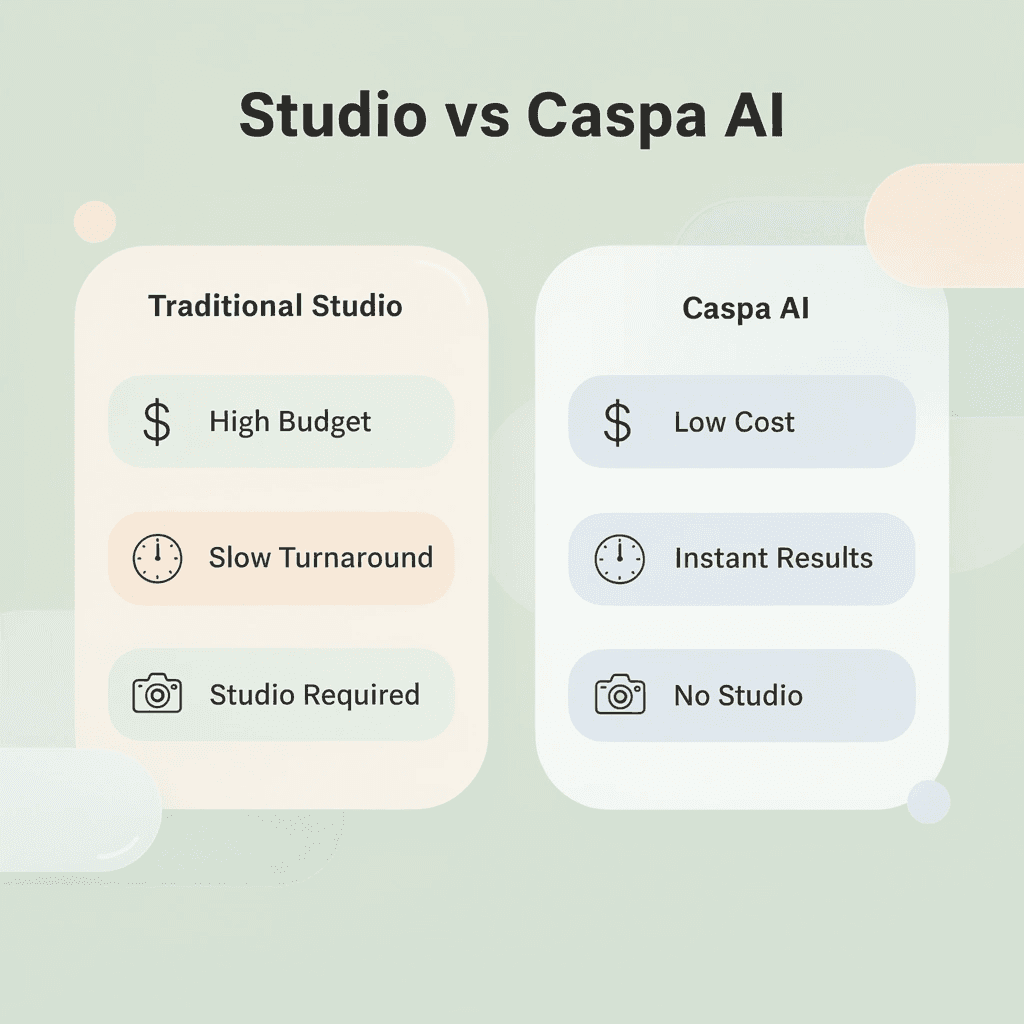
Product photography through Caspa lets you generate professional product photos, lifestyle imagery, and A+ content without a studio or large budget, helping your listing compete visually from day one.
Traditional Product Photography | Caspa AI Photography |
|---|---|
High-cost studio setup | No studio required |
Days or weeks of turnaround | Results from day one |
Limited lifestyle scene options | Unlimited lifestyle imagery |
Requires a large production budget | Works on any budget |
Manual editing and reshoots | AI-generated, ready to publish |
🎯 Key Point: Caspa removes every traditional barrier to professional product visuals — no studio, no crew, no bloated budget required.
Your next sale is waiting. Give it something worth stopping for.
✅ Best Practice: Pair compelling lifestyle imagery with A+ content to create a listing experience that builds buyer confidence and drives higher conversion rates from the first click.
Related Reading
Best Background For Product Photography
T-shirt Mockup Ai
Placeit Alternative
Ai Clothing Mockup Generator
Amazon Merch On Demand
Ai Clothing Model Generator
Flat Lay Product Photography
Placeit Pricing
Ai Product Video Maker
Printful Vs Gelato
Amazon Ai Tools
Teespring Alternatives
Ai Fashion Model Generator
Advertising Product Photography
Luxury Product Photography
Printify Vs Gelato
Redbubble Vs Printful
Merch On Demand
Teespring Vs Printful
Ecommerce Product Video
Ai Product Photo Editor