

Online shoppers cannot touch, try, or test a product before buying, which means visuals carry the full weight of the purchase decision. That gap between curiosity and confidence is where most sales are won or lost, making ecommerce product photography and video essential tools for any brand competing for attention.
Producing high-quality product visuals does not have to require a large budget or a full production crew. Brands looking for a faster, more affordable starting point can explore Caspa's AI-powered product photography to generate studio-quality images and video-ready assets in minutes.
Table of Contents
- Why Great Products Still Struggle to Convert Online
- What Is an Ecommerce Product Video?
- Benefits of Using Ecommerce Product Videos
- What Makes an Effective Ecommerce Product Video?
- How to Create Ecommerce Product Videos Without a Large Production Budget
- How Caspa Helps Ecommerce Brands Create Product Videos Faster and at Lower Cost
- Get Product Videos that Increase Your Sales Today
Summary
- Cart abandonment rates average around 70% across ecommerce sites, according to Envive AI's 2026 ecommerce conversion research. That figure reflects shoppers who got close to purchasing, felt uncertain, and left. The gap is rarely a product problem. It is a communication problem in which the page fails to answer the questions a buyer needs answered before committing.
- Mobile ecommerce conversion rates are typically 2x lower than desktop rates, and content quality is a significant factor in that gap. Mobile shoppers scroll fast and have little patience for product pages that require effort to understand. Short product demo clips and contextual lifestyle imagery do the explanatory work in seconds, reducing the cognitive load that causes mobile shoppers to abandon before converting.
- 96% of people have watched an explainer video to learn more about a product or service, according to HubSpot's Video Marketing Statistics. Reading a spec sheet requires imagination and effort. Watching a product in motion requires neither. That reduction in cognitive effort directly drives purchase confidence and explains why video consistently outperforms static content at the decision stage.
- Shoppers who view videos are 1.81x more likely to purchase than non-video viewers, according to SellersCommerce. That lift comes from video's ability to answer tactile questions that copy and photography cannot address, including how something fits, folds, absorbs, or functions in a real environment. Fewer unanswered questions at the decision point means fewer abandoned carts and fewer returns driven by mismatched expectations.
- Product videos can increase conversions by up to 80% on landing pages, according to Commerce-UI's research, and a single well-executed video compounds that return across paid social, email, marketplace listings, and retargeting ads simultaneously. The efficiency argument is underrated. Brands producing consistent video content across multiple touchpoints from a single asset are outperforming larger competitors with slower, more complex production pipelines.
- 89% of consumers say watching a video convinced them to buy a product or service, according to SundaySky's 2025 video marketing research, and lifestyle-context demonstrations are a primary driver of that influence. Shoppers are not watching to learn specifications. They are watching to be certain the product will work for their specific situation, which is why showing a product solving a real problem in a real environment consistently outperforms showing the product in isolation.
- Product photography addresses this by providing brands with the foundational visual assets before any video production begins, since strong demo clips and lifestyle content depend on high-quality imagery as their starting point.
Why Great Products Still Struggle to Convert Online
Having a great product is necessary. It is not enough.
"A great product without great presentation is a missed opportunity — doubt fills the gap where confidence should be." — E-commerce Conversion Principle
🎯 Key Point: Product quality alone does not guarantee online sales. How you present that product is equally critical to converting browsers into buyers.

Online shoppers face a unique worry that in-store shoppers never do. They cannot pick up the product, feel how heavy it is, check the stitching, or watch it work right in front of them. All they have is what you show them on the page. When that content is thin or only shows flat angles on a white background, doubt fills the gap — and doubt kills the sale.
💡 Tip: Replace flat, single-angle images with rich, multi-perspective content — think texture close-ups, in-use demonstrations, and scale references — to eliminate the uncertainty that stops shoppers from clicking Buy.
⚠️ Warning: Thin product content is one of the most overlooked causes of abandoned carts and low conversion rates — never assume a good product will "speak for itself" online.
| In-Store Shopping | Online Shopping |
|---|---|
| Can physically handle the product | Relies entirely on page content |
| Feels weight and texture firsthand | Needs close-up imagery and descriptions |
| Watches the product work in real time | Depends on video demos or GIFs |
| Asks staff questions instantly | Needs FAQs and detailed specs |
| Leaves with zero doubt | Leaves if doubt is not resolved |
What is the real reason shoppers abandon before buying?
The failure point is usually not the product itself, but the information gap between what a shopper needs to feel confident and what the brand provides. According to Envive AI's 2026 ecommerce conversion research, cart abandonment rates average around 70% across ecommerce sites. This reflects millions of shoppers who got close, felt uncertain, and left. A product page that cannot answer "how does this work?" or "how big is it?" teaches customers to leave.
Most brands invest in cleaner photography, tighter copy, or better pricing. But they solve for looks and cost when the actual problem is how the product feels to use. Shoppers need to see products move, stretch, pour, fold, or fit—not static images. Platforms like Caspa's AI product photography address this directly, generating video-ready assets, lifestyle visuals with human models, and contextual product content without studio shoots or five-figure budgets.
How does showing a product in context change conversion outcomes?
Brands that show their product solving a real problem in a real environment consistently outperform those that only show what it looks like. A supplement brand showing a morning routine converts better than one showing a bottle on a marble surface. A tool brand showing assembly in thirty seconds converts better than a four-angle carousel. The content that closes sales answers the buyer's unspoken question: "Will this actually work for me?"
According to Envive AI, mobile ecommerce conversion rates are typically 2x lower than desktop rates, partly due to content. Mobile shoppers scroll and decide faster, with less patience for pages requiring effort to understand the offer. Rich visual content—especially short product demo clips and contextual lifestyle imagery—explains the offer in seconds.
Is a poor product page really a communication problem?
The gap between a great product and a converting product page is almost always a communication problem, not a product problem. What you sell matters. How clearly you show it matters more.
But understanding why products fail to convert is only half the picture. What changes when you determine what an ecommerce product video should accomplish?
Related Reading
- Ecommerce Product Photography
- Ai Tools for E-commerce
- Printify Alternatives
- Photoroom Pricing
- Ecommerce Product Photography Services
- E-commerce AI Tools
- Printful Alternatives
- Best Ai Tools for E-commerce
- How To Sell On Shopify
- Redbubble Alternatives
- Ecommerce Product Videos
- Automated Product Photography
- Ecommerce Product Imagery
- Visual Merchandising Ecommerce
- Photoroom Cost
What Is an Ecommerce Product Video?
An ecommerce product video is a short video made for one specific job: helping an online shopper decide whether to buy. It lives on product pages, marketplaces like Amazon, social feeds, and paid ad placements. Its purpose is to answer the questions a shopper is already asking — before they leave.
"The ecommerce product video exists for a single mission: convert hesitation into confidence at the exact moment a shopper is deciding."
🎯 Key Point: An ecommerce product video is not a brand film or a commercial — it's a conversion tool built specifically for the online shopping moment.
💡 Tip: Think of your product video as a virtual sales rep — it should answer the real questions shoppers have about fit, function, and feel before they ever reach checkout.
| Video Placement | Primary Purpose |
|---|---|
| Product Pages | Build confidence, reduce returns |
| Amazon & Marketplaces | Stand out, answer buyer questions |
| Social Feeds | Drive discovery and clicks |
| Paid Ad Placements | Convert cold audiences fast |

How does a product video differ from traditional advertising?
Traditional advertising creates desire. Product video resolves doubt. A brand campaign might show a runner crossing a finish line at sunrise. A product video demonstrates how the shoe's lacing system works, how the sole compresses underfoot, and what the fit looks like on an actual person. One builds feeling. The other builds confidence. Only one closes the sale.
What formats actually exist?
The most common format is the product demonstration video, which shows features and functionality that still pictures cannot convey. Lifestyle videos place the product in a real setting so shoppers can imagine owning it. Unboxing videos reduce anxiety about what arrives at the door. 360-degree videos replicate the in-store experience of picking up and examining an item. Comparison videos help buyers see differences between similar products. UGC-style videos, made to resemble content from real customers rather than polished advertising, carry a credibility that polished advertising often lacks.
Why do brands still default to static photography?
Most ecommerce brands use static photography because it is familiar and fast to produce. The hidden cost emerges when shoppers cannot fully see a product from one angle. Uncertainty doesn't announce itself—it looks like a shopper who clicked away. Platforms like Caspa let brands generate product videos, lifestyle visuals, and demonstration content without a studio shoot, compressing what took days into a workflow that takes minutes.
How does video reduce the effort required to evaluate a product?
According to HubSpot's Video Marketing Statistics, 96% of people have watched an explainer video to learn more about a product or service. Reading a spec sheet demands effort and imagination, while watching a product in motion requires neither. The cognitive load drops, and the path to purchase shortens.
How does matching format to product type affect outcomes?
The formats are not interchangeable. A skincare serum benefits from a demonstration showing texture, application, and results. Furniture needs a lifestyle context that communicates scale and feel. A technical gadget earns trust through a comparison video addressing trade-offs. Matching format to product type is strategic, not creative, and getting it wrong is as costly as having no video at all.
Once you understand what a product video does, the real question becomes how much it changes shopper behavior.
Benefits of Using Ecommerce Product Videos
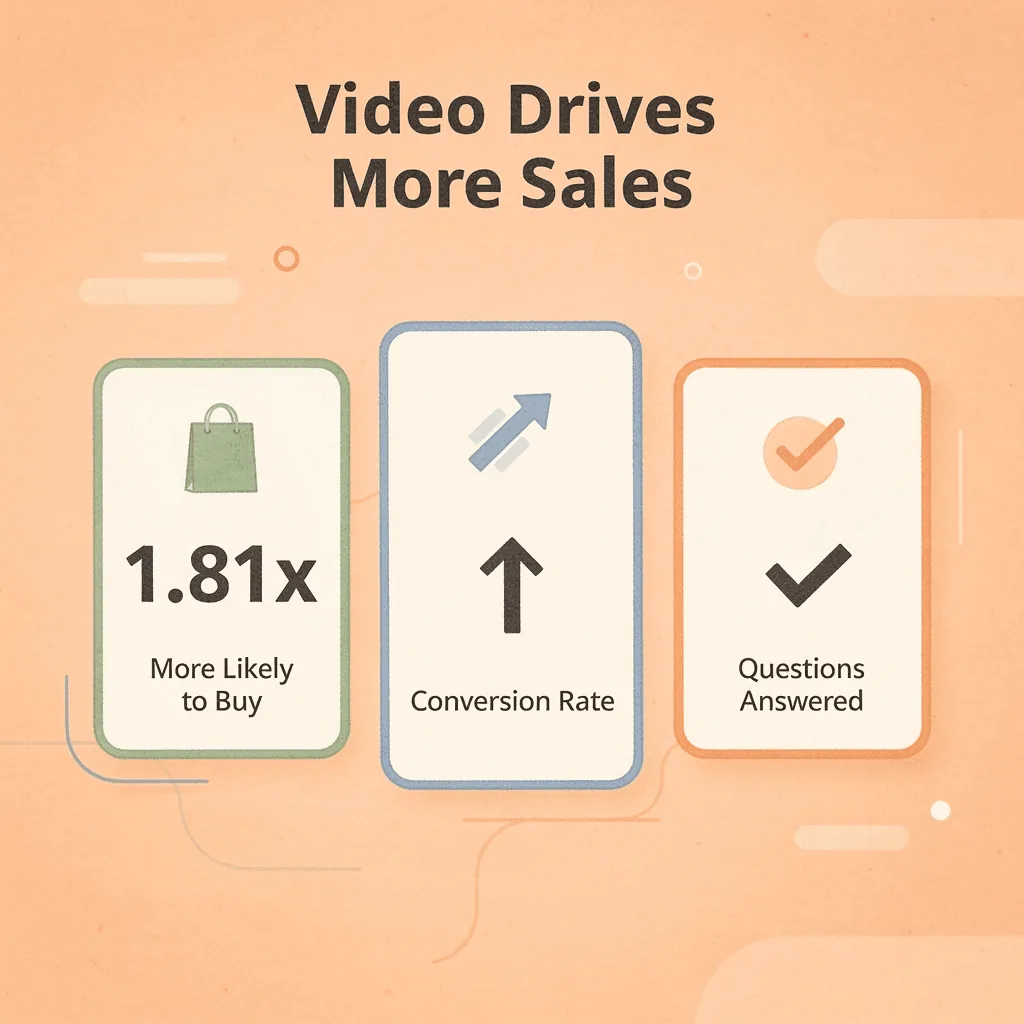
Product video answers the specific questions that stop people from buying. According to the SellersCommerce Blog, shoppers who watch video are 1.81x more likely to buy than shoppers who don't watch video — the difference between a product page that keeps customers and one that loses them.
"Shoppers who watch video are 1.81x more likely to buy than shoppers who don't watch video." — SellersCommerce Blog
🎯 Key Point: Adding product video to your listings isn't optional — it's the single most effective tool for converting hesitant shoppers into paying customers.
💡 Tip: Place your product video above the fold on your product page so shoppers encounter it before they have a chance to bounce.
| Shopper Behavior | Without Video | With Video |
|---|---|---|
| Purchase likelihood | Baseline | 1.81x higher |
| Customer confidence | Lower | Significantly higher |
| Page engagement | Reduced | Increased |
| Unanswered questions | More likely | Minimized |
What video can text and images not
Video closes the gap between customer expectations and reality. A shopper reads a description and views a photo, but cannot answer: " Will this work for me? Video shows the product in motion, in a real setting, at actual size. It answers questions words cannot—how a zipper sounds, how a cream soaks in, how a chair looks in a room. When customers see these answers rather than imagine them, doubt decreases and confidence increases, reducing abandoned carts and returns from products that fail to meet customer expectations.
How can brands produce video content without studio overhead?
Traditional video production creates a bottleneck: studio time, hired talent, and weeks of editing. Brands with dozens of SKUs cannot afford to shoot everything at studio rates. Platforms like Caspa generate ultra-realistic product videos with human models and custom backgrounds in a fraction of the time and at a fraction of the cost, enabling solo operators and established Shopify or Amazon sellers to produce studio-quality content without studio overhead.
The compounding return on a single asset
One well-executed product video powers paid social campaigns, email sequences, marketplace listings, and retargeting ads simultaneously. This single asset compounds returns across every channel. According to Commerce-UI's research on video in ecommerce, product videos can increase conversions by up to 80% on landing pages. Multiplied across multiple placements from one piece of content, the impact becomes undeniable.
The brands winning in ecommerce produce the right content consistently across the right touchpoints. Video is no longer a luxury line item; it's the baseline expectation shoppers bring to every product page.
But knowing that video works is only half the equation. The harder question is what separates videos that convert from those skipped in three seconds.
Related Reading
- How To Sell On Amazon
- Printful Vs Printify
- Shopify Vs Woocommerce
- Ai For Product Photos
- Ai Generated Product Images
- Ai Product Photo Generator
- Amazon Vs Shopify
- Ai Product Video Generator
- Ai For Ecommerce
- Ai Clothing Model
- Shopify Vs Bigcommerce
- Printful Review
- Shopify Vs Amazon
- Ai Model For Clothing
- Ai Product Video
- Ai Fashion Model
- Printful Pricing
- Best Amazon Seller Tools
What Makes an Effective Ecommerce Product Video?
Good product videos answer shoppers' questions by clearing up confusion and demonstrating value. Built around how shoppers think and make decisions rather than brand aesthetics, they give shoppers the confidence to click "add to cart" without hesitation.

Start with the question, not the product
The failure point is usually this: brands open their product videos by showing the product, while shoppers open them looking for answers. That gap is where attention dies. Before scripting a single frame, list the top five objections your reviews and customer service emails reveal, then build the video around addressing those objections one by one. A shoe brand that leads with "here's how it fits on a wide foot" converts better than one that leads with a logo animation because it speaks directly to the doubt already in the shopper's mind.
Why do benefits sell better than features?
A feature tells you a jacket has a 20,000mm waterproof rating. A benefit shows someone hiking through a downpour, dry and moving fast. According to SundaySky's 2025 video marketing research, 89% of consumers say watching a video convinced them to buy a product or service. People watch videos to feel confident that a product will work for them, not to learn specifications.
How does on-demand video production remove pipeline bottlenecks?
Most ecommerce teams batch video production through periodic studio shoots to manage costs, but this creates rigidity. When a new product launches mid-quarter or a seasonal campaign needs fresh footage, the pipeline stalls waiting for the next shoot window. Platforms like Caspa let brands generate product videos with human models and custom backgrounds on demand, collapsing multi-week production cycles into minutes without sacrificing the visual quality that builds shopper trust.
Real-world context does the work that static imagery cannot
Showing a product in use helps people buy it, not just choose a style. When shoppers see a backpack being loaded into an overhead bin or a blender processing frozen fruit without stopping, they stop imagining and start deciding. Shopify's research on video marketing shows product videos can increase purchases by up to 144%, with lifestyle-context demonstrations driving significant lift by reducing the mental work shoppers would otherwise do themselves.
Quality signals trust before a word is spoken
Poor lighting, shaky framing, or inconsistent color grading make the product look worse than it is and signal a careless brand. Visual quality serves as a proxy for product quality in the shopper's mind, forming in the first two seconds. Consistent styling across product videos, listing images, and ad creative compounds this effect: when every visual asset feels deliberate and trustworthy, it influences purchase decisions.
Knowing what makes a great product video is one thing; knowing how to get one working for your store is where the real leverage lives.
How to Create Ecommerce Product Videos Without a Large Production Budget
Many ecommerce brands understand the value of product videos but assume they require expensive equipment, professional studios, and extensive editing resources. For brands with dozens or hundreds of products, traditional content production can quickly become one of the largest marketing expenses. By focusing on efficient workflows and using modern content creation tools, brands can produce high-quality video assets without large production budgets.
"37% of marketers who do not use video cite lack of time as a barrier, while 26% cite cost as a major challenge." — Wyzowl, 2025 State of Video Marketing Report
| Production Challenge | % of Marketers Affected |
|---|---|
| Lack of time | 37% |
| Cost | 26% |
⚠️ Warning: Assuming that high-quality product videos always require a professional studio is one of the most common — and costly — misconceptions in ecommerce marketing. Don't let this belief stall your video strategy.
💡 Tip: The real barrier to product video creation isn't budget — it's workflow. Brands that invest in efficient content systems and modern creation tools consistently produce more video at a fraction of the traditional cost.
How do you identify what your product videos actually need to show?
Before making any video, figure out what information customers need most to decide whether to buy. Review customer reviews, support tickets, product questions, and competitor feedback to identify common concerns. Focus on answering the questions most likely to influence buying decisions rather than demonstrating every product feature. This approach simplifies production while ensuring every scene serves the video's goal.
Why do consistent visual assets matter for product video production?
Good product videos start with strong visual assets. Whether you're creating product demonstrations, lifestyle content, social media videos, or advertisements, consistency across your visuals strengthens brand perception and builds trust. This includes product photography, lifestyle imagery, product cutouts, branded backgrounds, color consistency, and visual styling. Consistent visual assets become easier to reuse across multiple videos and marketing channels.
How can repurposing existing content reduce video production costs?
Making every video from scratch can get expensive fast. Many ecommerce brands already have product photos, lifestyle images, customer content, product demonstrations, and marketing graphics. These materials can be transformed into video content through animations, transitions, motion effects, zoom sequences, and storytelling frameworks. Reusing existing content lets brands create multiple video variations from the same materials, increasing output without significantly raising production costs.
What creative approaches help brands get more from their video assets?
Different customers respond to different types of messages. Testing multiple creative approaches improves results while maximizing value from existing assets. Common approaches include lifestyle videos (showing the product in real-life situations), feature videos (highlighting specific functions and capabilities), and problem-solution videos (showing how the product solves a customer problem). Testing multiple variations helps brands identify which messages resonate with their audience before investing in larger campaigns.
How do scalable workflows help growing product catalogs keep up with video demand?
As product catalogs grow, creating content becomes increasingly difficult to manage. A brand with 10 products may organize traditional photoshoots and video shoots. A brand with 500 products faces a fundamentally different challenge: every new product traditionally requires photography, video production, editing, retouching, asset management, and distribution across channels.
According to HubSpot's State of Marketing research, video remains one of the highest-performing content formats for both engagement and return on investment, leading more brands to increase video production efforts each year. Brands need scalable workflows that allow them to create content efficiently across entire product catalogs. Modern AI tools are helping ecommerce brands generate product visuals, create video content, and scale production far more efficiently than traditional workflows, making professional product videos accessible to brands without large creative budgets.
How Caspa Helps Ecommerce Brands Create Product Videos Faster and at Lower Cost
Making high-quality ecommerce product videos has traditionally required coordinating photographers, videographers, models, studios, editing software, and production schedules. For businesses with large product catalogs, these requirements make video production expensive, time-consuming, and difficult to scale. The challenge gets even harder when products need content for multiple channels—product pages, social media, paid ads, email marketing, and online marketplaces—often requiring separate videos for each use case.
"For ecommerce brands with large catalogs, traditional video production isn't just costly—it's a scaling bottleneck that slows down go-to-market speed across every channel."
| Production Element | Traditional Approach | With Caspa |
|---|---|---|
| Photographers & Videographers | Required, costly to hire | Not needed |
| Studio & Equipment | Booked in advance | Fully replaced by AI |
| Editing Software | Separate tools, steep learning curve | Built-in, streamlined |
| Multi-Channel Variants | Separate shoots per format | Generated instantly |
| Scalability | Slow and expensive | Fast and cost-effective |
🎯 Key Point: The more SKUs a brand carries, the more painful traditional video production becomes—costs and timelines multiply with every product added to the catalog.
⚠️ Warning: Relying on traditional production workflows for multi-channel content means brands are constantly playing catch-up—by the time one video is finished, campaign windows may have already closed.
Caspa solves this by bringing product photography and video creation into a single AI-powered platform. Instead of organizing traditional photoshoots, ecommerce brands can generate professional product content faster and at a fraction of the cost.
💡 Tip: With Caspa, brands can produce content for every major channel—from paid ads to product pages—without booking a studio or hiring a production crew.
How does Caspa simplify product content creation for ecommerce brands?
With Caspa, brands can create ultra-realistic product scenes and lifestyle content using AI, eliminating the need for physical locations, expensive sets, or complicated logistics. The platform enables AI-generated human models, making it easier to produce lifestyle-focused content that contextualizes products while reducing costs associated with hiring talent and organizing shoots.
For brands with existing product images, Caspa transforms visual assets into engaging video content suitable for multiple marketing channels: product pages, social media, paid advertising, email marketing, and marketplace listings, without requiring separate creation for each campaign.
How does a unified platform help teams manage product content more efficiently?
Because photography, video generation, editing, and enhancement tools are on a single platform, teams manage the entire product content workflow from a single location. Existing visuals can be edited, enhanced, upscaled, or adapted for new campaigns without requiring multiple software tools or outside resources.
Caspa helps brands maintain visual consistency across hundreds or thousands of products. A unified visual identity strengthens brand presentation at every customer touchpoint, which is especially valuable for businesses managing large inventories or frequently launching products. Rather than waiting weeks for production, brands can generate ready-to-use content faster, bringing products to market sooner and responding more quickly to marketing opportunities.
By reducing dependence on traditional photography and videography workflows, Caspa helps ecommerce brands lower production costs, accelerate content creation, and scale product video production more efficiently.
Get Product Videos that Increase Your Sales Today
Caspa lets ecommerce brands create product videos, lifestyle visuals, and professional images in minutes without a production budget, studio, or lengthy content calendar. It cuts production time from weeks to minutes while maintaining the visual quality that converts browsers into buyers.
"It cuts production time from weeks to minutes while keeping the visual quality that turns browsers into buyers." — Caspa
🎯 Key Point: You don't need a big-budget production team to create scroll-stopping product content—Caspa delivers studio-quality visuals in a fraction of the time.
Winning brands on Shopify and Amazon outpace competitors through speed, not spending. Every day a product listing sits without a video costs you real sales. Caspa shows you how fast that gap closes.
💡 Tip: Don't wait for a perfect production window—every hour your listing lacks video is a missed conversion opportunity.
🔑 Takeaway: The fastest-moving brands win on ecommerce platforms. Speed to publish is now a critical competitive advantage, and Caspa is built to give you exactly that.
| Traditional Production | With Caspa |
|---|---|
| Weeks of planning & scheduling | Minutes to create |
| High production budget required | No budget needed |
| Studio & crew required | No studio needed |
| Slow content calendar | Instant visual output |
Related Reading
- Ai Product Video Maker
- Ai Clothing Model Generator
- Merch On Demand
- Printify Vs Gelato
- Luxury Product Photography
- Ai Clothing Mockup Generator
- Flat Lay Product Photography
- Amazon Ai Tools
- Printful Vs Gelato
- Ecommerce Product Video
- Advertising Product Photography
- Ai Fashion Model Generator
- Redbubble Vs Printful
- Teespring Vs Printful
- Amazon Merch On Demand
- Teespring Alternatives
- Best Background For Product Photography
- Ai Product Photo Editor
- T-shirt Mockup Ai
- Placeit Alternative
- Placeit Pricing