
Printful Review: Is It the Right POD Platform for Your Business?

Choosing a print-on-demand platform is one of the most consequential decisions a new online store owner will make. Printful is one of the most recognized names in the space, but whether it is the right fit depends on a business's specific needs, budget, and growth plans. This honest Printful review covers the platform's strengths, limitations, pricing, and product quality so sellers can make an informed call.
Even the best fulfillment setup falls flat without visuals that build trust and drive conversions. Printful provides mockups, but standing out in a crowded market often requires something more polished and on-brand. Sellers looking to elevate their store's look without a studio budget can explore AI-powered product photography as a practical alternative.
Table of Contents
Why So Many Entrepreneurs Choose Printful
What does Printful do well?
The Biggest Limitations of Printful
Why Product Presentation Often Matters More Than Fulfillment
What to Look for Beyond Printful When Growing a POD Brand
How Caspa Helps Printful Sellers Create Better-Converting Product Visuals
Get Product Photos that Increase Your Sales Today
Summary
Print-on-demand profit margins typically range from 10 to 30 percent because each unit is produced individually rather than in bulk. That compressed margin means every other variable in the business gets amplified, including pricing, conversion rate, and customer acquisition cost. Sellers working with thin margins have very few levers that move the needle without touching price, which makes controlling production costs on content and visuals unusually important.
Visual appearance is the primary deciding factor for 93% of consumers when making a purchase, according to Swell's research on physical product bundling. Online shopping is a purely visual experience, and product images have to do the work that touch, texture, and physical context would otherwise handle in a retail setting. Generic mockups shared across dozens of stores create a specific trust problem by making products feel like catalog entries rather than something made with intention.
Platform diversification is already standard practice for experienced POD sellers. Over 45% of print-on-demand sellers use more than one platform to reduce risk and expand their product range, according to Dynamic Mockups' print-on-demand statistics. Scaling brands tend to build redundancy into their supply chain before a fulfillment failure forces the issue, not after it costs them reviews and repeat customers.
Custom apparel accounts for approximately 38% of all print-on-demand product sales globally, making it both the most popular and most competitive category. When hundreds of sellers are listing similar t-shirts and hoodies, the differentiator is rarely the product itself. It is how the product is shown, framed, and positioned across every touchpoint a buyer encounters before deciding to purchase.
The content demand for a growing POD store compounds faster than most sellers plan for. New SKUs need product images, seasonal campaigns need fresh creative, and marketplace listings need platform-compliant visuals, often on overlapping timelines. Teams relying on ad-hoc photo shoots find that production cycles stretch from days into weeks, narrowing campaign windows before assets are even ready.
Bundles with cohesive presentation see up to 30% higher perceived value than individually listed items, according to Swell's research. That gap in perceived value is created entirely before a customer reaches checkout, and it lives in the quality of the image, the realism of the setting, and whether the product looks like something a credible brand produced. Fulfillment determines whether you keep a customer, but presentation determines whether you ever get one.
Product photography addresses this by giving POD sellers a way to generate studio-quality lifestyle images and marketplace visuals at the pace a growing catalog actually demands, without physical shoots or a large production budget.
Why So Many Entrepreneurs Choose Printful
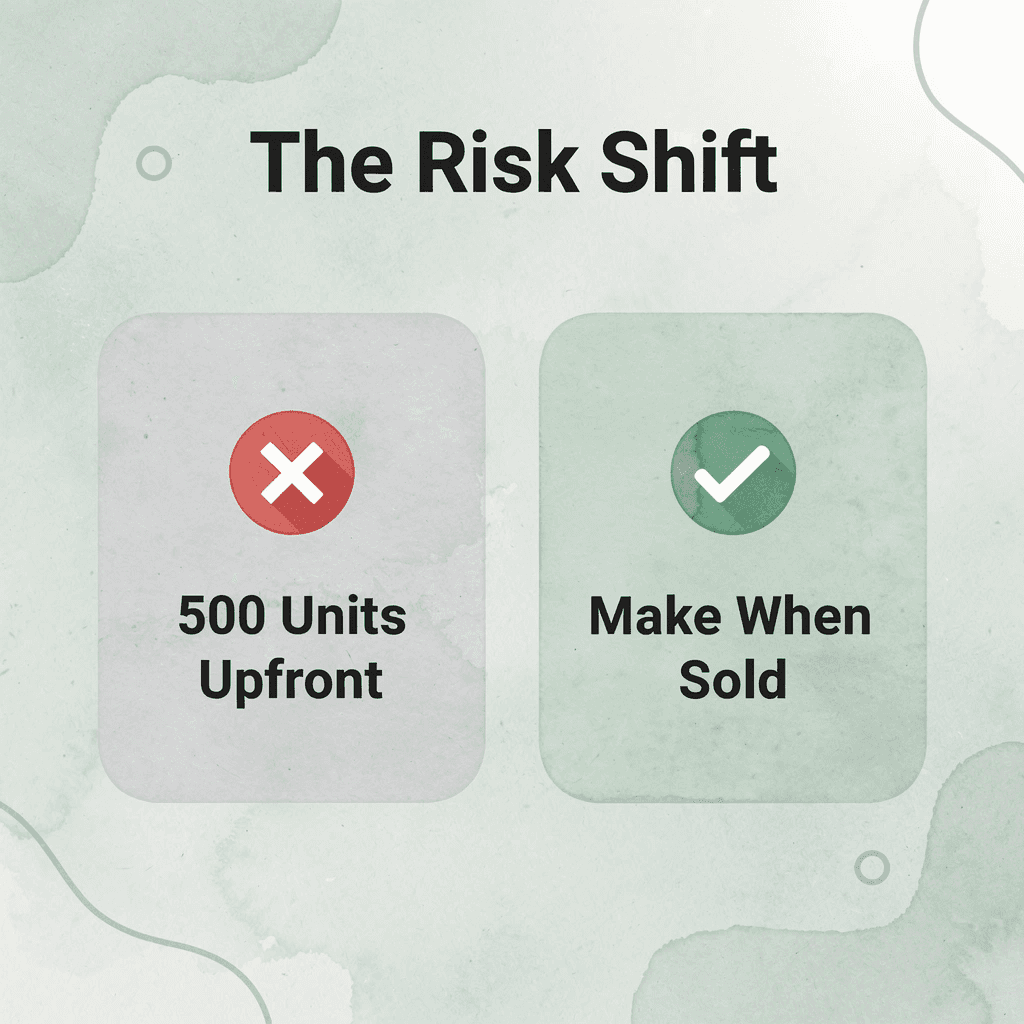
Printful removes the scary upfront cost of starting a product business. You don't need to order 500 units of a t-shirt and hope it sells. Design it, list it, and only make it when someone pays. That shift in risk changes who gets to participate in ecommerce — opening the door to anyone with an idea, not just those with deep pockets.
"Design it, list it, and only make it when someone pays — Printful's print-on-demand model fundamentally shifts who can afford to start a product business."
💡 Tip: If you've been hesitant to launch a product line because of inventory costs, print-on-demand is the model that eliminates that barrier entirely — no bulk orders, no warehousing, no wasted stock.
🔑 Takeaway: The real power of Printful isn't just convenience — it's the democratization of ecommerce, letting entrepreneurs validate ideas before committing a single dollar to inventory.
Traditional Product Business | Printful Print-on-Demand |
|---|---|
500+ unit minimum orders | Zero inventory required |
High upfront capital | No upfront cost |
Inventory risk | Only produce when sold |
Warehousing needed | Fulfilled automatically |
How does Printful fit into existing ecommerce workflows?
According to the Printful Blog's print-on-demand profitability research, Printful works with 20+ online selling platforms, so sellers aren't locked into one channel. Whether you're on Shopify, Etsy, or WooCommerce, the platform integrates with your existing workflow. This flexibility matters when setup time directly reduces time available for marketing or product development. Printful's own dropshipping statistics show that over 900,000 merchants use the platform. When that many independent sellers choose the same tool, it demonstrates genuine usefulness rather than hype.
What operational complexity does Printful remove for sellers?
Most new ecommerce founders spend weeks finding manufacturers, negotiating minimums, and managing samples before launching. As product lines grow, complexity multiplies. Sellers using Printful's mockup generator sometimes find default visuals don't capture design quality—our AI product photography fills this gap, producing studio-quality images without studio budgets while lifting conversion rates.
Why does Printful's infrastructure model matter for brand consistency?
Printful positions itself as infrastructure, not a supplier. The company owns its fulfillment centers rather than outsourcing entirely, giving sellers predictability on quality and shipping timelines. For brands building a reputation, that consistency outweighs savings from cheaper alternatives with inconsistent results.
What Does Printful Do Well?
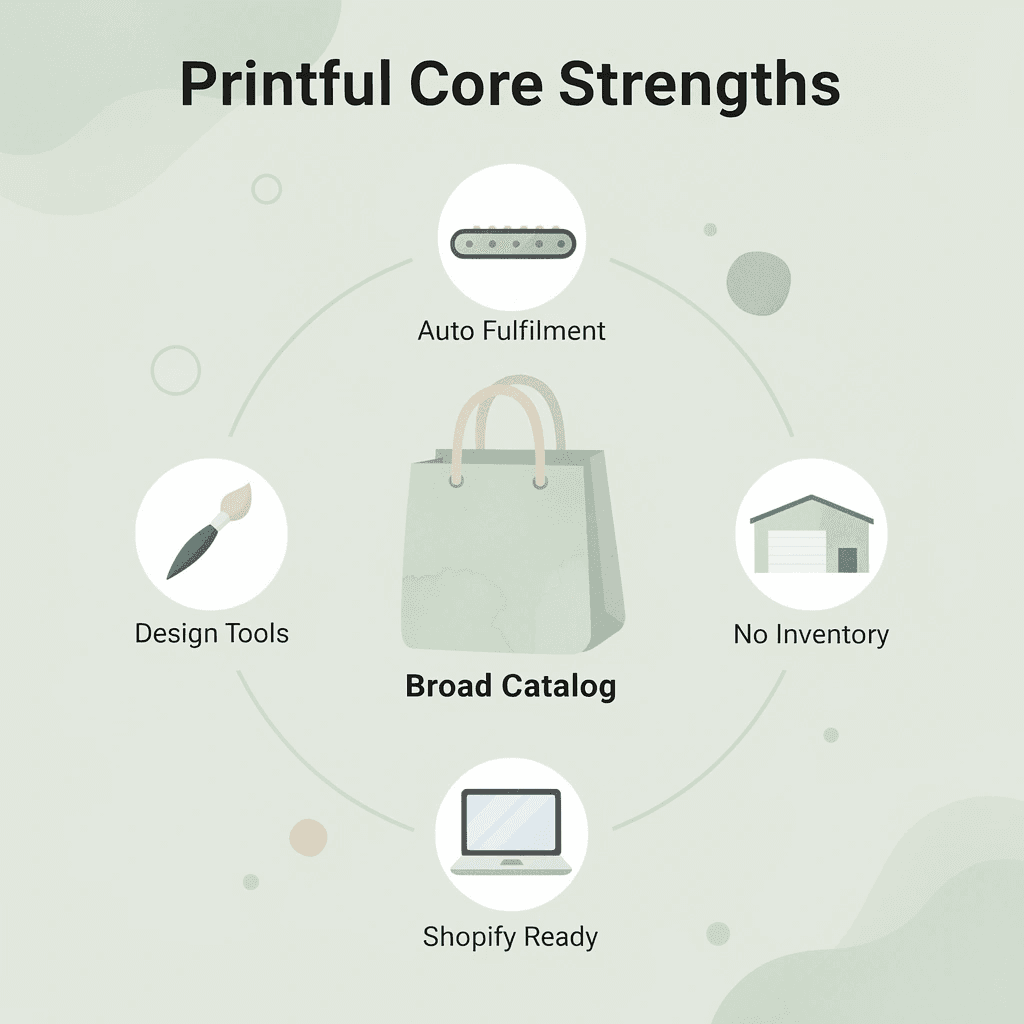
Printful lets entrepreneurs sell physical products without the operational burden that typically crushes early-stage businesses. The catalog is broad, fulfillment runs automatically, and someone with a design idea and a Shopify account can be selling within a day.
"Someone with a design idea and a Shopify account can go from concept to selling physical products in under 24 hours — without touching inventory, packaging, or shipping."
🎯 Key Point: Printful removes the three biggest operational barriers for new sellers — inventory management, fulfillment logistics, and upfront product costs — so you can focus entirely on design and marketing.
💡 Tip: If you're an early-stage entrepreneur, Printful's automatic fulfillment means you can launch a fully operational product store with zero warehouse overhead and no minimum order quantities.
What Printful Handles | What You Focus On |
|---|---|
Printing & production | Design creation |
Packaging & shipping | Marketing & sales |
Inventory management | Brand building |
Order fulfillment | Customer relationships |
How far does that catalog actually stretch?
According to the Printful Blog's print-on-demand research, Printful offers 340+ products across categories, letting brands test apparel, home goods, accessories, and wall art without supplier contracts. This range matters because most early-stage businesses fail by overcommitting to a single category before validating demand. A wide catalog converts that risk into an experiment.
What makes the fulfillment model work at scale?
The on-demand production model is the backbone of Printful's operations. Printful's own data shows fulfillment running at over 1 million orders per month, demonstrating that the infrastructure can handle real demand without breaking down—a critical requirement for growing brands before entrusting customer relationships to a third-party fulfillment partner. The most underrated part of this model is what it removes from your decision-making: no warehouse lease, no minimum order quantities, no inventory write-offs at season's end. For a first-time founder, that's the difference between launching and waiting another year.
Where visual content becomes the real differentiator
Default mockups work initially, but as catalogs grow and competition increases, flat mockups on generic backgrounds stop converting. Most sellers respond by booking photo shoots or hiring freelance editors, adding cost and delays with each new product.
How do AI platforms remove the friction of scaling visual content?
AI product photography platforms like Caspa eliminate this problem. Brands can create realistic product images and A+ content at a fraction of the cost while maintaining visual quality as catalogs expand. For Printful sellers managing dozens of SKUs across multiple channels, this production speed transforms what's possible.
Why do the best-converting brands treat visual content as a core function?
Printful excels at operations, but top-selling brands treat visual content as a core business function, not an afterthought.
Related Reading
The Biggest Limitations of Printful
Printful's limitations become especially clear when examining the financial side carefully.
"Profit margins run as low as 10 to 30 percent because each item is made one at a time instead of in bulk." — Printful Blog, Print-on-Demand Statistics
⚠️ Warning: Thin margins are not a mere inconvenience; they are a structural constraint that affects every business decision you make on the platform.
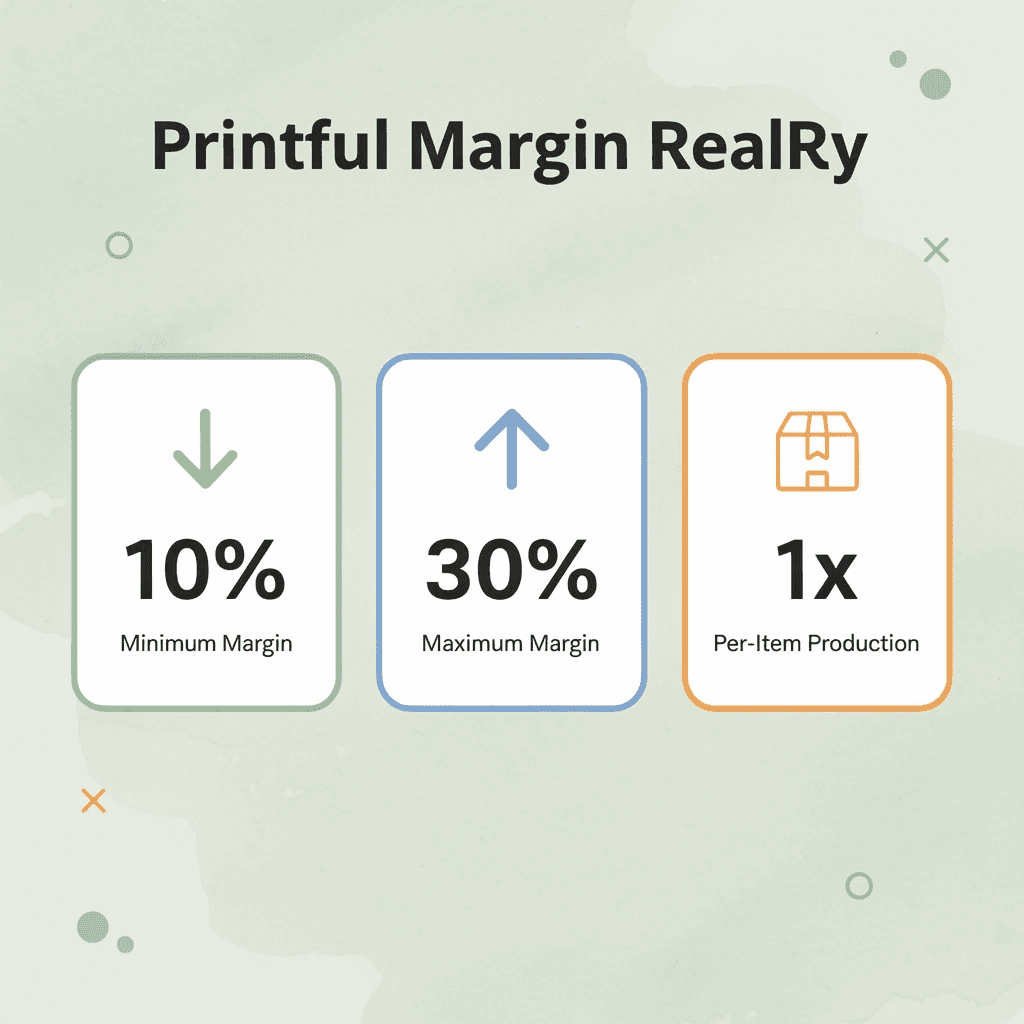
According to the Printful Blog's print-on-demand statistics, profit margins run as low as 10 to 30 percent because each item is made one at a time instead of in bulk. With thin margins, every detail matters more: pricing, conversion rate, customer acquisition cost, and product presentation quality.
🔑 Takeaway: When your margin ceiling is just 30%, there is zero room for error — optimizing each variable isn't optional; it's essential for survival.
Key Variable | Why It Matters at Low Margins |
|---|---|
Pricing | Small mispricing directly eliminates profit |
Conversion Rate | More traffic is needed to hit revenue targets |
Customer Acquisition Cost | High CAC can wipe out an entire order's margin |
Product Presentation Quality | Poor presentation kills the conversion rate needed to scale |
Where the model creates real friction
The per-unit cost problem worsens as you grow. PodVector AI's 2025 Printful review notes that a standard Bella+Canvas 3001 tee costs roughly $13.25 base plus $4.69 for first-item US shipping, totaling close to $18 landed cost before markup. Sell that shirt for $29, and your margin leaves little room for paid advertising, returns, or platform fees.
How can sellers protect margins without raising prices?
Most Printful sellers offset tight margins through organic content and social media, but this requires significant time producing product visuals, lifestyle shots, and listing images. Brands using product photography tools powered by AI can generate studio-quality images at a fraction of the traditional cost, transforming visual content from a bottleneck into a repeatable system. When margins are compressed, cutting production costs on your content stack is one of the few levers that move the needle without raising prices.
The Control Problem Nobody Warns You About
The dependency issue goes deeper than most Printful reviews acknowledge. You don't control production timelines, stock availability, or how a fulfillment center handles peak periods. If a product runs out of stock or a batch ships late, your customer contacts you, not Printful. That gap between what happens and how customers perceive your brand is where trust erodes, one delayed order at a time.
Which parts of the business actually belong to you?
When fulfillment is outsourced, brand consistency depends entirely on what happens before the order is placed. Your product page, images, copy, and pricing are the only parts of the experience you fully own. That's where to invest. The parts of the business you control matter far more than the parts you've handed off, making the next question far more consequential than it first appears.
Why Product Presentation Often Matters More Than Fulfillment
Fulfillment is the promise you make after someone decides to buy. Presentation is what makes them decide in the first place. When those two get confused, sellers optimize shipping speeds and workflows while their product pages quietly lose potential customers who never even clicked.
"You can have the fastest fulfillment in the world, but if your product presentation fails to convert, those logistics investments mean nothing." — E-Commerce Best Practices
🎯 Key Point: Presentation drives the decision. Fulfillment delivers on it. Confusing the two means investing in the wrong stage of the customer journey.
⚠️ Warning: Sellers who over-index on shipping speed and operational workflows while neglecting product page quality are optimizing after the moment that matters most — the click that never happens.
Stage | What It Controls | When It Matters |
|---|---|---|
Presentation | Product pages, images, copy, first impressions | Before the purchase decision |
Fulfillment | Shipping, packaging, and delivery speed | After the purchase decision |
The Costly Mistake | Optimizing fulfillment over presentation | Lost customers who never converted |

Why do visuals drive purchasing decisions more than logistics?
The pattern is clear: a store with reliable fulfillment but forgettable visuals underperforms against a competitor whose products look more alive and worth owning. According to Swell's Physical Product Bundling Statistics, 93% of consumers say visual appearance is the key deciding factor in a purchasing decision. Online shopping is purely visual; the image must do the work that touch, texture, and physical context would handle in a store. Generic mockups create a trust problem. When a shopper sees the same flat-lay template across a dozen stores, the product stops feeling intentional and becomes a catalog entry. Lifestyle imagery answers the question every shopper asks: What does this look like in my life?
How can sellers move beyond default mockup generators at scale?
Most sellers rely on default mockup generators, which is reasonable but limiting as stores scale across dozens of SKUs. Platforms like Caspa generate ultra-realistic product images and lifestyle scenes without Photoshop expertise or photography setups, compressing multi-day production into an afternoon workflow. Swell also reports that bundles with cohesive packaging and presentation see up to 30% higher perceived value than individually listed items. This gap forms before checkout through image quality, setting realism, and product credibility. Presentation and fulfillment are not equal levers. Fulfillment determines whether you keep a customer; presentation determines whether you acquire one.
Related Reading
Ai For Product Photos
Ai Generated Product Images
Ai Product Photo Generator
Amazon Vs Shopify
Ai Product Video Generator
Ai Clothing Model
Printful Review
Shopify Vs Amazon
Ai Model For Clothing
Ai Product Video
Ai Fashion Model
Printful Pricing
Best Amazon Seller Tools
What to Look for Beyond Printful When Growing a POD Brand
Growing a print-on-demand brand after it launches requires solving problems far beyond just fulfillment. Printful handles getting products to customers' doors, but driving traffic and conversions demands separate infrastructure that most sellers critically underestimate.
"The brands that scale past survival mode aren't just fulfillment-optimized — they're built on traffic, conversion, and retention systems that operate independently of their POD supplier." — POD Industry Insight
💡 Tip: Once your fulfillment pipeline is stable, your real growth levers are marketing infrastructure, audience building, and conversion rate optimization — none of which Printful controls for you.
⚠️ Warning: Relying solely on your POD supplier's ecosystem is one of the most common reasons promising brands plateau early — your traffic engine and customer retention strategy must be built independently.
Growth Layer | Who Owns It | Why It Matters |
|---|---|---|
Product Fulfillment | Printful | Gets orders to customers |
Traffic Generation | You | Drives new visitors to your store |
Conversion Optimization | You | Turns browsers into buyers |
Customer Retention | You | Builds long-term brand value |
🔑 Takeaway: Scaling a POD brand means treating fulfillment as the foundation, not the finish line — the real competitive advantage is built on everything that happens before the order is placed.

Platform diversification is a growth signal, not a hedge
Relying on a single supplier creates problems when demand exceeds what one platform can handle. According to Dynamic Mockups' print-on-demand statistics, more than 45% of POD sellers use multiple platforms to expand their product range and reduce risk. Growing brands build backup plans into their supply chain before fulfillment failures damage reviews and cause them to lose repeat customers, rather than relying on a single vendor's catalog or production capacity.
The content volume problem nobody budgets for
Growing POD stores face rising content demand: new products need product images, seasonal campaigns need fresh creative, marketplace listings need platform-compliant visuals, and social feeds need daily or weekly assets. Traditional photography shoots don't scale, with production cycles stretching from days into weeks and narrowing campaign windows.
Caspa's AI product photography platform replaces studio workflows entirely, generating ultra-realistic product and lifestyle visuals without physical shoots and cutting production costs by up to 10x. For brands managing multiple product lines across Shopify, Amazon, and Etsy, this output speed provides a structural advantage.
Why does category saturation change the math on visibility?
Coastal Reign's 2025 print-on-demand statistics report shows that custom apparel comprises 38% of all print-on-demand product sales globally. In a market where hundreds of sellers offer similar t-shirts and hoodies, what distinguishes a product is how it is presented and positioned at every touchpoint potential buyers encounter.
How do growing brands turn visual content into a repeatable system?
Brands that grow past a certain revenue ceiling treat visual content as a core business function, not a one-time task. They build repeatable systems for generating product photography, marketplace assets, and social creative at the pace the market demands. Once that system is in place, attention becomes something you can earn. Once you know what your visual content stack needs to do, how do you build it?
How Caspa Helps Printful Sellers Create Better-Converting Product Visuals
Throughout this review, one theme has come up again and again: launching a print-on-demand store is no longer hard. Platforms like Printful have made it easy to create products, automate fulfillment, and start selling. The real challenge is getting attention in a crowded market where countless stores compete for the same customers. When shoppers find similar products across multiple websites, how things look becomes a critical competitive advantage. That's where Caspa comes in.
💡 Tip: If your product visuals look identical to every other store, you're competing on price alone—a race to the bottom. Caspa gives you the visual edge to compete on quality instead.
"When shoppers find similar products across multiple websites, how things look becomes a critical competitive advantage—and that gap is exactly where winning stores are built." — Key Insight
🎯 Key Point: Printful solves the fulfillment problem. Caspa solves the conversion problem—turning browsers into buyers through better-converting product visuals that stand out in a saturated market.

How does Caspa help sellers move beyond generic mockups?
Many Printful sellers start with standard mockups for speed and ease. The problem is that thousands of other sellers use similar images. Our Caspa AI-powered product photography helps brands move beyond basic mockups by creating polished, professional-looking visuals that appear more credible, premium, and engaging to potential customers.
Lifestyle imagery helps customers envision products in real-world settings. Traditionally, creating these images required photographers, locations, props, models, and substantial budgets. Caspa makes lifestyle image generation accessible by allowing sellers to create realistic scenes that showcase products in context, transforming simple listings into experiences customers can imagine themselves inhabiting.
How does model and background generation improve product presentation?
For clothing brands, showing products on people significantly influences customer perception. Customers want to see how clothing looks when worn and how it fits into different styles. Our human model generation capabilities help brands create model-based imagery without organizing traditional photo shoots, producing a wider range of visual assets while maintaining consistency across their catalogs.
Backgrounds play a major role in how professional a product image appears. Our background replacement feature enables sellers to create visuals tailored to different channels, campaigns, and audiences without separate photoshoots. A product may need a clean white background for a marketplace listing, a branded environment for a website, and a lifestyle setting for social media advertising.
How does Caspa help sellers compete on marketplaces and at scale?
Blurry, low-resolution, or poorly optimized images hurt customer confidence and diminish perceived product value. Caspa improves image quality through enhancement and upscaling features, preparing assets for ecommerce stores, digital advertising, social media campaigns, and marketplace listings.
Many Printful sellers expand beyond their own websites to sell through platforms such as Etsy and Amazon. These channels are highly competitive, and product images often determine which listings get attention. Caspa helps businesses create marketplace-ready visuals that look polished and are optimized for product discovery, enabling products to stand out in crowded search results.
One of the biggest challenges for growing ecommerce brands is content volume. Every product launch, marketing campaign, seasonal promotion, and advertising initiative requires fresh creative assets. Caspa speeds up the creative process by helping brands generate and refine product visuals more efficiently, enabling sellers to create content faster and test more creative variations.
Printful helps businesses create and fulfill products. Caspa helps businesses market those products more effectively. A fulfillment platform delivers orders efficiently, but customers must first discover the product, trust the brand, and decide to purchase. Product presentation plays a central role in this decision. By helping sellers create stronger product photography, lifestyle imagery, model content, and marketplace assets, Caspa addresses a critical growth challenge for print-on-demand businesses: standing out in a crowded market.
Get Product Photos that Increase Your Sales Today
If your Printful store is getting traffic but not making sales, the problem is with how things look. Shoppers make decisions in a few seconds, and flat mockups usually don't help you make the sale.
"Shoppers make decisions in just a few seconds — and flat mockups are rarely enough to convert a browser into a buyer." — Ecommerce Visual Marketing Insight
💡 Tip: If your conversion rate is low despite solid traffic, your product visuals are the weakest link in your sales funnel.
⚠️ Warning: Relying on generic flat mockups alone can undercut your store's credibility, even when your actual product is excellent.

Platforms like product photography help close the gap between what your product actually is and what a customer thinks it could be for them. Our Caspa platform lets ecommerce sellers create studio-quality lifestyle images, infographics, and model content — without needing a photography budget or long production timelines. For solo sellers and growing brands alike, your visual content finally keeps up with your product catalog, ad spending, and goals.
🎯 Key Point: Caspa eliminates the need for expensive shoots by delivering studio-quality visuals that match your pace of growth — no photographer required.
Visual Content Type | What It Does For You |
|---|---|
Lifestyle Images | Shows your product in context, building an emotional connection |
Infographics | Highlights key features and benefits at a glance |
Model Content | Adds human relatability and boosts buyer confidence |
Related Reading
Ai Product Photo Editor
Ecommerce Product Video
Printify Vs Gelato
Best Ai For Clothing Brands
Ai Clothing Model Generator
Ai Fashion Model Generator
Redbubble Vs Printful
Placeit Pricing
Best Background For Product Photography
Amazon Merch On Demand
Teespring Alternatives
Advertising Product Photography
Placeit Alternative
Luxury Product Photography
T-shirt Mockup Ai
Amazon Ai Tools
Printful Vs Gelato
Ai Clothing Mockup Generator
Merch On Demand
Teespring Vs Printful
Flat Lay Product Photography
Ai Product Video Maker